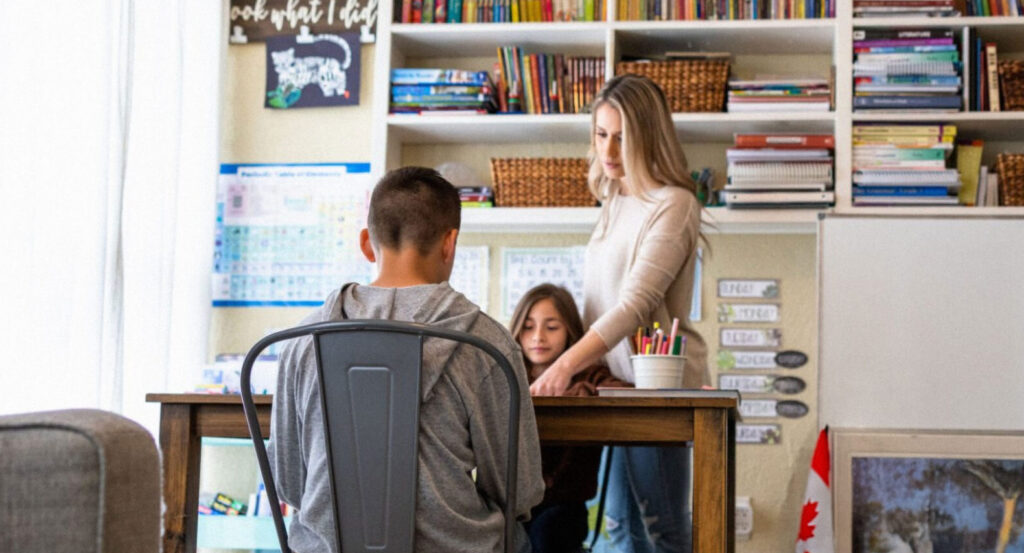
This report examines the financial impact on taxpayers of partially funding independent and home education in Alberta—and finds that school choice saves Albertans money.
There is considerable demand for independent and home education in Alberta. From 2011 to 2024, independent enrolment increased annually in all but one year, growing from 23,705 to 45,762 students—a 93 percent increase (not including Early Childhood Services). Homeschooling is growing even faster, nearly tripling enrolment since 2011. By comparison, the rest of Alberta’s K–12 enrolment increased by 28.6 percent in the same period.
Given such a contrast, we expect these alternative educational choices have offerings that are not only unique but of considerable value to the families enrolled in their communities. Yet, they are much too small a share of enrolment to be seen as a competitive threat, making up a combined 6.7 percent of all Alberta K–12 students. Independent enrolment is 5.7 percent and home education 3.1 percent of Alberta students. (Note: There is considerable overlap between the categories, as 98 percent of home education programs are supervised by a school—two-thirds of which are independent. In other words, one-third of independent students are in home education programs.)
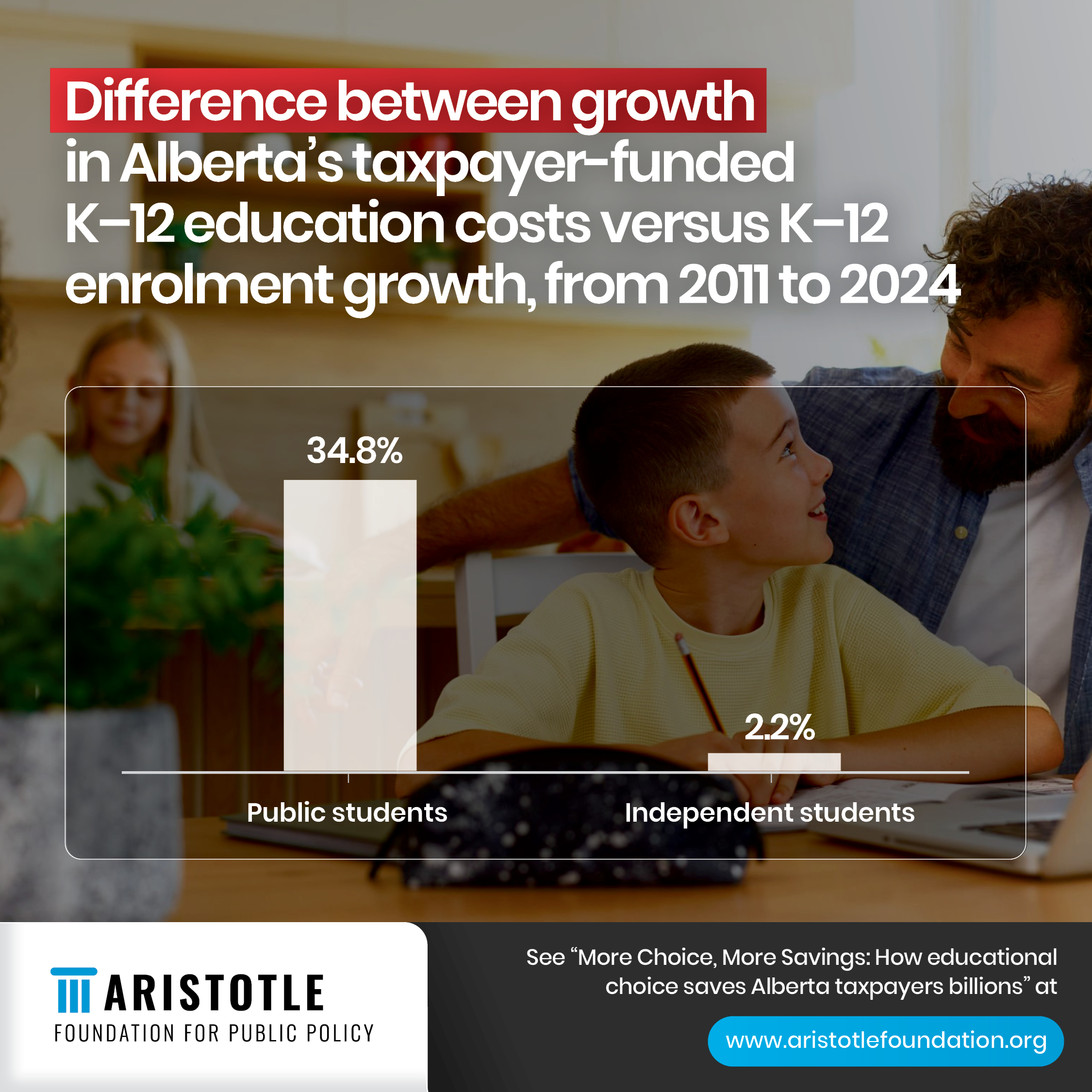
Independent and home education do not receive capital funding, so the above are only the savings on operating expenses. Accordingly, from 2011 to 2024, the budget for independent schools rose 95 percent, in tandem with a 93 percent rise in independent enrolment. Conversely, the cost of fully funded students rose by 37.3 percent, while fully funded enrolment increased by only 27.7 percent. In other words, public and separate school costs climbed nearly 10 points or 34.8 percent faster than enrolment, since 2011, despite their per-student costs remaining essentially unchanged.
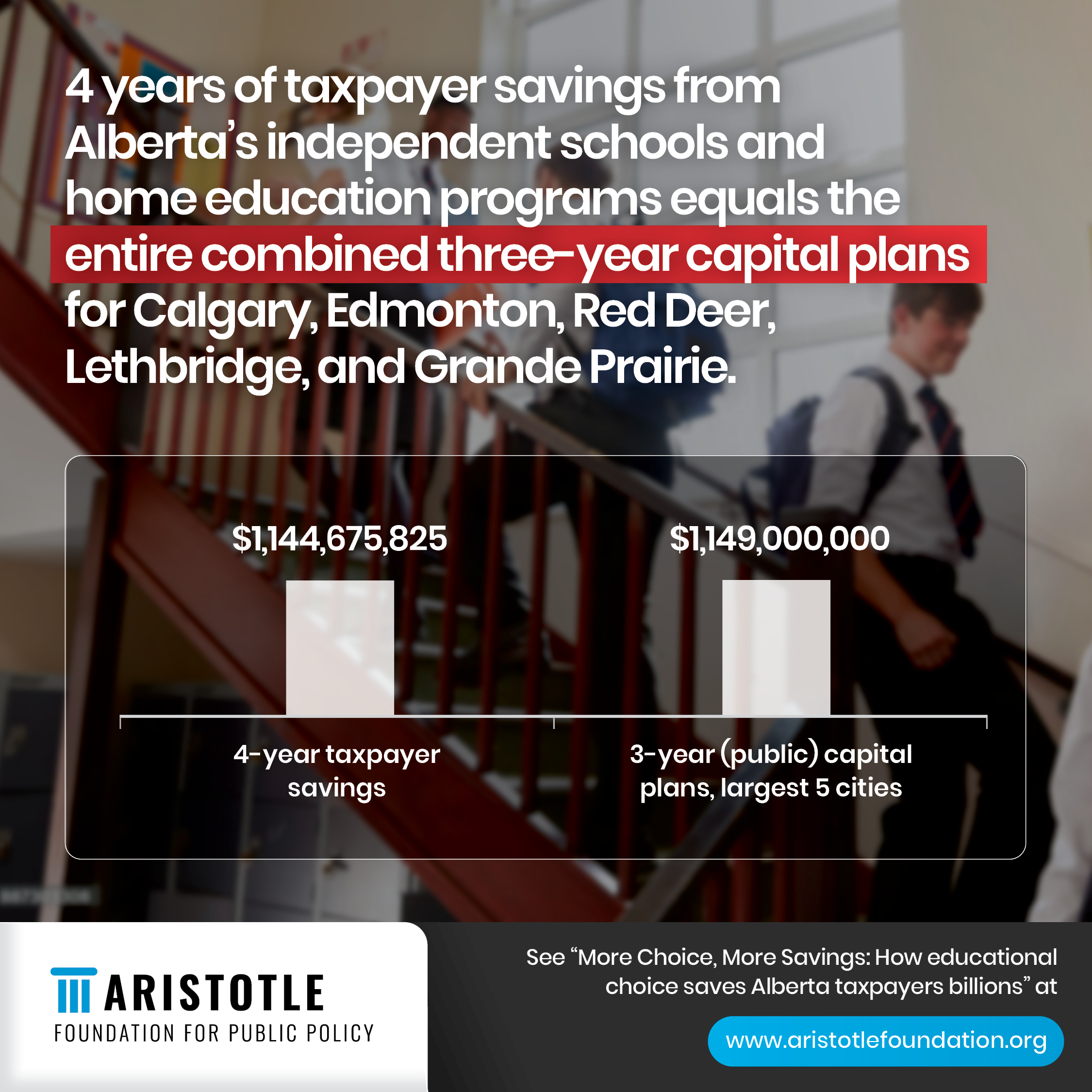
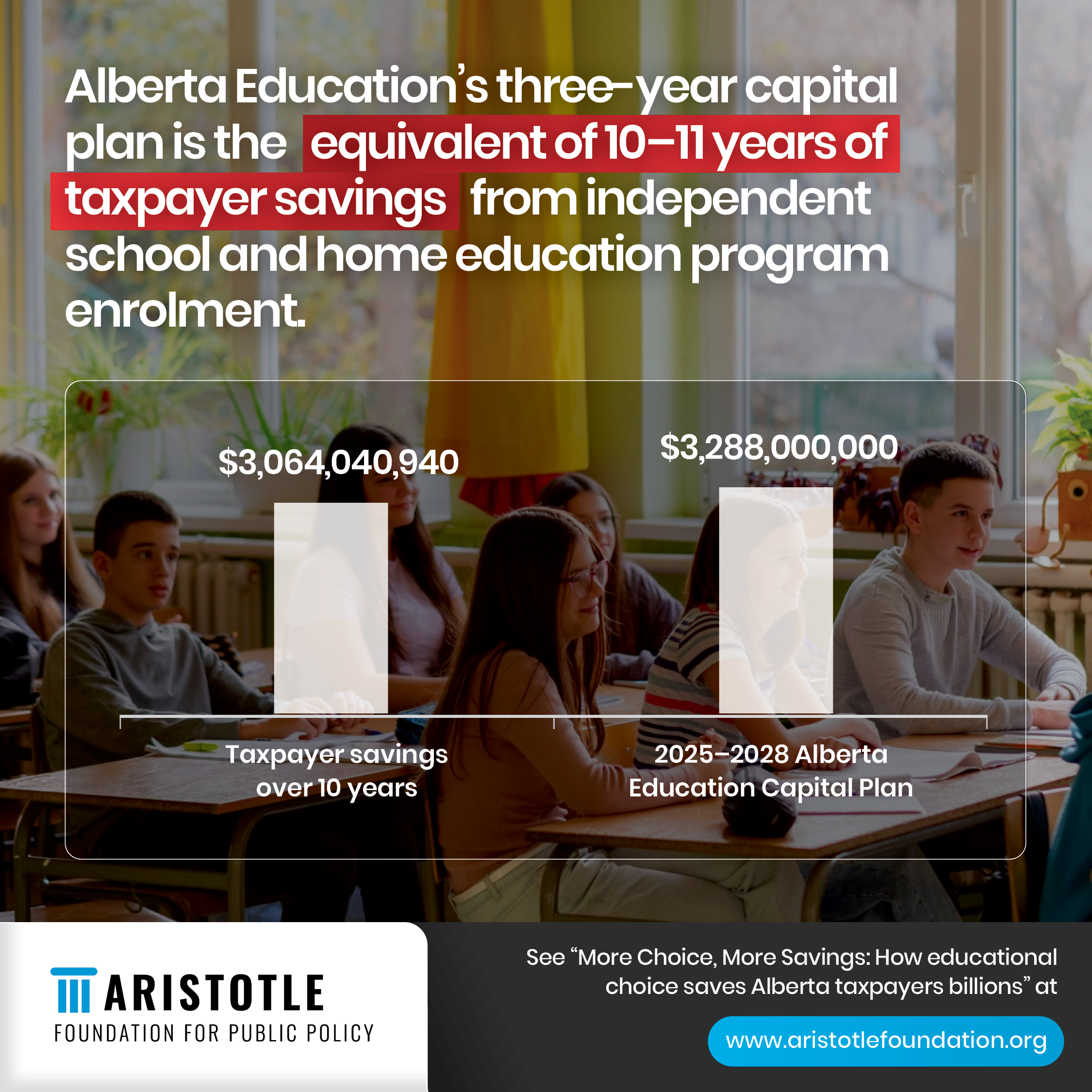
It is important to put all of the above into context, by considering the opportunity cost of these savings. In the five Alberta cities with the largest school capacity—Calgary, Edmonton, Red Deer, Lethbridge, and Grande Prairie—their combined three-year capital plans amount to $1.149 billion. Thus, four-years’ worth of savings from independent and home enrolment pays for all the new schools needed in these cities. For perspective, the entire Ministry of Education’s capital plan for 2025–2028 is $3.29 billion—about 10 to 11 years’ worth of taxpayer savings.
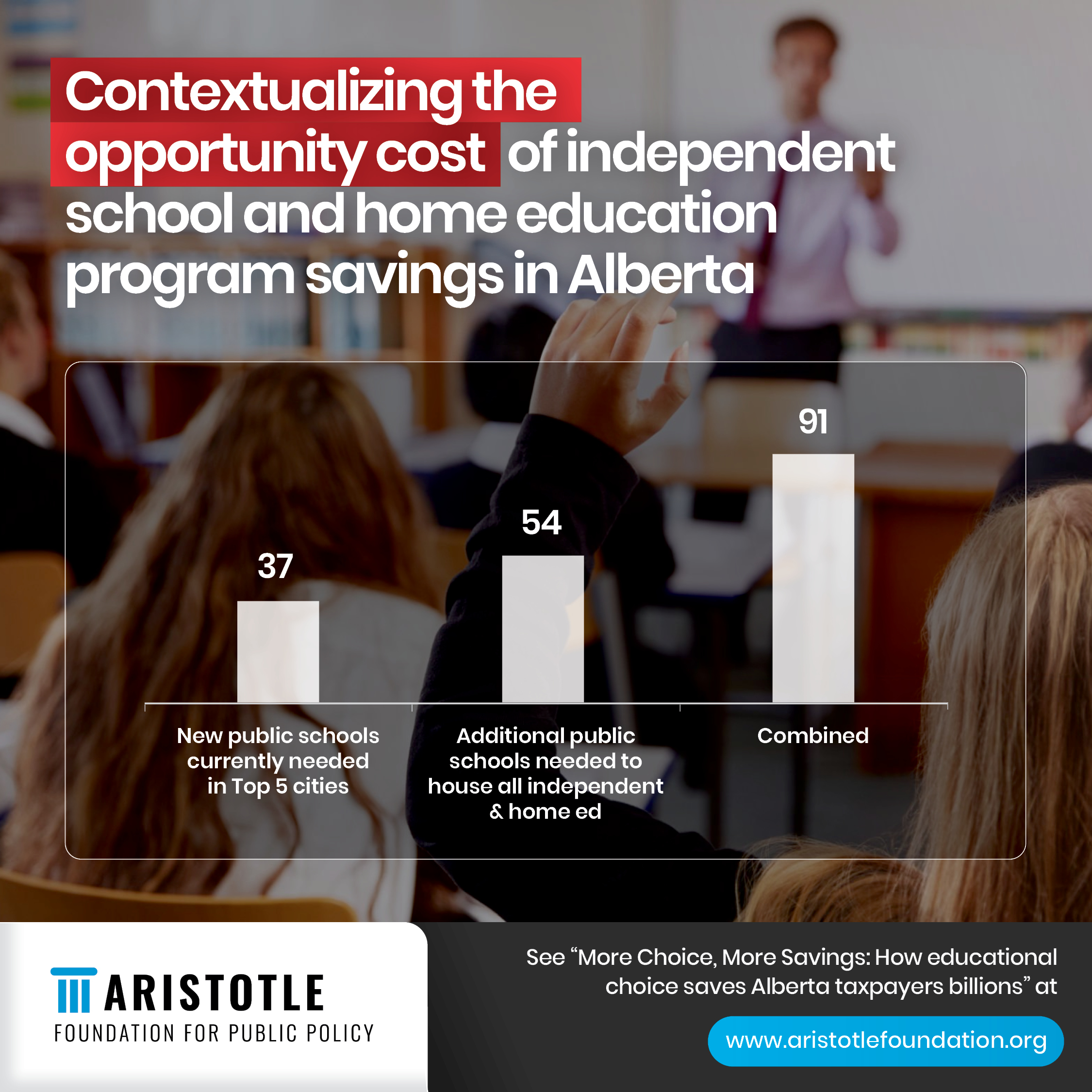
Another way of looking at it is to consider what would happen if independent and home education programs were defunded and all those students migrated to public schools. That would require at least 54 additional public schools. Presently, the aforementioned five cities enrol 60 percent of the province’s students and have budgeted for 37 new schools (Calgary and Edmonton are already overcrowded). Thus, these cities would need to nearly triple capacity overnight, to 91 new schools—with a capital cost of at least $3 billion—to accommodate such an influx.
Bottom line: In Alberta, independent schools and home education save taxpayers money. The Alberta government is right to promote an education system that values a diversity of approaches, offering a wide range of school options to as many children as possible—not to mention, the advantages of funding independent schools and home education go far beyond the substantial cost savings.
The purpose of this study is to estimate the financial impact, for Alberta taxpayers, of students that choose to enrol in independent or home education. The report begins with essential context on what independent schools and home education are in Alberta and how they fit within the province’s education system. Next, enrolment trends and annual reports are examined, in order to calculate whether these alternative educational choices are a fiscal burden or blessing to Albertans. With total and per-student costs, we also estimate the cost of these students migrating to public schools, the impact on capacity constraints, and the costs of building out new capacity to accommodate such a migration if independent schools and funded home education programs did not exist.
Alberta has long had the most pluralistic education system in North America. Up until 2012, there were at least 19 ways for Albertan children to school—15 of which were fully or partially taxpayer funded (see Exhibit A1 and Figure A1 in the Appendix). Today, there remain at least 17 ways for Albertans to school: 13 are at least partially funded (see Exhibit A1, Figure A2, and Figure A3 in the Appendix).
Of all the 802,336 K–12 students in Alberta, two-thirds were enrolled in public school board schools in 2024—the year of analysis (Figure 1). The large majority of this is in what are colloquially known as “public schools”; these are the common schools in almost every neighbourhood—the cultural norm throughout North America. But given such a lengthy list of publicly overseen, taxpayer-funded educational options, referring to just one option as “public” is a misnomer at best. For example, within public school boards, many Albertans opt into alternative programs—examples include Calgary Islamic School and Edmonton Christian Schools—which hardly match “public school” stereotypes but are nonetheless public school board schools. Likewise, there are Mennonite, former separate, and (not separate) Protestant public schools in rural Alberta (e.g., all of the aforementioned are in the county of Saint Paul). And, until 2012, there was at least one Catholic public (not separate) school (e.g., Greater Saint Albert Catholic).

Source: Government of Alberta (2026).1
Note: Home-educated students (3.1%) are included in the school authorities’ count, as—exceptions notwithstanding—students register and are counted with a school authority (e.g., an independent, public, or separate school).
This report focuses primarily on just two of the 17 ways to school in Alberta: accredited funded independent and home education supervised by a school authority.
Alberta Education delineates between “Shared Responsibility” programs, “Home Education supervised by [a] school authority,” and “Notification only, non-funded.” Shared responsibility programs tend to be synonymous with distributed learning, distance education, online programs, and/or hybrid schooling. As they are a complex category with a unique and varying funding rate but only constitute one-quarter of 1 percent (0.26%) of Alberta students—more than half of which are supervised by public, separate, or francophone schools—they are excluded from our analysis.
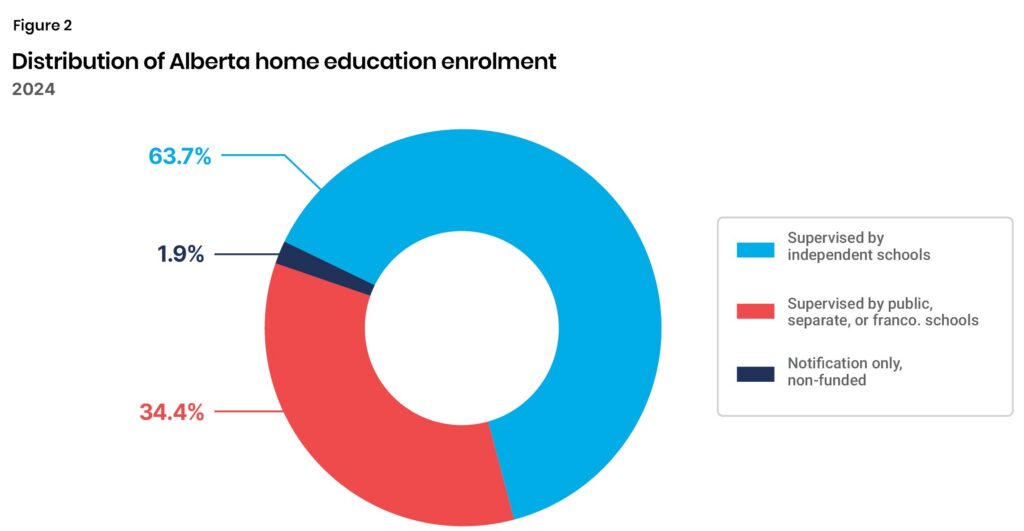
Home education has less to do with location than with authority. Parents are the primary educators, but education can and does happen beyond just the home. Over 98 percent of Alberta home-educated students are registered with a school authority; of these registrations, nearly two-thirds are with independent schools (Figure 2).
Source: Alberta Education (2025).2
Note: This excludes the 2,057 students in shared responsibility programs (thus, the denominator is 22,653).
Recognizing that parents are, by nature, the natural custodians and first educators of their child,3 Alberta does not require students to register with a school. However, compulsory education remains in effect through notification requirements. One-twentieth of 1 percent (0.05%) of Albertan students are notification-only homeschoolers. They do not receive any taxpayer funding.
Regulatory categories aside, “What is a homeschooler?” is a central research question at present in education policy globally. A growing community of scholars—including but not limited to Angela Watson,4 Eric Wearne,5 Michael McShane,6 Albert Cheng,7 Matthew Lee,8 and Catherine Sunshine9 (not to mention the many scholars in Continental Europe and Latin America)—have published robust research on this since 2020, distinguishing between homeschool, home-educated, hybrid-school, micro-school, learning pods, etc.
Homeschooling is remarkably fluid in two ways. First, many if not most homeschoolers do not match conventional stereotypes. Of all school types, homeschoolers are the hardest—i.e., near impossible—to define, once the definition moves beyond education authority. Intuitively, this makes sense, as the whole premise of homeschooling is its heterogeneity; it is a bespoke educational experience. Second, students move in and out of homeschooling; 80 percent of homeschoolers are only educated at home for some of their K–12 schooling. In other words, only one in five home-educated students completes all of K–12 as a homeschooler. The exact same share—20 percent—of all graduates who at some point homeschooled, did so for only one year. Around one-third of all homeschoolers only homeschool for two years or less of their entire K–12 education.10
Alberta Education reports that there are 237 independent schools in the province, as of January 2026.11 Although sometimes referred to as “private” schools,a these schools are heavily regulated and must annually submit operating plans to the Ministry of Education. But they have independence in their day-to-day operations, governance, and purpose, and, thus, shall be referred to as independent schools in this report. Of note, “three-quarters of independent schools belong to a school association…[providing] an additional layer of accountability beyond that of government regulation”.12
a. Until fairly recently, the Ministry of Education used the label “private school,” but this was updated to the more accurate term, “independent school.”
Three regulatory categories of independent schools
There are three regulated categories of Alberta independent schools. In addition to the aforementioned, all independent schools must meet the basic requirements set out in the Independent Schools Regulation subsection of the Education Act and follow municipal bylaws. Those who meet only these requirements are simply “registered” independent schools. Those who also employ provincially certified teachers are “accredited” independent schools. Neither of these two categories receives funding. To receive 70 percent of the per-student public grant for operating expenses, “accredited funded” independent schools must be a charity or nonprofit, teach the province’s programs of study, and have a provincially certificated principal, in addition to certified teachers. No independent school receives capital grants.
Figure 3 shows that, of reported enrolment, 97.6 percent of independent school students attend accredited funded schools.

Source: Hunt et al. (2021).13
Types of independent schools
Independent schools are a naturally diverse ecosystem. Nearly 60 percent of Alberta’s independent schools are religious—mostly non-Catholic Christian, but also Jewish, Sikh, Islamic, and other religions. Nearly half have a special emphasis, such as classical (i.e., the liberal arts tradition), special education, Montessori, etc. Only 9 percent of Alberta’s independent schools are top tier—”those schools that are commonly thought of as ‘elite,’ with competitive admissions policies, high academic standards, excellent facilities, and [high] tuition.”14
Seventy-five percent of Alberta independent schools enrol fewer than 300 students.15
Why parents choose independent schools
In Alberta, the top five reasons parents give for choosing a non-religious independent school are that the school:16
For religious independent schools, the top five reasons are that the school:17
Regardless of the type of independent school—whether religious or special emphasis or top tier (or all of the above)—parents are nearly unanimous in that they “chose the school for its supportive, nurturing, and safe environment that instills confidence and character in students.”18
Who chooses independent schools?
Alberta independent schools are middle-class institutions. Their students are much more likely to hail from two-parent households who work in middle-class occupations, but “when comparing like-to-like family structures, independent-school families have a lower household income than their Albertan peers.”19
In 2020, median per-student tuition was $4,000 a year—only slightly more than the average hockey family spends per child on their out-of-school sport of choice.20 Yet, 88 percent of parents make financial sacrifices to afford independent schooling.21
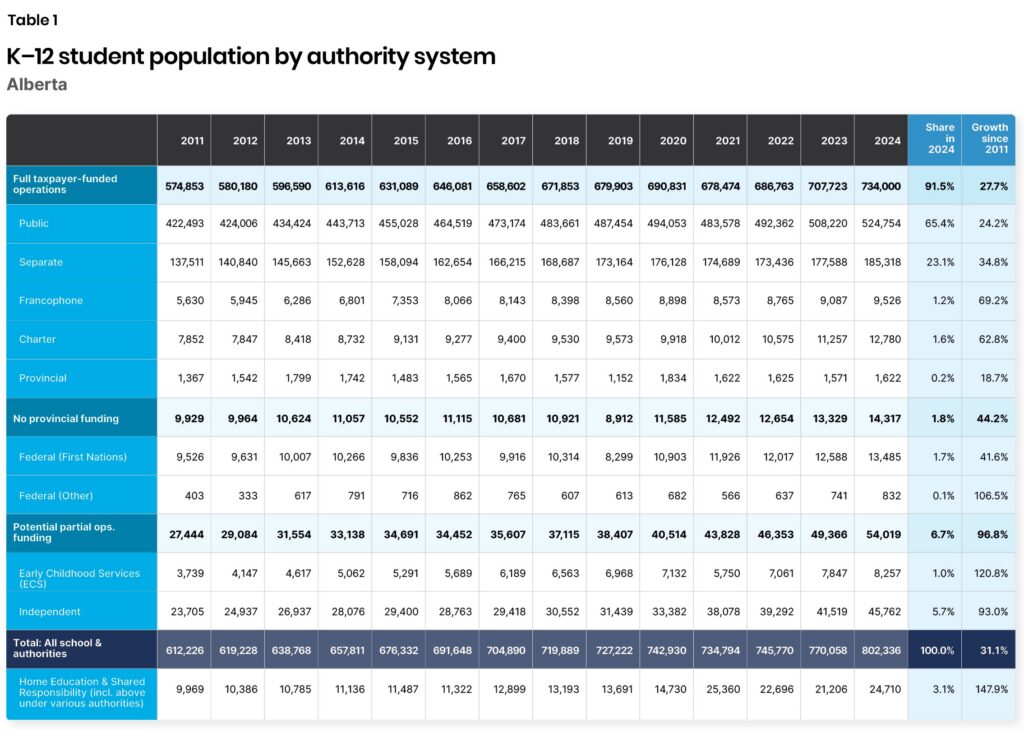
Table 1 presents the distribution of Alberta’s 802,336 K–12 students. Nearly two-thirds (65.4%) are enrolled within public school boards, whether their local-catchment boundary school or an alternative program. Nearly one-quarter (23%) are enrolled in public Catholic separate schools. In total, 91.5 percent of Alberta students receive full taxpayer funding towards their school’s operational expenses. Less than 2 percent are under federal jurisdiction and, thus, do not receive provincial funding. And 6.7 percent receive substantial partial funding. The 3.1 percent enrolled in home education receive minimal funding.
Source: Authors’ sorting of Government of Alberta (2026) and Alberta Education (2015).22
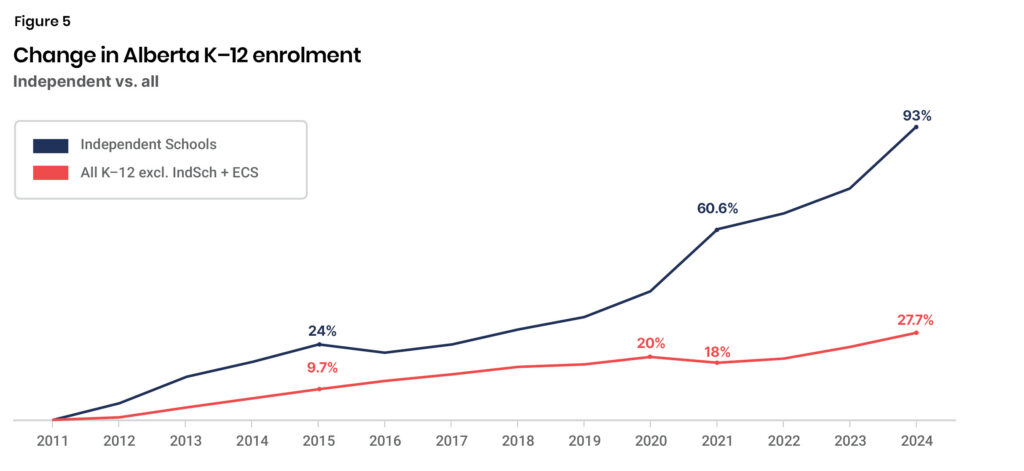
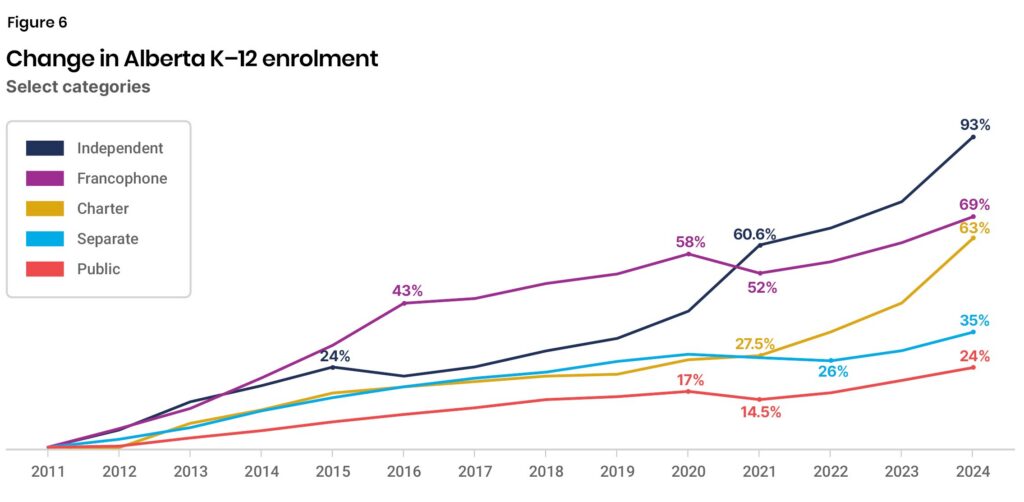
Of school categories above 1 percent of total K–12 enrolment, independent and home education are growing the fastest. Independent school enrolment has doubled since 2011,b increasing at three times the rate of growth outside the independent sector. From 2011 to 2024, independent enrolment increased annually in all but one year, growing from 23,705 to 45,762 students (Figure 4)—a 93 percent increase. By comparison, excluding independent schools and Early Childhood Services (ECS) independent operators,c Figure 5 shows Alberta’s K–12 enrolment rose 27.7 percent in the same period. Figure 6 breaks this down in more detail, showing that independent growth even outpaces francophone and charter enrolment growth, which are 69 percent and 63 percent, respectively, across the same period. Home education is growing the fastest, with enrolment nearly doubling-and-a-half since 2011 (Figure 7).
b. Relevant amendments were made to Alberta’s Education Act in 2012, so 2011 is used as the initial baseline.
c. ECS independent operators offer early education up to and including Kindergarten.

Source: Government of Alberta (2026), Alberta Education (2015).23
Source: Authors’ calculations based on Government of Alberta (2026) and Alberta Education (2015).24
Source: Authors’ calculations based on Government of Alberta (2026) and Alberta Education (2015).25

Source: Authors’ calculations based on Government of Alberta (2026) and Alberta Education (2015).26
As enrolment has expanded across all school types, so too has Alberta’s total education spending. But the distribution has not been even. From 2011 to 2024, the budget for independent schools rose 95 percent, in tandem with a 93 percent rise in independent enrolment. Conversely, the student-specific and general cost of fully funded students rose 37.3 percent, while fully funded enrolment increased by 27.7 percent. In other words, public school and separate school costs climbed nearly 10 points or 34.8 percent faster than enrolment, since 2011, as shown in Figure 8 (see Appendix Table A1 for further details on costs).
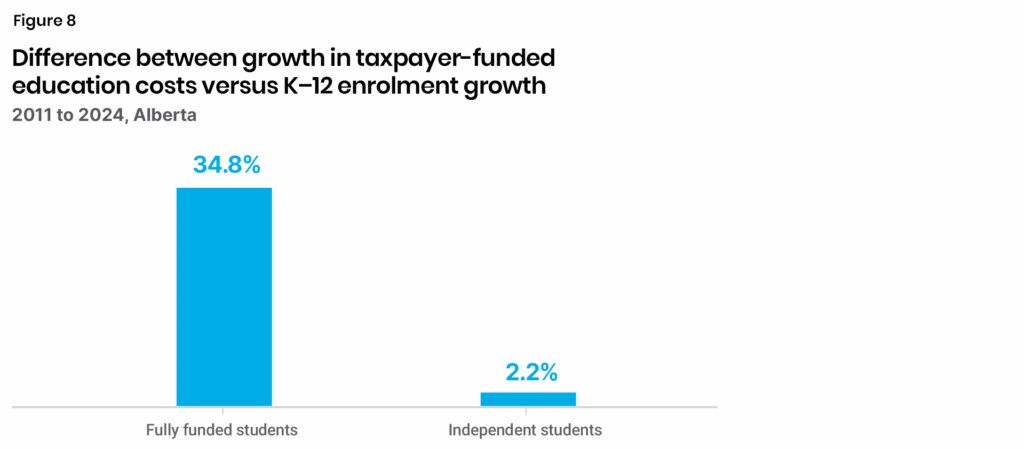
Source: Authors’ calculations based on Government of Alberta (2026), Alberta Education (2015), and Alberta Education annual reports (various years).27
But as presented in the next section, per-student costs remained relatively flat. Applying the enrolment and costing data, we can calculate the per-student costs.
The first step in estimating the cost or savings of independent and home education enrolment is to differentiate students based on the level of taxpayer funding they receive towards their school’s operating expenses.
Table 2 summarizes the last five years of Alberta Education enrolment data. Of note, one-third of independent students are in a shared responsibility (2.2%) or home education program (31.5%); two-thirds (66.3%) are in “brick-and-mortar” schools. The latter necessarily receives considerably more funding than homeschoolers, due to operational expenses that home-based programs lack; this must be accounted for in calculations. Thus, 30,334 of 45,762 independent students are included as independents in our calculations, and the others are treated according to their respective funding category.
Accordingly, Table 2 clarifies the distribution of home education programs. Since 98 percent of home education and all shared responsibility enrolment is supervised and the former receives substantially less funds than “brick-and-mortar” students, they need to be subtracted from their supervising school in the calculations. Nearly two-thirds (62.4%) are registered with independent schools, either in shared responsibility (4%) or home education programs (58.4%). Over one-third (35.8%) are registered with public, separate, francophone, or other fully funded schools, in shared responsibility (4.3%) or home education programs (31.5%). In total, 8.3 percent of the total home education count are in shared responsibility programs, and 1.7 percent are notification-only homeschoolers. As the latter do not receive any funding and shared responsibility students have a different funding formula (and over half are public or separate students)—and, combined, they are merely 10 percent of home education enrolment—both are excluded from our costing analysis.d In other words, we include 22,224 of 24,710 (90%) home-based students in our calculations.
In Table 2, fully fundede students—public, separate, francophone, charter, and provincial students—are grouped together in one category, federal studentsf are excluded (as their funding is outside Alberta Education), and potentially partially funded students are divided by authority category: “ECS Independent Operators,” “Independent,” and “Home Education.” As ECS independent operators only serve Kindergarten and lower, they are excluded. Our analysis focuses solely on independent schools and home education.
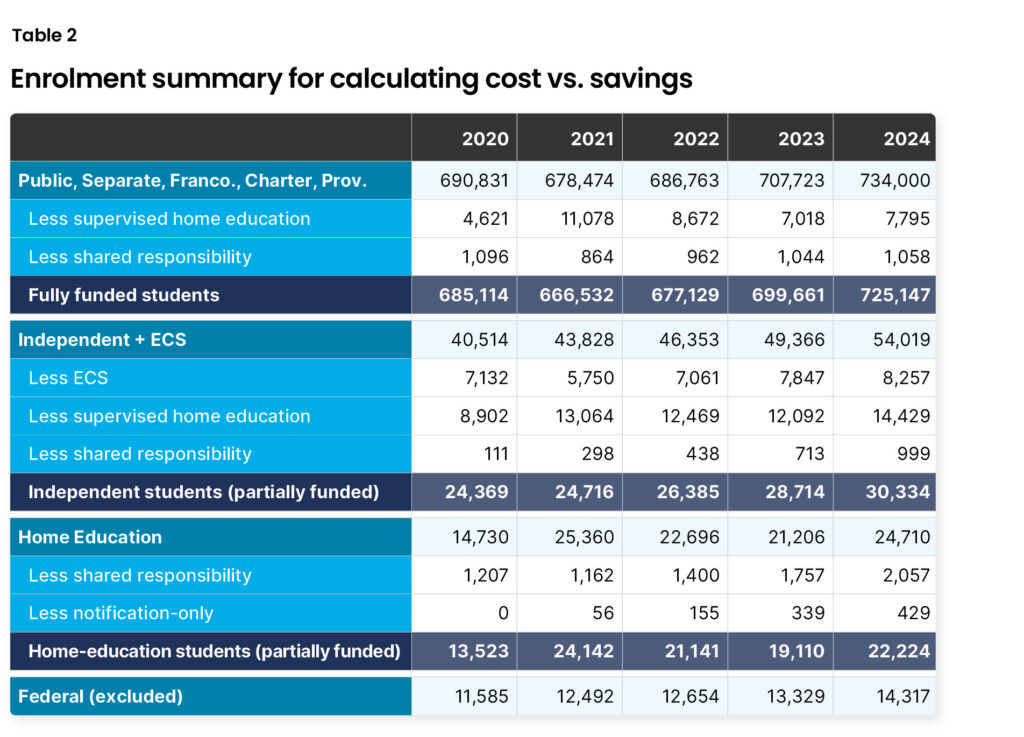
Source: Authors’ calculations based on Government of Alberta (2026).28
Tables 3 and 4 itemize the service costs of Alberta Education’s budget. To ensure we do not overestimate the impact of a hypothetical scenario where an independent or homeschool student enrols in a fully funded school, only three categories are considered for public system costs: “Instruction – ECS to Grade 12,” “Operations and Maintenance,” and “Student Transportation.” In 2024, the most recent data at the time of writing, these three student-specific costs accounted for $8.14 billion, as shown in the first line of Table 4. Five additional categories in Table 3—governance and system administration, program support services, basic education programs, debt servicing costs, and the 2013 Alberta flooding—are excluded from the summaries of education spending (Table 4) and per-student calculations. The rationale for excluding these costs is that if a student moves from an independent or home authority to a fully funded school, it should not be assumed that costs like debt servicing or governance will necessarily increase. While they may rise, our conservative estimates assume some expenses will remain constant.g
d. Note that in most public-facing student population statistics on Government of Alberta webpages, shared responsibility students are often triple counted; the same students are counted in the “Shared Responsibility” category, in the “Home Education” category, and with their registered school authority.
e. Full funding refers to fully taxpayer-funded operating expenses. Charter schools do not receive any capital funding, and all schools fundraise within their school communities for various non-operating costs; hence, even within residentially-assigned public schools, there are extreme disparities between “fully funded” schools (e.g., in Calgary: Elbow Park vs. Falconridge).
f. Federal students are primarily, although not exclusively, indigenous students at on-reserve schools, which are funded by the federal government.
g. It is important to note that our approach and assumptions deliberately and significantly differ from those used in reports by the Alberta Teachers’ Association (ATA), Fraser Institute, and Statistics Canada on per-student education costs. Others include broader categories and different allocation methods. We exclude costs that may not necessarily increase with student enrolment shifts. This ensures a more precise comparison of the actual per-student fiscal burden or savings between schools.

Source: Alberta Education annual reports (various years).29
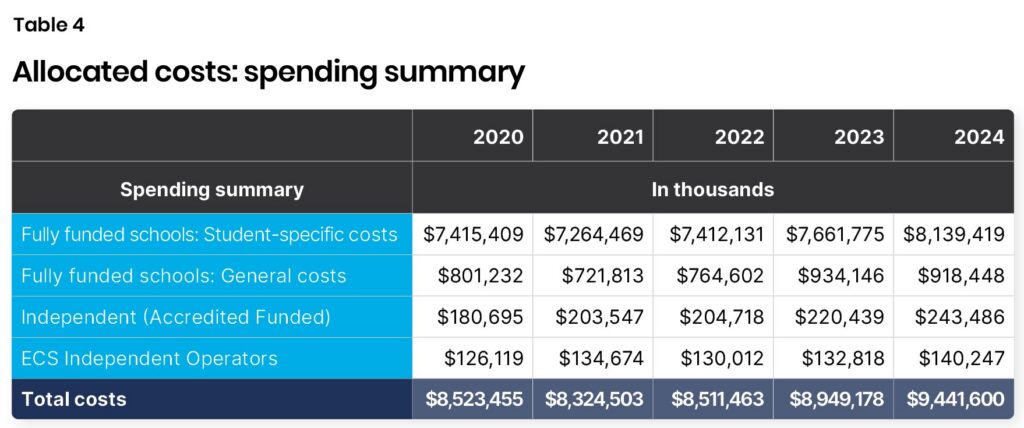
Source: Authors’ calculations based on Alberta Education annual reports (various years).30
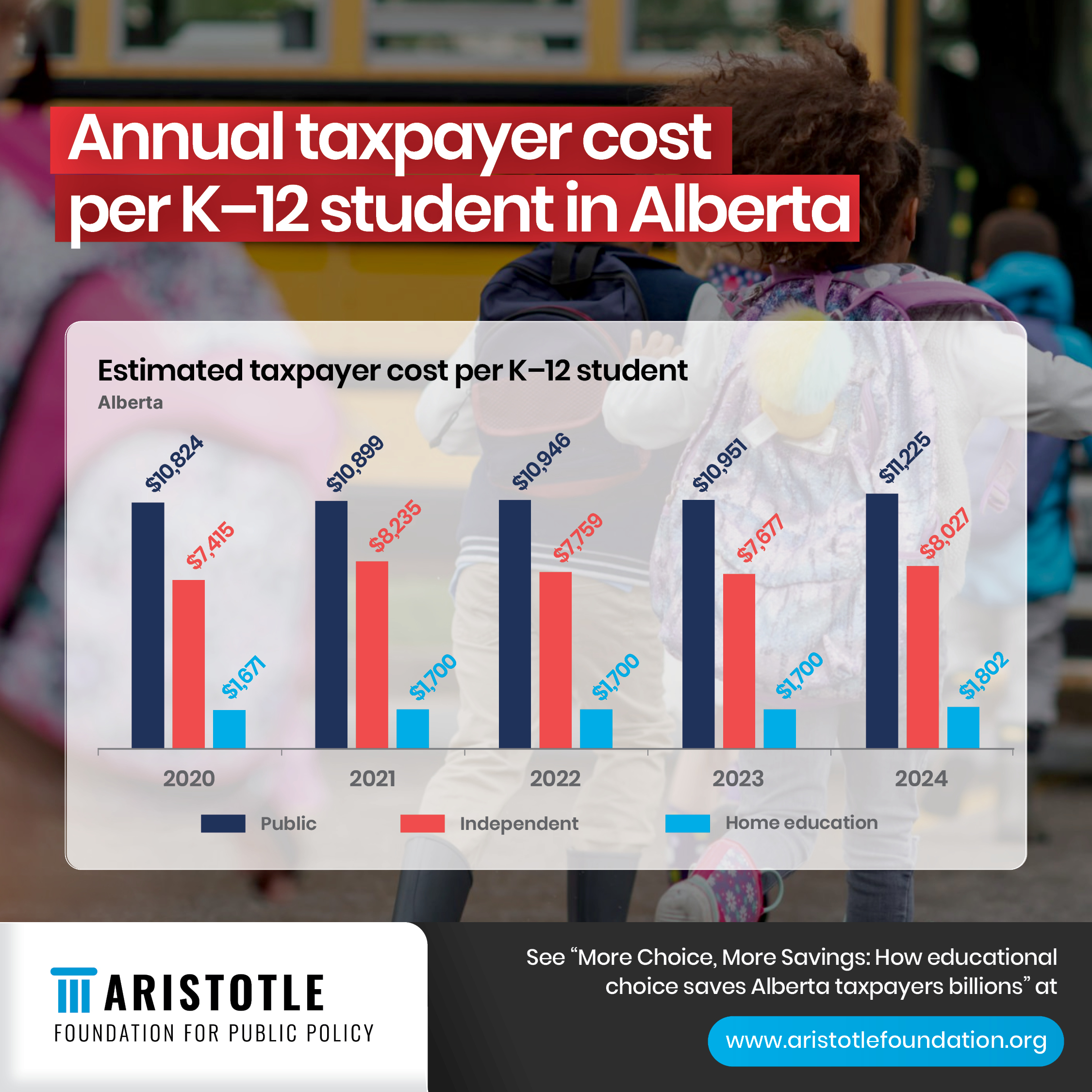
Figure 9 excludes the general costs of fully funded students and ECS independent operators (and shared responsibility) to narrow in on and compare the annual per-student cost of fully funded, independent, and home-education students. Annually, fully funded schools’ per-student operating expenses cost taxpayers $11,225, compared to $8,027 for independent and $1,802 for home-educated students. It is important to note that this average per-student, per-year cost is only the base grant for home education. Included in the fully funded and independent cost are other grants—e.g., maintenance, transportation, etc.—that can and should be allocated on a per-student basis. Funding rates also vary by grade. Most significantly, for both fully funded and independent students, additional tiered funding exists for various special needs, such as mild, moderate, and severe disabilities. And with fully funded students, there are cost differences between rural and urban/suburban schooling.31 All of this is captured in the average. Hence, the independent per-student share is not a clean 70 percent of the fully funded rate; it has varied from 68.5 percent to 75.6 percent over the last five years.
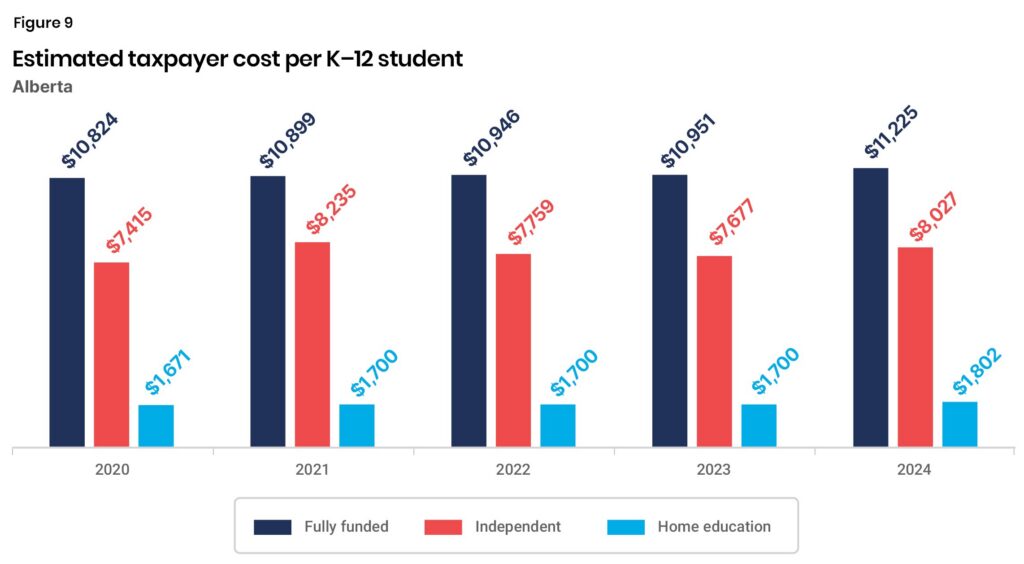
Source: Authors’ calculations based on Government of Alberta (2026) and Alberta Education annual reports (various years).32
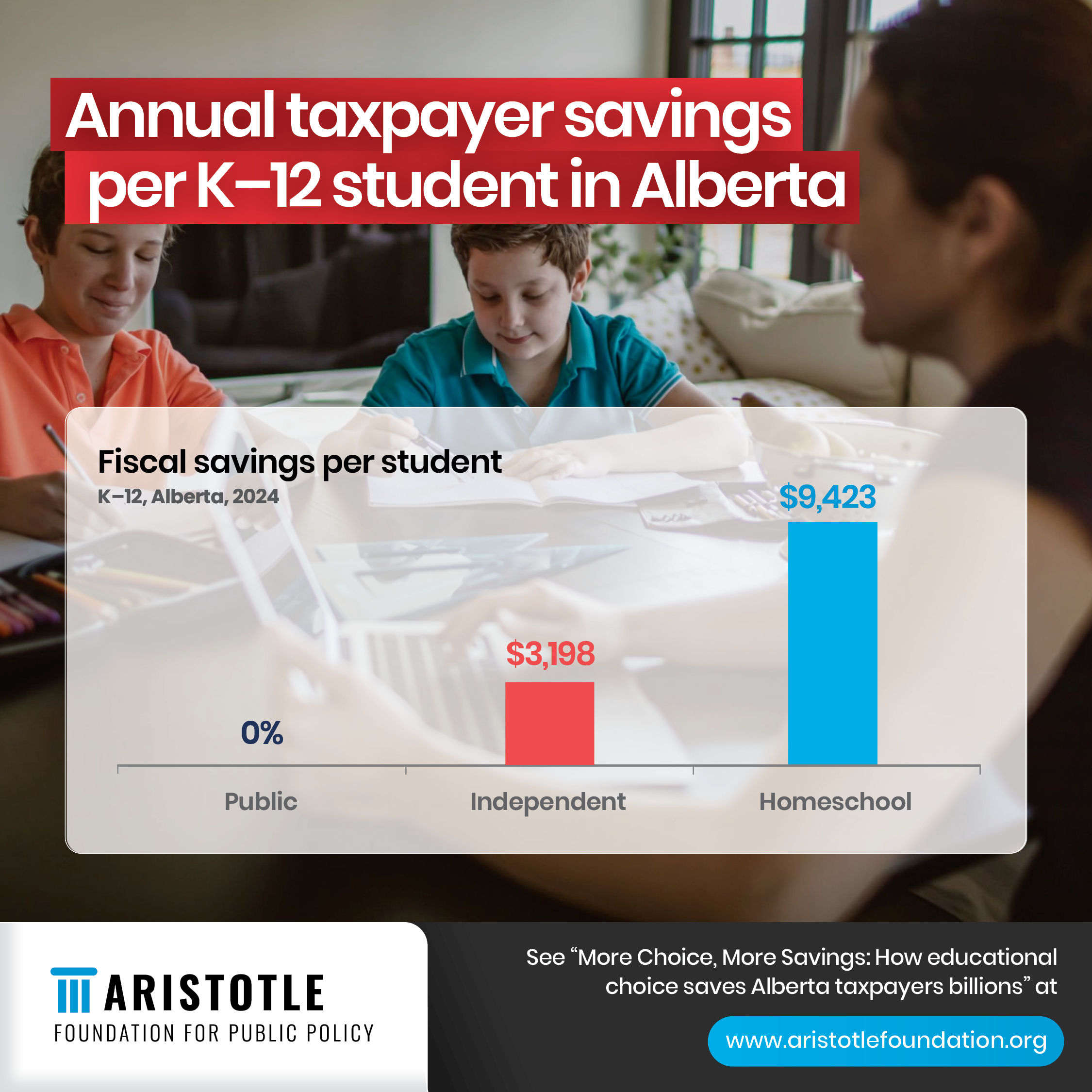
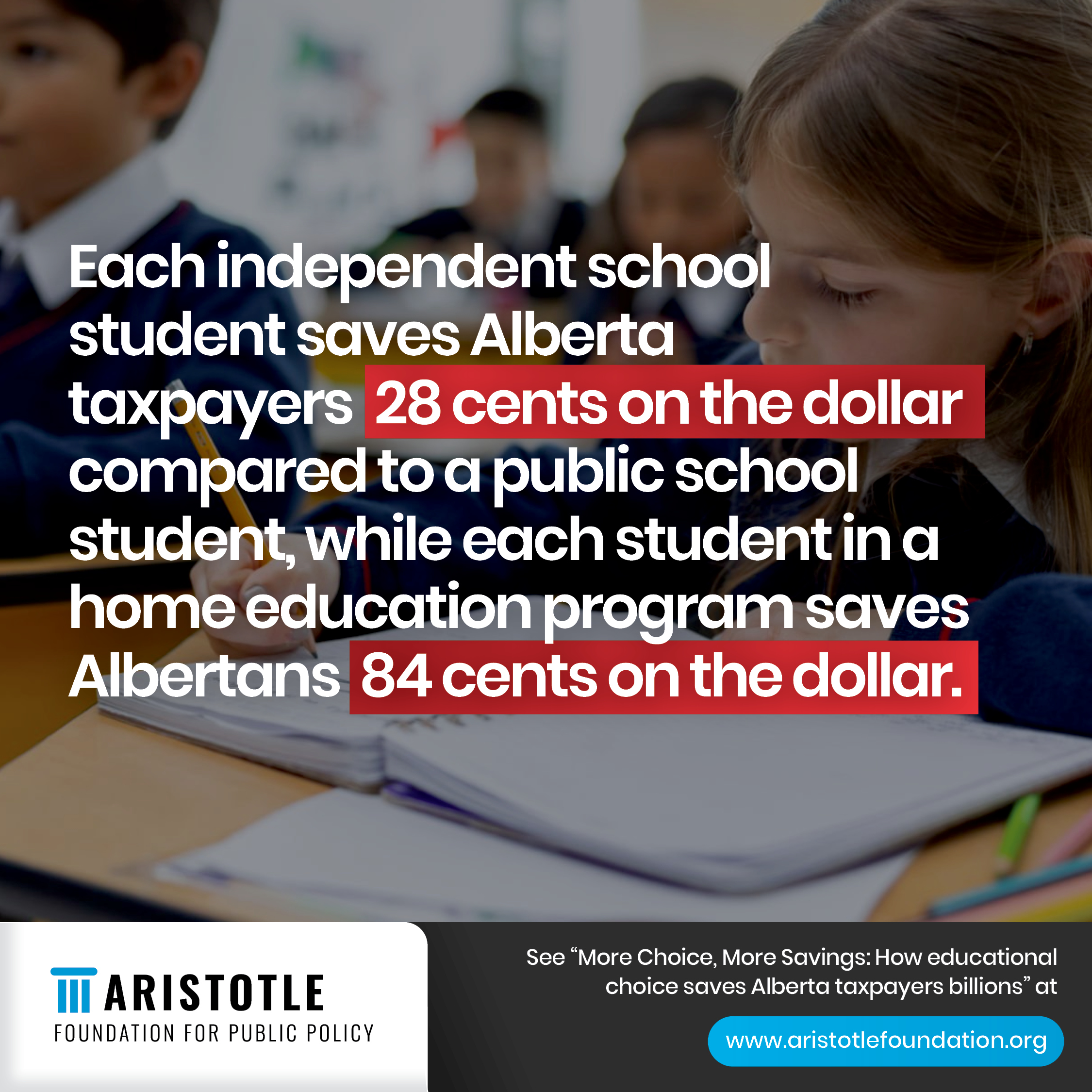
Therefore, on average, Albertans realize per-student annual savings of $9,423 and $3,198 for every home-educated and independent school student, respectively (Figure 10). In other words, each student in an independent school saves Alberta taxpayers 28 cents on the dollar, while each homeschool student saves 84 cents to the dollar.
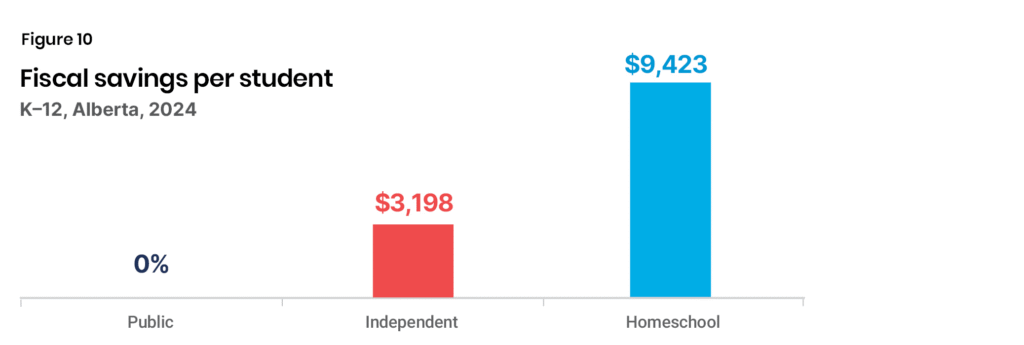
Source: Authors’ calculations based on Government of Alberta (2026) and Alberta Education annual reports (various years).33
Bringing it all together—enrolments and allocated costs—reveals a fresh perspective. Fully funded enrolment is essentially in line with student-specific costs; the former is 90.4 percent of all Alberta K–12 enrolment and the latter constitute 86.2 percent of Alberta Education costs (Figure 11). Naturally, this parallel relationship does not exist with partially funded students.
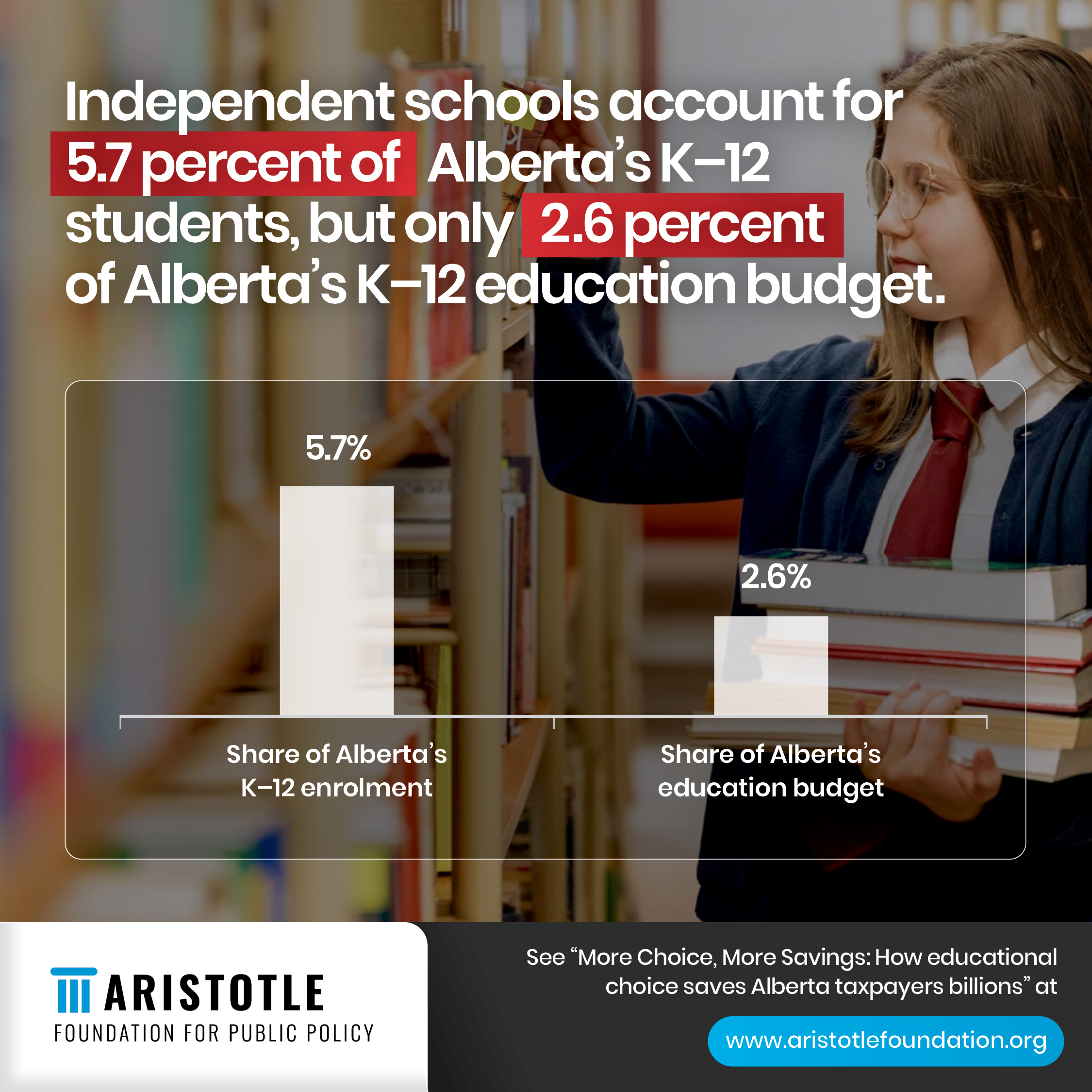
But the size of the gap is staggering—and helps to demonstrate what taxpayers gain with independent and home enrolment. Figure 11 shows that funded home-education students make up 2.8 percent of total K–12 enrolment but only 0.5 percent of total K–12 costs. In other words, homeschoolers’ enrolment share is nearly six times greater than their share of the Alberta Education budget. Likewise, funded independent school students’ share of enrolment is 46.6 percent greater than their share of total province-wide education costs.

Source: Authors’ calculations based on Government of Alberta (2026) and Alberta Education annual report (2025).34
What if independent and home education ended overnight? In other words, what if there was a radical policy change and all at once—today—every independent and homeschool student had to enrol as a regular, full-time student at their local catchment’s government-run school? There are two ramifications that need to be closely examined: cost and capacity.
Table 5 estimates the fiscal impact on Albertan taxpayers if every partially funded student had to be fully funded. Families that have chosen to be unfunded independent schoolers and unfunded homeschoolers, we can safely assume, would be unaffected by cuts to funding. But the same cannot be assumed of their peers. If funding to independents and home education was completely cut, it is possible—even likely—that many, if not most, of those partially funded students would opt into a funded authority and, thus, become fully funded. It is beyond the scope of this report to model out a sensitivity analysis; suffice it to state that funded students account for 98 percent of the independent and home-educated students in Alberta Education’s enrolment counts.35 Thus, an estimate that assumes 100 percent migration is not unreasonable (i.e., statistically, it is within an acceptable margin of error of plus or minus 5 percent).
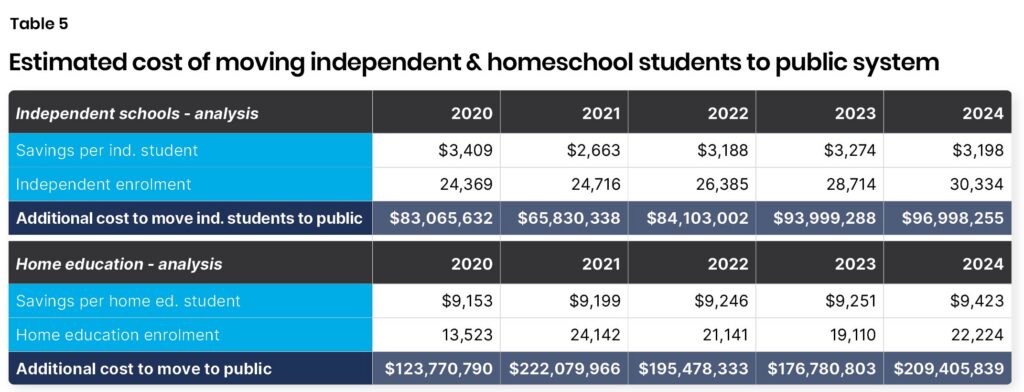
Source: Authors’ calculations based on Government of Alberta (2026) and Alberta Education annual reports (various years).36
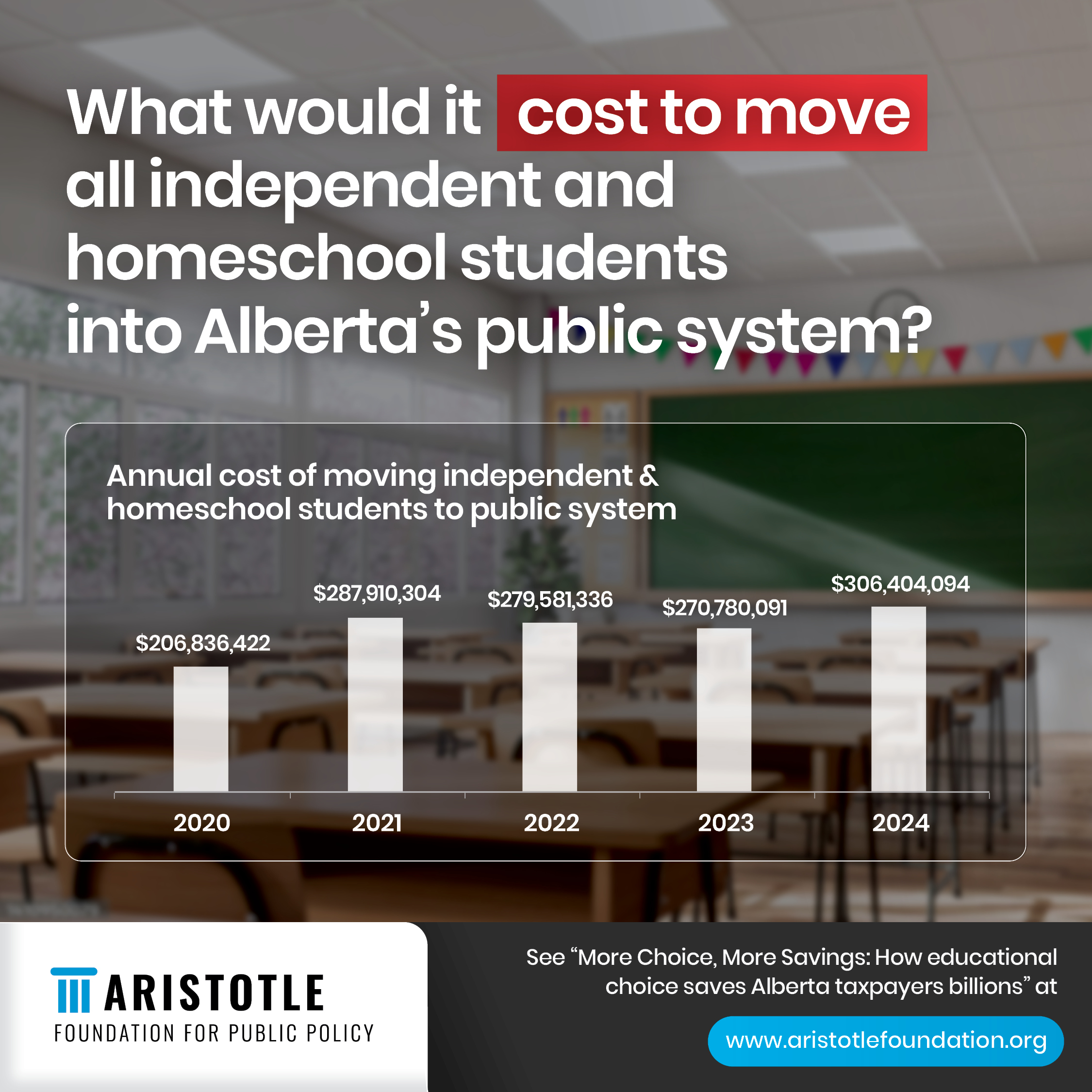
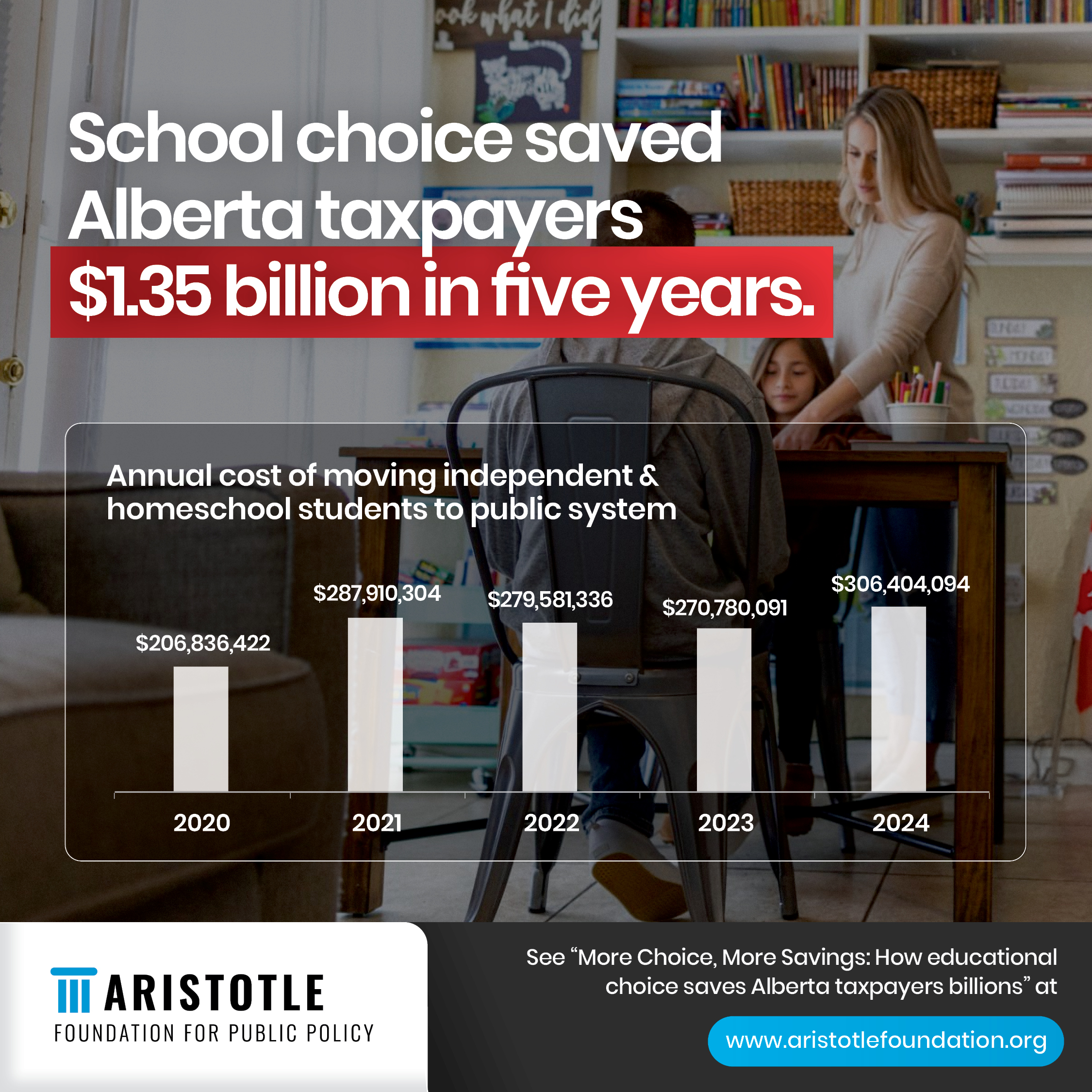
Such a migration is equivalent to 3.2 percent of the entire Alberta Education budget, just to cover the operating expenses—let alone significant, necessary additional capital expenditures. These added operational expenses would cost Albertans an extra $306 million per year (Figure 12). Over the last five years, that would have cost taxpayers an additional $1.35 billion.

Source: Authors’ calculations based on Government of Alberta (2026) and Alberta Education annual reports (various years).37
If all independent schools were shuttered tomorrow, could public school boards accommodate the mass influx of students? Presently, there is not the capacity; it would take many years—and billions of extra taxpayer dollars—to build the basic facilities needed to accommodate such an enrolment surge.
The Calgary Board of Education (CBE), Alberta’s largest school division—accounting for 143,373 students—reports:
Currently, 175 schools (approximately 73%) are full or over capacity based on Alberta Education’s criteria. The system utilization rate is 95% and is expected to exceed 100% in the next two years. High schools are already at 108% capacity.38
For context, the CBE—and presumably other Alberta school districts—has a utilization target of 85 percent.39 In production-operations management, the cardinal rule is that the optimal utilization rate is 80 percent. More than 10 percentage points lower is economically inefficient, and more than 10 percentage points higher is not sustainable and does not allow for sufficient operational flexibility.
Remarkably, the Alberta Education system—if assessed as a whole—is operating at a near-perfect utilization rate of 80.5 percent, with 726,546 school-division students enrolled in schools with a combined capacity of 902,099 seats. However, this overarching view does not necessarily reflect school-level realities. Some schools are overcrowded; some are underutilized.
Table 6 presents the school capacity utilization rates by school location. The combined utilization rate for the 12 municipalities with more than 10,000 students is 87 percent. Excluding them, the province’s schools are grossly underutilized, operating at only 67.6 percent of capacity, on average. Conversely, Calgary and Edmonton districts—home to 53 percent of all fully funded students—are at full capacity or overcrowded, whether public or separate. Table 7 presents utilization rates for the largest two school districts in each of Alberta’s five highest-capacity cities.h
h. The total number of non-independent, funded school authorities ranges from 4–13 per city.
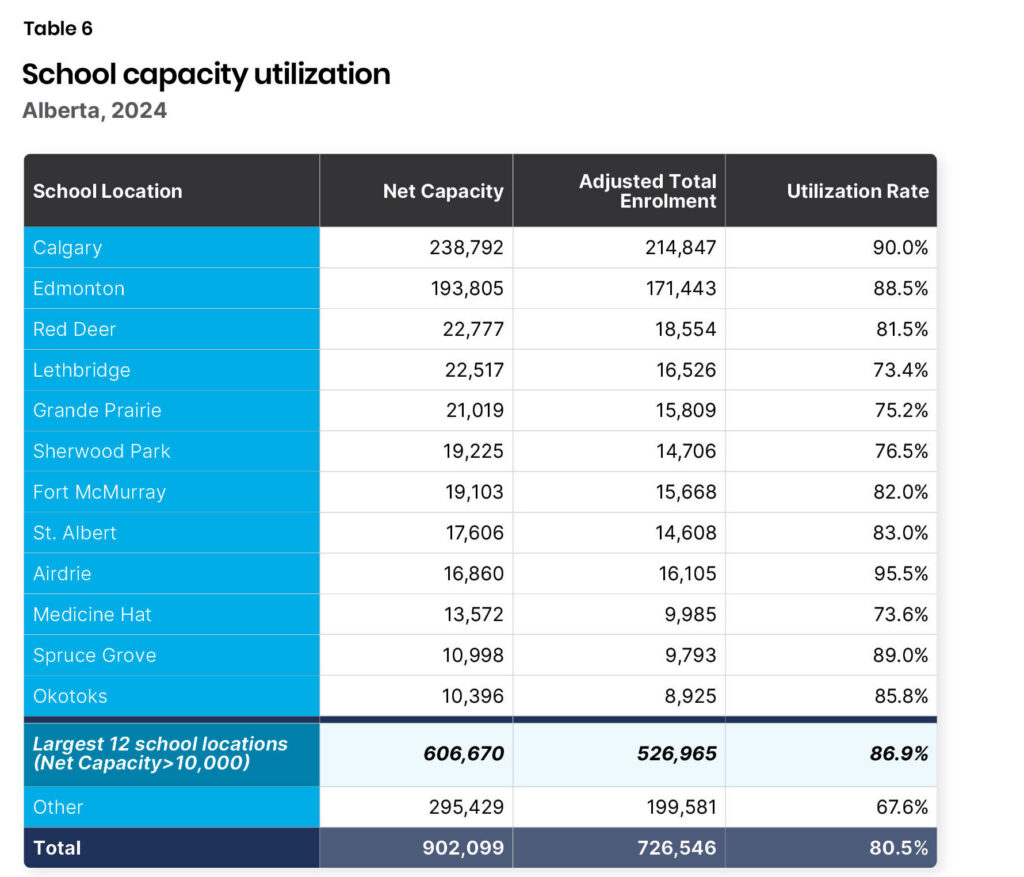
Source: Authors’ calculations based on Government of Canada (2024).40
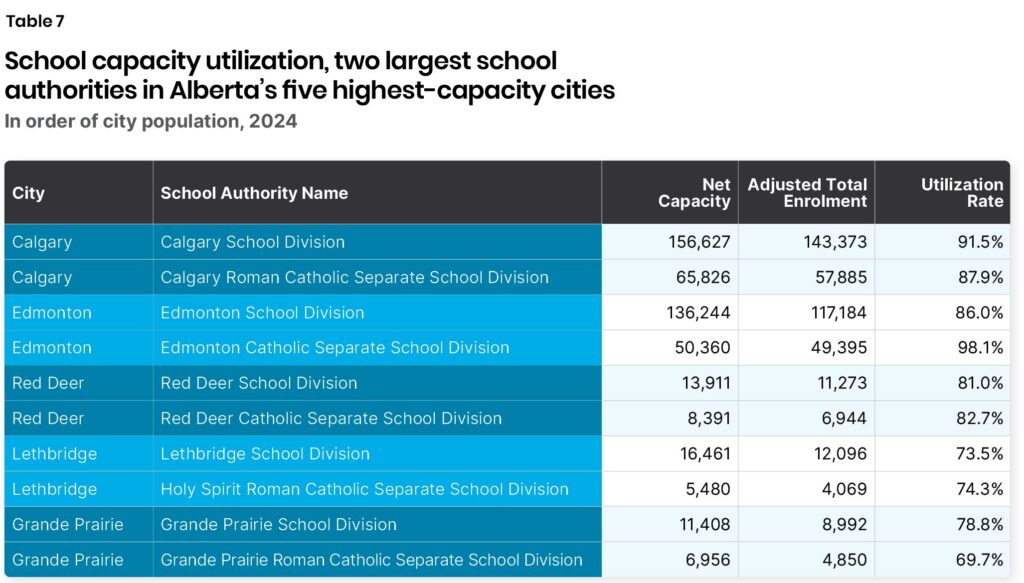
Source: Authors’ calculations based on Government of Canada (2024).41
Simply building out more capacity is more complex than might be imagined. Take the modernization of Calgary’s John Diefenbaker high school—just one of many illustrative examples. The school board identified the need for upgrades more than 13 years before those essential upgrades were realized:
In other words, around the time Susie is ready for kindergarten, we identify that there won’t be a seat for her in high school. Good start. But unfortunately, the seat isn’t ready for her until she’s graduated and off to college.42
Commissioning and completing school expansions, let alone building new schools, is a remarkably slow undertaking. But assuming new capacity could be built in a timely manner, despite the unlikeliness, what would it cost?
In the five Alberta cities with the most potential capacity for students—Calgary, Edmonton, Red Deer, Lethbridge, and Grande Prairie—their capital plans call for a combined 37 new schools (Table 8) in the immediate future.43 The average cost works out to around $32.8 million per school, to house an average 981 students. In other words, each seat costs roughly $33,471. Accommodating even 20,000 new students—less than half of all independent and home education enrolment—would require $669 million in immediate construction spending, which is the equivalent of one-fifth of Alberta’s entire education capital plan for 2025–28.44

Source: Three-year capital plan (various school divisions): Calgary Board of Education (2025), Edmonton Public Schools (2025), Red Deer Public School Division (2024), Lethbridge School Division (2025), and Grande Prairie Public School Division (2025).45
A simple estimate, plugging in these assumptions, suggests that roughly 54 additional schools (Figure 13)—costing an estimated $1.76 billion—would be necessary to accommodate all 52,558 students migrating to public schools from independent and home education. For context, that works out to about $1,519 per Alberta homeowner. Given that the overwhelming majority of independent enrolment is in these five geographic areas46—i.e., Calgary, Edmonton, Red Deer, Lethbridge, and Grande Prairie—it is safe to suggest that between double to triple the number of planned new schools would need to be built immediately to accommodate the influx (i.e., 91 not 37 new schools), especially in the already overcrowded Calgary and Edmonton school districts.

Source: Authors’ calculations based on Alberta Education annual reports (various years), Government of Alberta (2026), Calgary Board of Education (2025), Edmonton Public Schools (2025), Red Deer Public School Division (2024), Lethbridge School Division (2025), Grande Prairie Public School Division (2025), and Government of Canada (2024).47
Another way to look at this is in terms of the opportunity cost of the taxpayer savings. What Albertans save on independent schools and homeschoolers over four years is what is budgeted for in the (combined) three-year capital plans of the public school boards in Alberta’s five largest school-capacity cities, as shown in Figure 14. Calgary, Edmonton, Red Deer, Lethbridge, and Grande Prairie’s respective public school boards have a combined $1.15 billion budgeted for new schools in their three-year capital plans. This can be paid for by the $1.15 billion Alberta taxpayers have saved in the last four years alone, 2021 to 2024, thanks to independent school and home education enrolment. The entire Alberta Education three-year capital budget (2025-2028) of $3.29 billion can be more than paid for by 11 years of independent and homeschool savings ($3.37 billion).

Source: Authors’ calculations based on Government of Alberta (2025), Alberta Education annual reports (various years), Government of Alberta (2026), Calgary Board of Education (2025), Edmonton Public Schools (2025), Red Deer Public School Division (2024), Lethbridge School Division (2025), Grande Prairie Public School Division (2025), and Government of Canada (2024).48
Even with the aforementioned savings and the impossibility of accommodating a mass exodus of independent schoolers, self-interested organizations may decry any taxpayer funding outside their control, implying that public funding is for their public-sector union employees—not students and the public interest.
What if we blindly ignore all the above calculations and prejudicially judge the independent sector—a priori—as a burden? Rather than appreciate the fact that it more efficiently allocates taxpayer resources for the public interest, what if we hold it in contempt for the crime of bypassing public sector union dues? Even if we grant such an absurd assumption, how consequential would such a “burden” be?
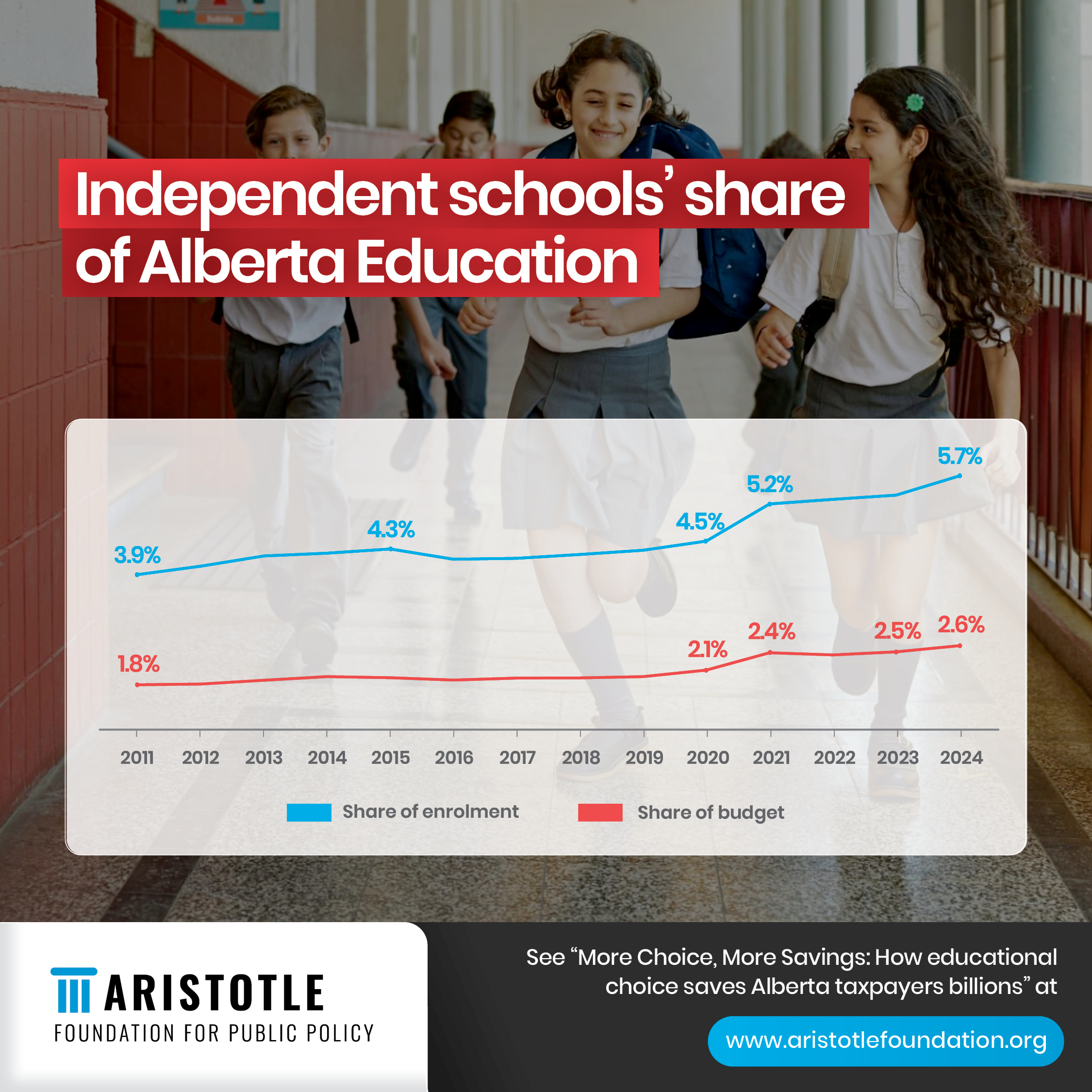
Figure 15 shows that Alberta independent schools are 0.09 percent of Alberta’s economy, less than half of 1 percent of the provincial budget, and less than 2 percent of the Ministry of Education’s budget. This is an infinitesimal cost, in light of the benefits. In other words, independent schools are an extraordinary “bang-for-buck” in Alberta. Moreover, the share of students enrolled in Alberta’s independent schools and home education is increasing at a faster rate than their share of the provincial budget (Figure 16). Given how many independent school students have exhausted all other options and have found educational success at these schools,49 it is nothing short of self-serving to call for the sector’s defunding.

Source: Hunt, Momoh, and Van Pelt (2021).50

Source: Authors’ calculations based on Government of Alberta (2026) and Alberta Education annual reports (various years).51
The advantages of funding independent schools and home education go far beyond the substantial cost savings. Students with diverse learning styles and unique interests can be better engaged through varied educational approaches. A top-down, one-size-fits-all education model does not support the goal of providing the best educational experiences and academic outcomes for every child. Therefore, the Alberta government is right to promote an education system that values a diversity of approaches, offering a wide range of school options to as many children as possible—not just those in specific school districts or those whose parents can afford to pay full tuition for independent schools.
In Alberta, independent schools and home education programs save taxpayers money. Fully funded schools (i.e., public, separate, francophone, etc.) cost taxpayers $11,225 per student, compared to $8,027 for independent and $1,802 for home-education students. In other words, each student in an independent school saves Alberta taxpayers 28 cents on the dollar, while each home education student saves 84 cents to the dollar. Combined, this amounts to annual taxpayer savings of $306.4 million, in the most recent year, and $1.35 billion over the last five years.
It is important to put this into context, by considering the opportunity cost of these savings. In the five Alberta cities with the largest school capacity—Calgary, Edmonton, Red Deer, Lethbridge, and Grande Prairie—their combined three-year capital plans amount to $1.149 billion. Thus, four-years’ worth of savings from independent and home enrolment pays for all the new schools needed in these cities. For perspective, the entire Ministry of Education’s capital plan for 2025–2028 is $3.29 billion—about 10 to 11 years’ worth of taxpayer savings.
Another way of looking at it is to consider what would happen if independent and home education programs were defunded and all those students migrated to public schools. That would require at least 54 additional public schools. Presently, the aforementioned five cities enrol 60 percent of the province’s students and have budgeted for 37 new schools (Calgary and Edmonton are already overcrowded). Thus, these cities would need to nearly triple capacity overnight, to 91 new schools—with a capital cost of at least $3 billion—to accommodate such an influx.
The Alberta government is right to promote an education system that values a diversity of approaches, offering a wide range of school options to as many children as possible. The advantages of funding independent schools and home education greatly exceed the significant cost savings.
Please see PDF for references.
David Hunt, MPP, BBA, is the research director at the Aristotle Foundation for Public Policy. His work has been presented at numerous conferences and to various levels of government, cited in major media, and used as evidence in court. Hunt holds a Master of Public Policy from Simon Fraser University and a Bachelor of Business Administration (with distinction) from Kwantlen Polytechnic University, where he was the Dean’s Medal recipient.
Ven Venkatachalam, PhD, CPA, is a senior economist at the Aristotle Foundation for Public Policy. With expertise in economic and fiscal policy, education, international relations, trade, energy, governance, immigration, tourism, and NGO matters, Venkatachalam has consulted for governments, NGOs, and private sector organizations across Asia, Europe, Canada, and the United States.
The authors would like to publicly acknowledge the research assistance of Pio Tran, Kristy Koehler, and Ava Peacock; we are grateful for your contributions.
About the Aristotle Foundation for Public Policy
Who we are
The Aristotle Foundation for Public Policy is a new education and public policy think tank that aims to renew a civil, common-sense approach to public discourse and public policy in Canada.
Our vision
A Canada where the sacrifices and successes of past generations are cherished and built upon; where citizens value each other for their character and merit; and where open inquiry and free expression are prized as the best path to a flourishing future for all.
Our mission
We champion reason, democracy, and civilization so that all can participate in a free, flourishing Canada.
Our theory of change: Canada’s idea culture is critical
Ideas—what people believe—come first in any change for ill or good. We will challenge ideas and policies where they are in error, and buttress ideas anchored in reality and excellence.
Donations
The Aristotle Foundation for Public Policy is a registered Canadian charity and all donations will receive a tax receipt. To maintain our independence, we do not seek nor will we accept government funding. Donations can be made at www.aristotlefoundation.org.
The Aristotle Foundation for Public Policy has internal policies to ensure research is empirical, scholarly, ethical, rigorous, honest, and contributes to the advancement of knowledge and the creation, application, and refinement of knowledge about public policy. Our staff, research fellows, and scholars develop their research in collaboration with the Aristotle Foundation’s staff and research director. Fact sheets, studies, and indices are all peer-reviewed. Subject to critical peer review, authors are responsible for their work and conclusions. The conclusions and views of scholars do not necessarily reflect those of the Board of Directors, donors, or staff.