
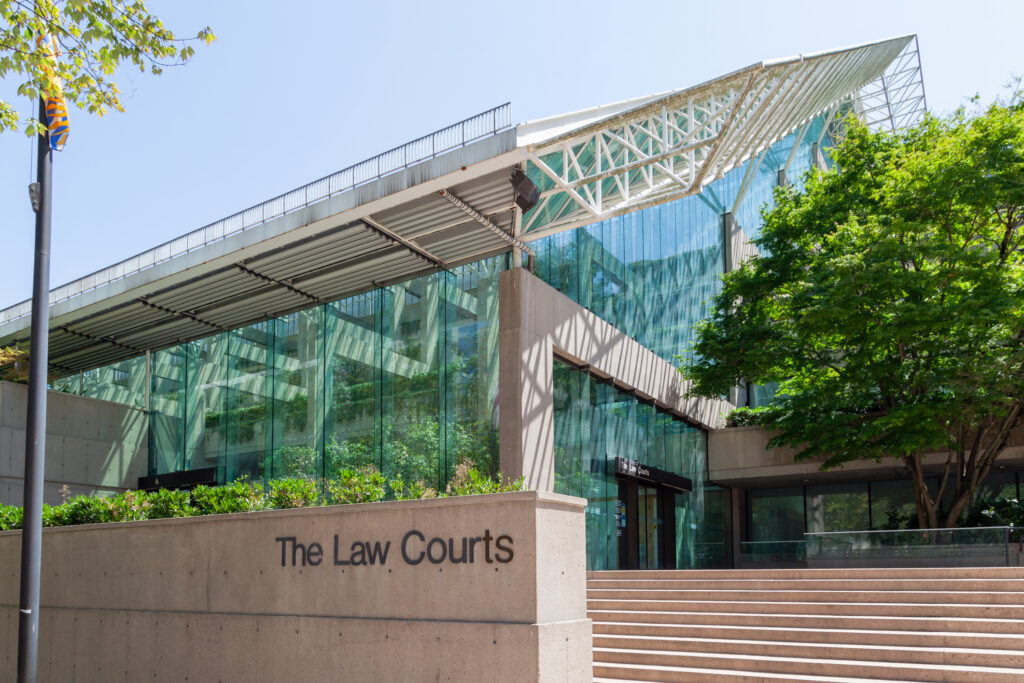
In August 2025, after one of the longest trials in Canadian history, the BC Supreme Court issued a landmark ruling:1 Justice Young declared that Cowichan Tribes hold Aboriginal title to the lands at their claimed historic village site in Richmond, British Columbia. The court ordered the return of certain government-held lands and declared some Crown grants of fee simple title “defective and invalid.” Both the provincial and federal governments have appealed the decision,2 with BC Attorney General Niki Sharma warning of “significant unintended consequences for fee simple private property rights.”
Public opinion polls show 60 percent of British Columbians believe the ruling will harm reconciliation rather than advance it.3 Property owners are worried. Politicians are debating. And broad concern about precedent is growing. In late January 2026, the Dzawada’enuxw First Nation, on the British Columbia coastline across from the northern tip of Vancouver Island, filed a claim for almost 650 hectares of private land around Kingcome Inlet, explicitly citing the Cowichan decision as changing “the legal landscape.”4 The case targets lands owned by the forestry company, Interfor Corp., and the Nature Trust of BC. Meanwhile, the British Columbia government continues to negotiate bilateral agreements with indigenous groups that grant similar powers, most recently transferring co-management of 166,000 hectares in the Nimpkish Valley to the ‘Na̱mg̱is First Nation—an area 11 times the size of Vancouver.
Yet missing from much of the discussion is a straightforward question: How much money have Canadian taxpayers already transferred to Cowichan Tribes? The answer turns out to be substantial. Since 2001, federal and provincial governments have provided Cowichan Tribes with nearly $1.3 billion in funding (adjusted for inflation to 2025 dollars). This occurred without any treaty obligation, as Cowichan Tribes have been engaged in treaty negotiations for over three decades without reaching a final agreement.5
In addition, the Cowichan Tribes have also received all the benefits of being part of Canada, including national security, police protection, a national currency, the rule of law, independent courts, health care, off-reserve educational opportunities including higher education, exemptions from tax on reserve,6 career opportunities nationwide if chosen, a $2.5 trillion economy by 2025,7 and more. While some may dismiss such benefits of a modern nation-state or even disparage the existence of Canada, the reality is that, throughout much of human history, most people have been forced to endure a life that the philosopher Thomas Hobbes described as “solitary, poor, nasty, brutish, and short.”8 That was life outside of an ordered, peaceful nation-state. It is still the case in some places around the world today, be it in nations ravaged by war, civil war, poverty, or other ills.
The benefits to the Cowichan Tribes, financial and otherwise—nearly $1.3 billion in just the most recent 24 years—should thus be considered in the context of a First Nation, without a treaty, that has asserted a reconciliation claim against other Canadians. Simply put, if the assertion is that a First Nation without a treaty is owed land or money, the public, political, and legal response should be: taxpayer funding and all other monetary and non-monetary benefits flowing to a First Nation should count in the “paid” column in reconciliation demands.
The case centred on approximately 1,846 acres at Tl’uqtinus, the traditional Cowichan village site on Lulu Island in what is now Richmond. After 513 days of hearings spread over 11 years,9 Madam Justice Young wrote an 863-page decision.10 The court found that Cowichan Tribes proved sufficient historical occupation to establish Aboriginal title over a portion of the claimed area, including some lands currently held by the federal government, the City of Richmond, and private landowners.
The historical and legal basis for Madam Justice Young’s decision should be analyzed separately. However, in this analysis, we will focus on a different but related matter: cash transfers to the Cowichan Tribes since 2001. It is relevant to land claims and, more broadly, to reconciliation because Cowichan Tribes have been part of the Hul’qumi’num Treaty Group, which has participated in the BC Treaty Process since 1993.11 After more than 30 years, treaty negotiations remain at Stage 5 (final negotiations), with no treaty signed. During this extended negotiation period, funding from Canadian taxpayers has continued to flow.
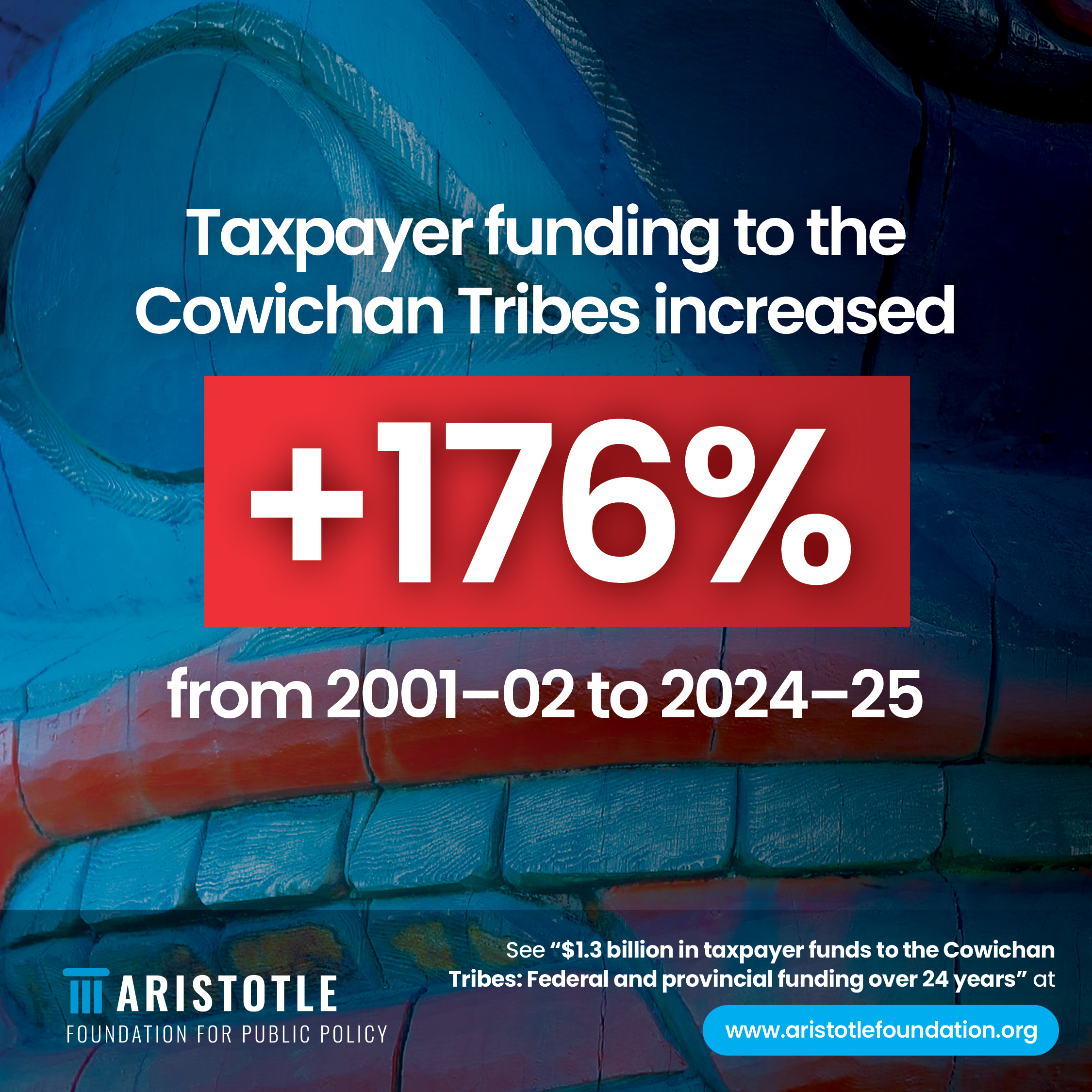
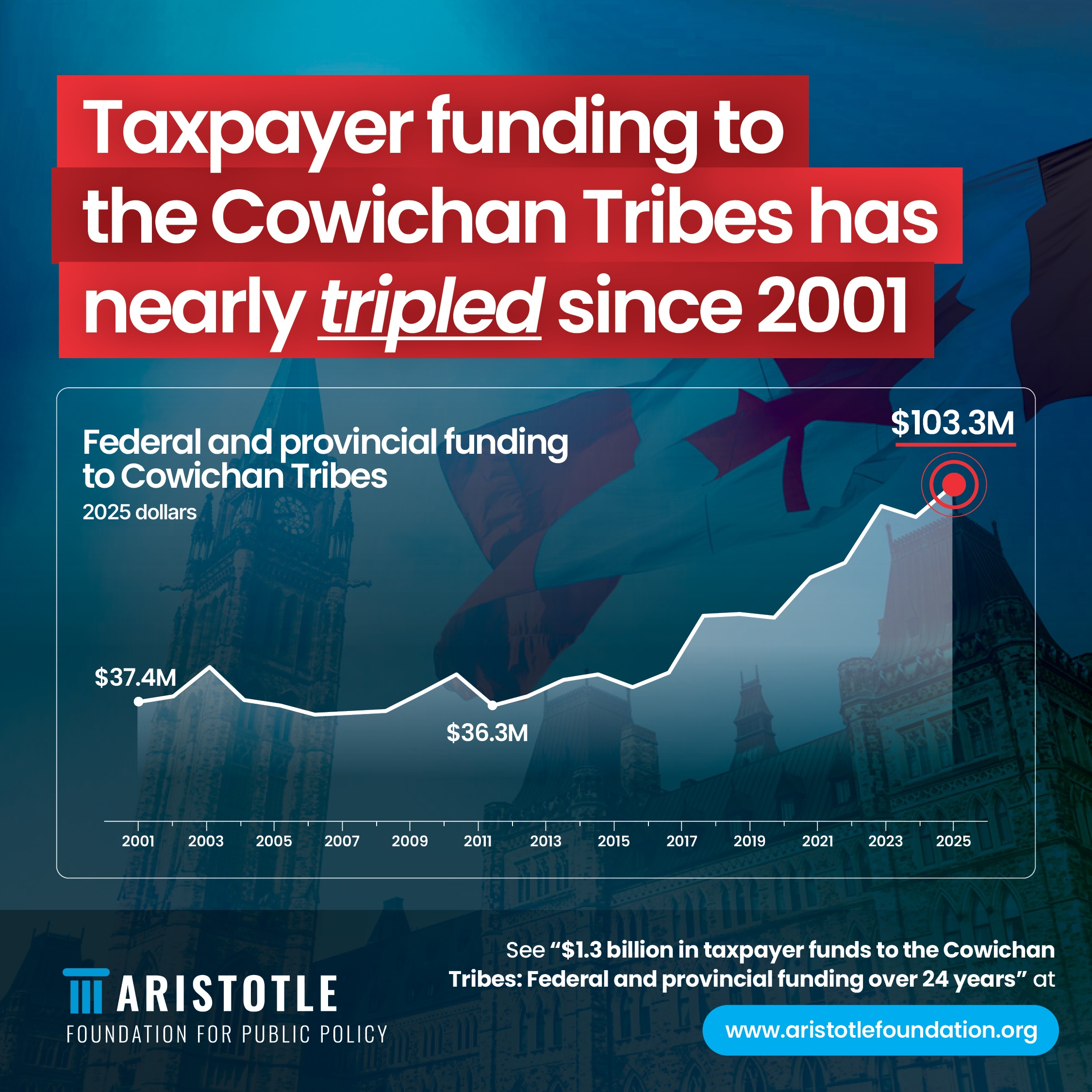
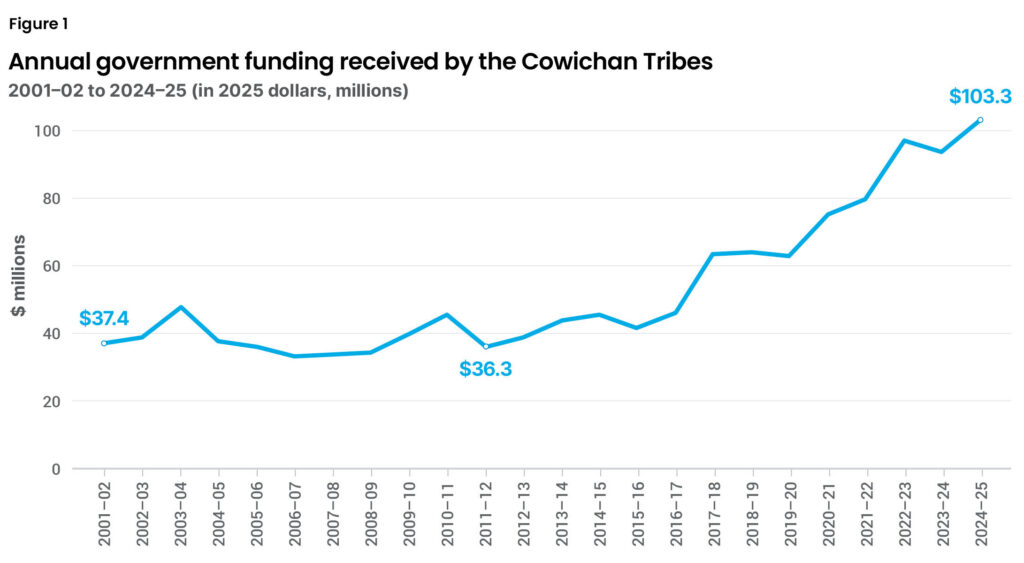
Between fiscal years 2001–02 and 2024–25, Cowichan Tribes received a total of nearly $1.3 billion from federal and provincial sources (Figure 1).12 All figures are inflation-adjusted to 2025 dollars to provide an apples-to-apples comparison over time.13 Annual funding started at just over $37 million in 2001–02 and reached over $103 million by 2024–25, representing an increase of 176 percent.
Source:
Authors’ calculations based on Cowichan Tribes’ annual reports (various years), inflation-adjusted to 2025 dollars.
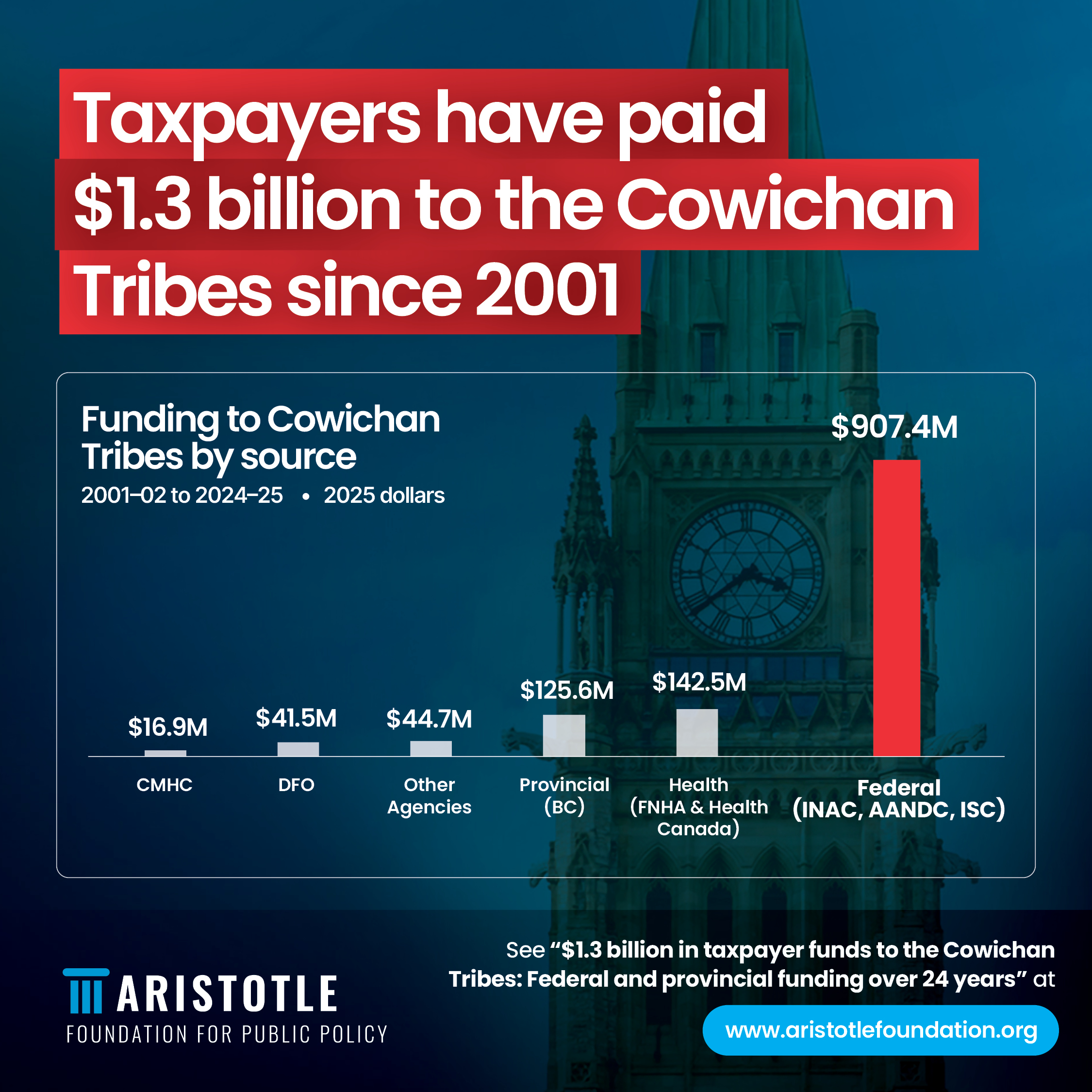
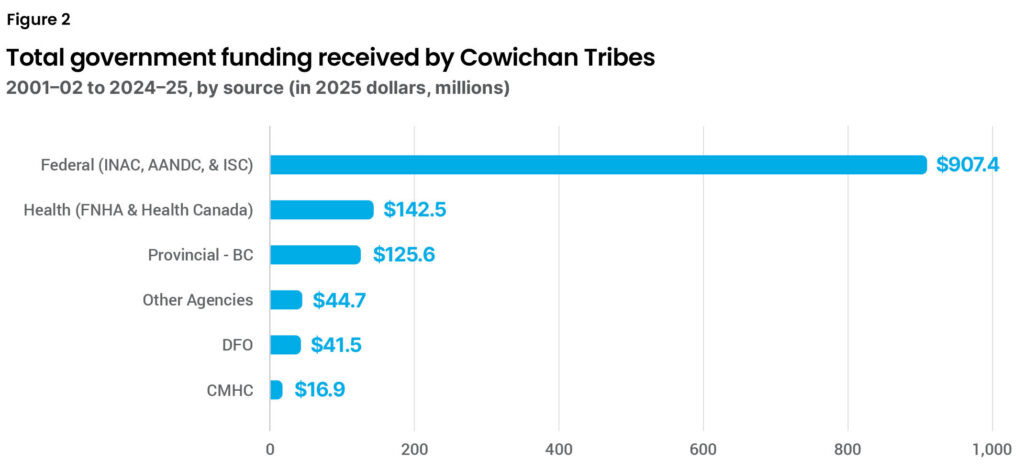
The largest share of funding came from federal indigenous affairs departments (Indigenous Services Canada and its predecessors), which provided $907 million over the period, representing 71 percent of the total. Health programs, delivered through the First Nations Health Authority and Health Canada, contributed $143 million (11 percent). The Province of BC provided $126 million (10 percent), while other sources, including the Department of Fisheries and Oceans, Canada Mortgage and Housing Corporation, and various federal agencies made up the remaining 8 percent (Figure 2).
Note:
- AANDC: Aboriginal Affairs and Northern Development Canada
- CMHC: Canada Mortgage and Housing Corporation
- DFO: Fisheries and Oceans Canada
- FNHA: First Nations Health Authority
- INAC: Indigenous and Northern Affairs Canada
- ISC: Indigenous Services Canada
Source:
Authors’ calculations based on Cowichan Tribes’ annual reports (various years), inflation-adjusted to 2025 dollars.
A notable acceleration occurred starting in 2017–18, when annual funding jumped from $46 million to $64 million. By 2020–21, during the COVID-19 pandemic, annual transfers had reached $75 million. The most recent fiscal year (2024–25) saw funding climb to $103 million, more than double the level from just eight years earlier.
The 2017–18 surge was driven almost entirely by federal indigenous affairs departments, which increased their transfers from $31 million in 2016–17 to $43 million in 2017–18. These spiked again during the COVID-19 pandemic and climbed further in 2024–25 to $79 million. The timing is notable: the acceleration in federal transfers began to rise dramatically after the change in government from Prime Minister Stephen Harper to Prime Minister Justin Trudeau, the latter of whom declared reconciliation as an important governing objective.14
There was a sharp rise in provincial (British Columbia) funding in 2022–23, more than tripling in one year from $8 million to $27 million before declining to $13 million in 2024–25. Health program funding remained relatively stable over this period, confirming that the recent escalation stems primarily from deliberate increases in federal indigenous affairs transfers, supplemented by a temporary provincial surge.
To be clear, these transfers are intended to support essential services including education, health care, infrastructure, housing, and social programs. That support and the need for the same, while important, is not the focus of this analysis. Instead, the question that should be asked is: should payments and benefits absent a treaty be counted towards any land claim, and, more generally, towards reconciliation demands in British Columbia?
Cowichan Tribes, with just over 5,600 registered members,15 represents the largest First Nation in British Columbia by population. The band encompasses seven traditional villages and holds reserve lands totaling 24 square kilometres. To put the nearly $1.3 billion in perspective, as of January 2026, Cowichan First Nation recorded 5,627 members in total, but just under half—2,651—lived on-reserve, with 335 members living on another (non-Cowichan) reserve and 2,641 members living off-reserve.
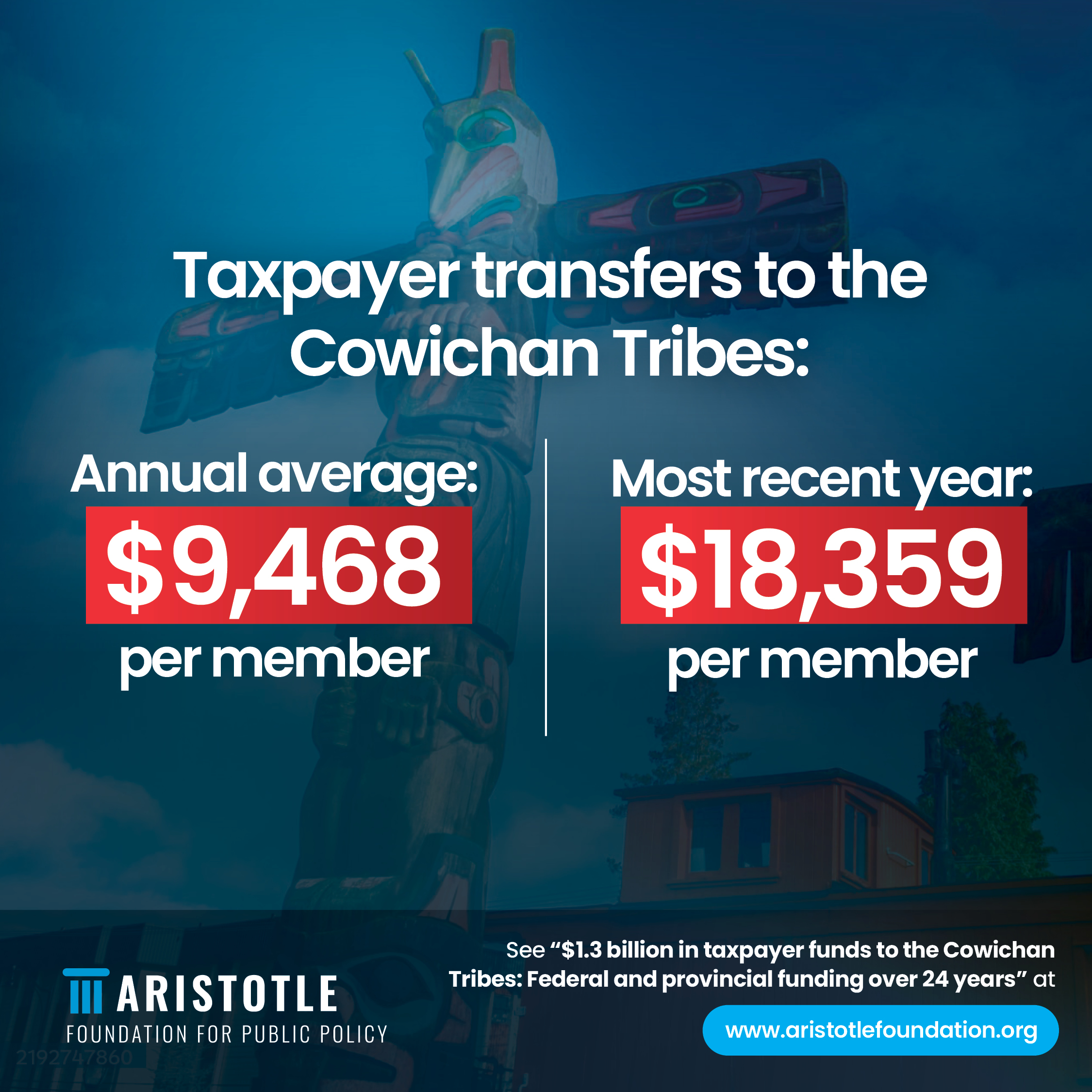
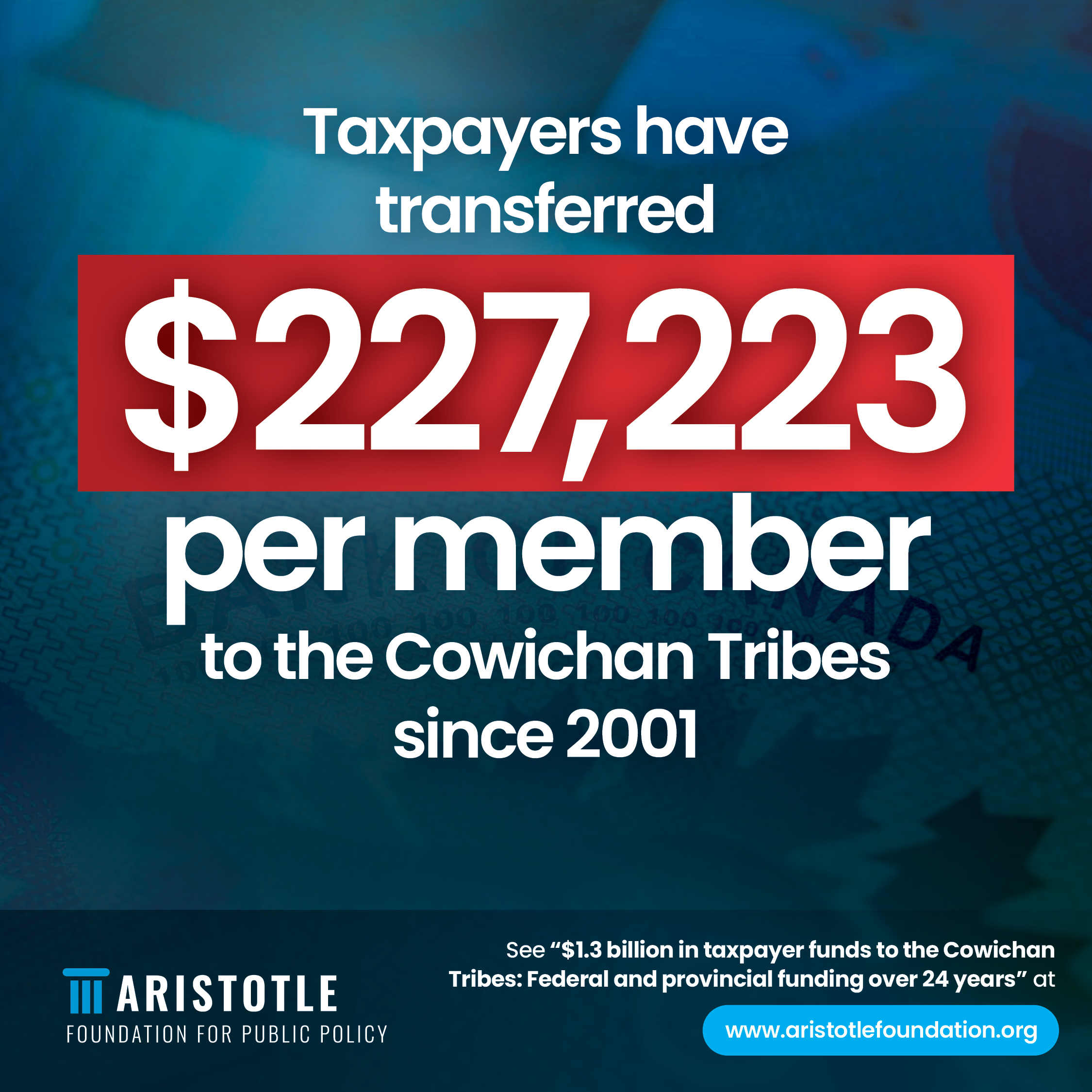
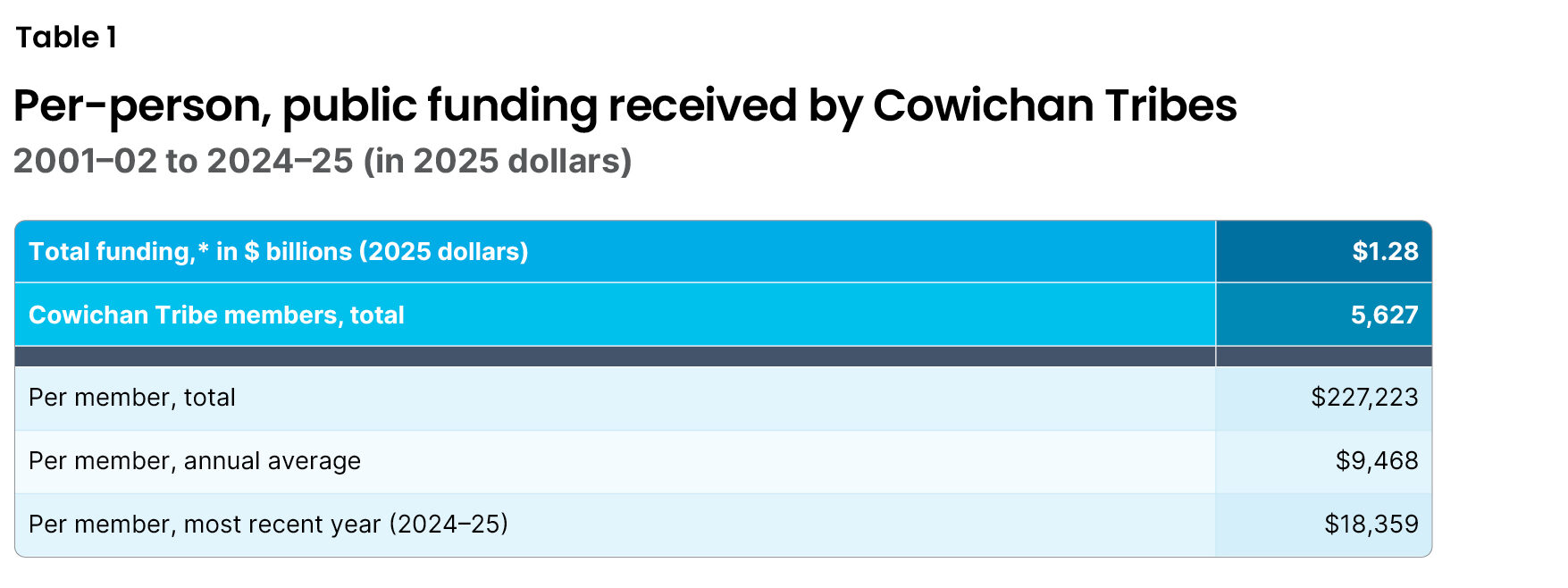
There are several possible ways to measure the per-person funding for the Cowichan Tribes. One way is to divide the funding by the 2,651 on-reserve members only. However, given that some services may flow to some members off-reserve, that approach may result in a higher per-person figure than is warranted. The other approach, chosen here, which is a more conservative estimate, is to measure all funding divided by all 5,627 members. This amounts to $227,223 per registered member over the 24-year period, or an average of $9,468 per member annually. In the most recent fiscal year (2024–25), per-member funding reached $18,359 (Table 1). We note that all such funding is in addition to per-person funding from governments that flow to all Canadians, indigenous and non-indigenous alike.a
*Note:
Excluding child and family services agreements.
Sources:
Authors’ calculations based on Cowichan Tribes’ annual reports (various years) and Crown-Indigenous Relations and Northern Affairs Canada (January 2026), inflation-adjusted to 2025 dollars.
[a] All indigenous Canadians, whether treaty or non-treaty, and whether a First Nations reserve or not, share in the spent funds by every level of government beyond their own First Nation, i.e., monies spent by the federal, provincial, and municipal governments. It is a mistaken comparison to compare per-capita on-reserve funding to per-capita funding for all Canadians: a reserve member will often share in much of both. It is an “and-and” comparison in most cases and not an “either/or.” A simple example: A First Nations member on-reserve will also share in the benefits of a highway off-reserve, a sports centre in town, national defence, hospitals off-reserve, and so forth. The exception to this general rule: where per-pupil funding on-reserve is an either/or funding stream.
Beyond the funding documented here, Cowichan Tribes also received $229.5 million in June 2024 through a four-year child and family services agreement with federal and provincial governments.16 That additional agreement adds roughly $40,785 per member over four years.
The question these numbers raise is not whether it is proper to transfer selected and useful support to indigenous communities; we would assert it is proper, with specific caveats around where support is helpful and useful versus where it is not.b Rather, it concerns whether $1.28 billion in transfers over 24 years, in the absence of any signed treaty, might reasonably be considered a substantial contribution toward reconciliation. From 2001 to 2025, Canadian taxpayers provided an average of $53.3 million annually to Cowichan Tribes without a legal treaty obligation to do so.
The Cowichan decision instructs both levels of government to negotiate in good faith with Cowichan Tribes to reconcile Aboriginal title with claimed property interests.17 That process will unfold over years as appeals work through the courts.
The implications extend beyond BC. Legal scholars warn that similar claims could emerge across Canada.18 In New Brunswick, the Wolastoqey First Nation has claimed the western half of the province, including large tracts owned by seven private companies. While a 2025 Court of Appeal decision there rejected Aboriginal title displacing private ownership, the ruling conflicts with the BC approach, setting up an inevitable Supreme Court of Canada showdown over whether private property remains secure anywhere an Aboriginal title claim succeeds.
One fact remains: Canadian taxpayers have already transferred nearly $1.3 billion to Cowichan Tribes since 2001. We have not even attempted to measure what the amount would be if traced back to the 19th or 20th centuries in total. This occurred without a treaty and during an extended negotiation process that has lasted more than three decades. As other indigenous groups file similar claims using Cowichan as precedent, and as the provincial government continues negotiating bilateral agreements that fundamentally alter property control, the financial baseline matters.19 We would assert these transfers should count toward reconciliation demands.
[b] An example: the issue of collective ownership of reserves and the lack of private property and resulting wealth creation—the lack of which is in part responsible for poorer outcomes—is an analytical matter for another paper.
Mark Milke, PhD, is the founder and president of the Aristotle Foundation for Public Policy. Mark is a public policy analyst and author with six books, over 70 studies, and more than 1,000 columns published in the last 25 years. His policy work has been published by numerous think tanks in Canada and internationally. He is editor of the Aristotle Foundation’s first book, The 1867 Project: Why Canada Should Be Cherished–Not Cancelled. Mark is also the past president of the Sir Winston Churchill Society of Calgary where he drove ahead the commissioning, fundraising, and installation of a statue of Churchill in Calgary on June 6, 2024—the 80th anniversary of D-Day.
Ven Venkatachalam, PhD, CPA, is a senior economist at the Aristotle Foundation for Public Policy. With expertise in economic and fiscal policy, international relations, trade, energy, governance, education, immigration, tourism, and NGO matters, Ven has consulted for governments, NGOs, and private sector organizations across Asia, Europe, Canada, and the United States.
Who we are
The Aristotle Foundation for Public Policy is a new education and public policy think tank that aims to renew a civil, common-sense approach to public discourse and public policy in Canada.
Our vision
A Canada where the sacrifices and successes of past generations are cherished and built upon; where citizens value each other for their character and merit; and where open inquiry and free expression are prized as the best path to a flourishing future for all.
Our mission
We champion reason, democracy, and civilization so that all can participate in a free, flourishing Canada.
Our theory of change: Canada’s idea culture is critical
Ideas—what people believe—come first in any change for ill or good. We will challenge ideas and policies where in error and buttress ideas anchored in reality and excellence.
Donations
The Aristotle Foundation for Public Policy is a registered Canadian charity, and all donations will receive a tax receipt. To maintain our independence, we do not seek nor will we accept government funding. Donations can be made at www.aristotlefoundation.org.
The Aristotle Foundation for Public Policy has internal policies to ensure research is empirical, scholarly, ethical, rigorous, honest, and contributes to the advancement of knowledge and the creation, application, and refinement of knowledge about public policy. Our staff, research fellows, and scholars develop their research in collaboration with the Aristotle Foundation’s staff and research director. Fact sheets, studies, and indices are all peer-reviewed. Subject to critical peer review, authors are responsible for their work and conclusions. The conclusions and views of scholars do not necessarily reflect those of the Board of Directors, donors, or staff.
Image credits: iStock