

There is declining confidence in our universities as institutions committed to the search for truth
Two University of Regina education professors have edited a new volume: Knowledge Under Siege: Charting a Future for Universities (University of Regina Press, 2026) in which fascism, settler colonialism and other right-wing influences are identified as threats to higher education.
The editors and their contributors fill more than 300 pages on an important subject — the future of our universities — and their essays proclaim that universities are besieged from the political right, including strong attacks on DEI, academic freedom and tenure, and that they must reaffirm their raison d’être as “autonomous and self-reflective institutions.”
The Canadian Association of University Teachers (CAUT), the national voice of faculty unions, quickly weighed in to support this narrative, calling it “an important milestone in the fight for higher education in a neoliberal age that seems hell-bent on eviscerating it.”
The narrative is incomplete and one-sided. External threats come from across the political spectrum including strong identity politics, which have taken a greater hold in Canada than in other liberal democracies. And while it might be comforting to identify the threats to universities as emanating from external sources, the clear and present danger is not from without, but within. Thus, the reflexive thumbs-up by CAUT; thus, the silence of many faculty, students and administrations when confronted by cancel culture; thus the denial of freedom of expression in our institutions; and widespread discrimination in jobs and admissions with the latest example being the exclusion of straight white males from five academic competitions at Memorial University.
These are not “the characteristics of autonomous and self-reflective institutions.” Rather, they help explain a widespread, declining confidence in our universities as institutions committed to the search for truth and the preparation of students for careers and citizenship. “Why the decline in confidence?” is the important question and the answer, or part of the answer, is the growing politicization of these institutions.
The call for greater autonomy and self-reflection may also overlook the external interests that must be accommodated. Governments, naturally, expect their universities to embody the best traditions of academic freedom and democratic liberalism. They, together with industries and businesses, expect university commitments to support commercialization and the economic development that is necessary to generate the resources required for public purposes, including post-secondary education. Families expect that members attending university will be accorded the priority they deserve. The general public expects them to be responsive public institutions, committed to teaching and research, and determined to serve the public good without partisan alignment.
To remain relevant universities must focus on the development of talent, be attentive to innovation leading to sustainable growth, be accountable to students and the public, and be partners in economic and technological transformation.
So yes, the operational autonomy of universities is important, as is the reflection necessary to support teaching and research excellence, but with due attention to the expectations of the many public and private sector interests on which they depend.
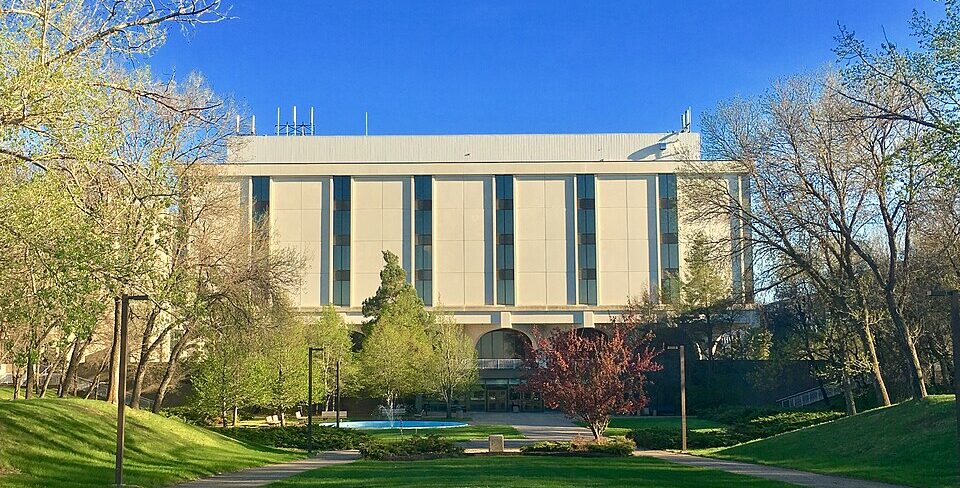
Peter MacKinnon is a Senior Fellow with the Aristotle Foundation for Public Policy, an Officer of the Order of Canada, a King’s Counsel, and a former president of three universities. Photo: John Archer Library, University of Regina. WikiCommons.
Like our work? Think more Canadians should see the facts? Please consider making a donation to the Aristotle Foundation.
SUBSCRIBE TO OUR NEWSLETTER