
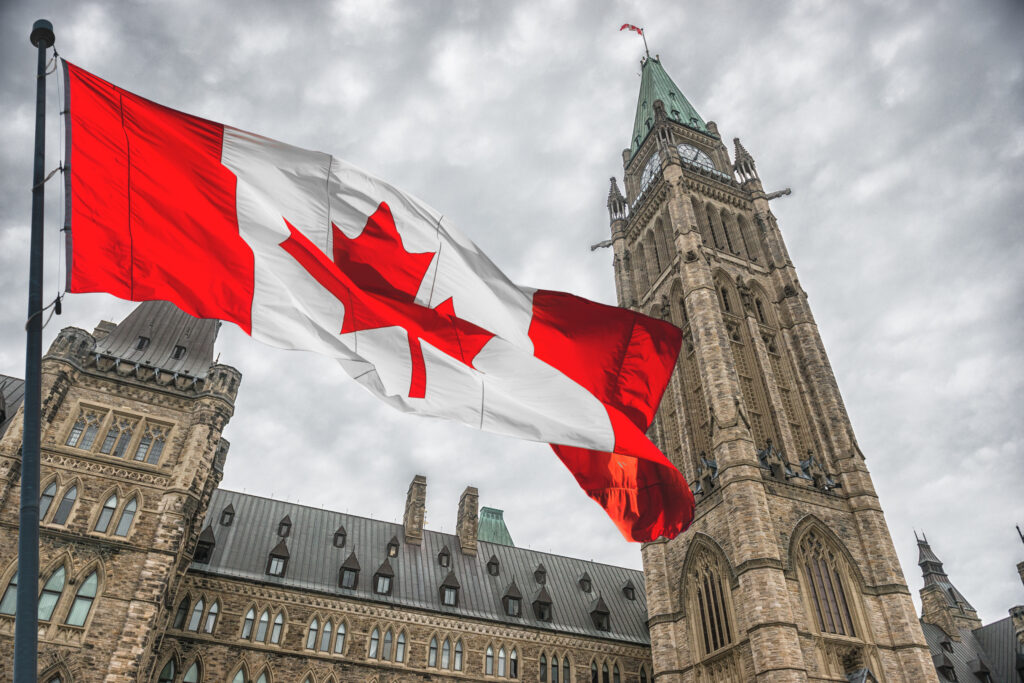
These days, Canada’s Notwithstanding Clause is the legal-political equivalent of a hot potato. Depending on whom you ask, it’s either a “nuclear option” that could lead to the “future downfall of our nation” or a constitutional counter against “judicial autocracy” that will save our parliamentary democracy.
Intended as a protection against judicial overreach by the courts, its future is now, ironically, being decided by the Supreme Court of Canada—which will shape how federal and provincial governments use the Notwithstanding Clause for years to come.
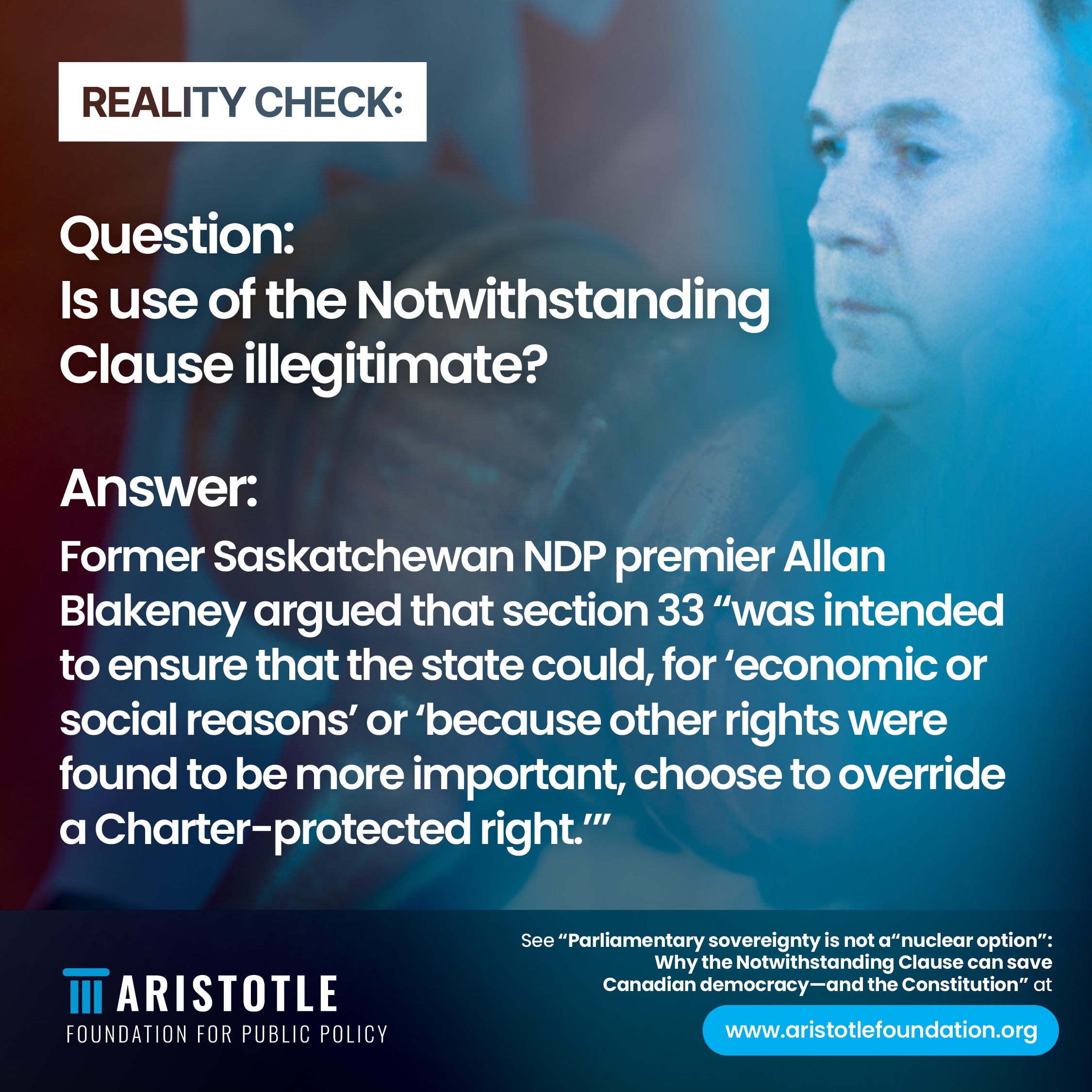
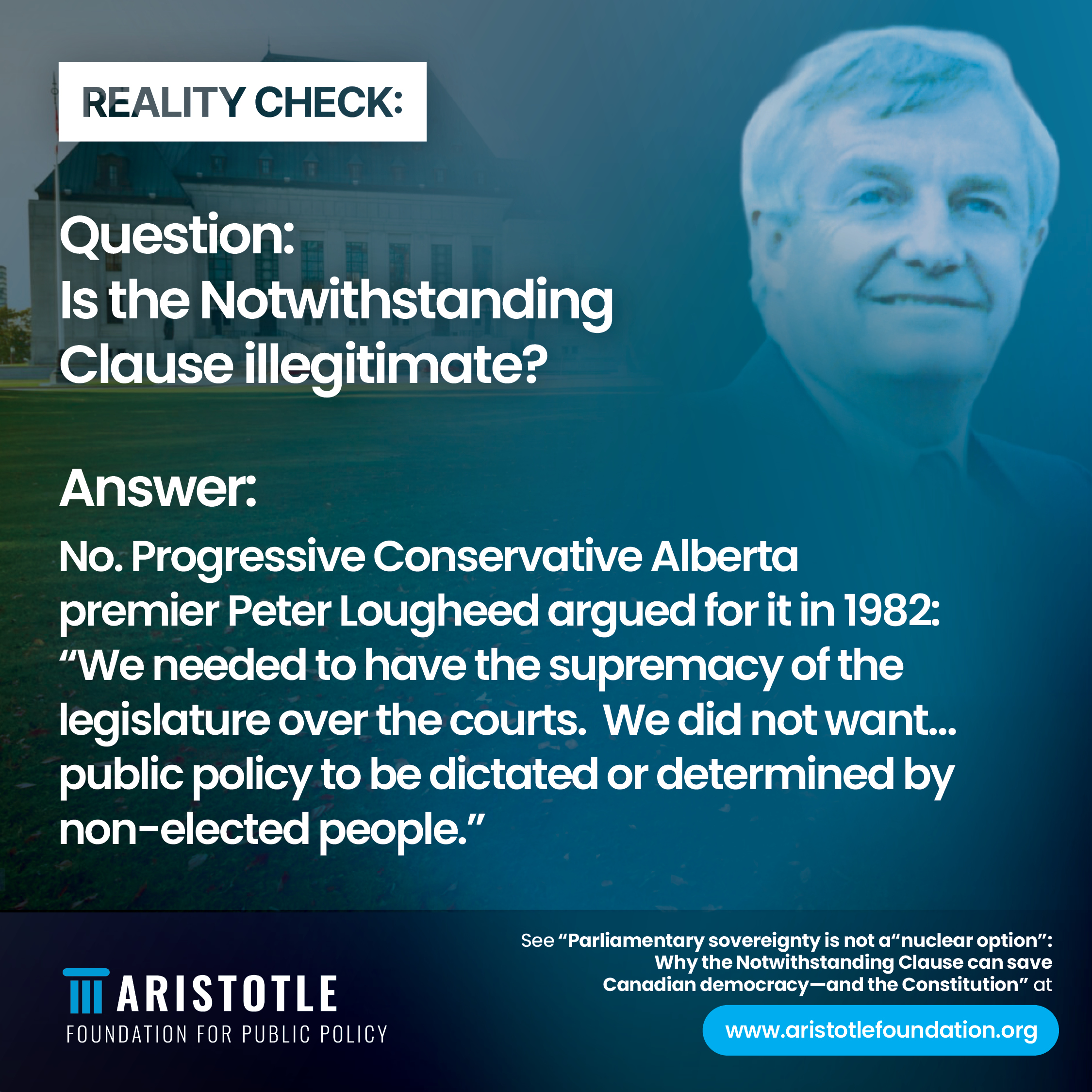
However, for all the legal and ideological jockeying over the Clause, its detractors ignore what two of the Charter’s founding fathers—former Saskatchewan NDP premier Allan Blakeney and former Alberta PC premier Peter Lougheed—actually said about it.
But first, some background.
In March, the famous Clause, part of the Charter of Rights and Freedoms, came under unprecedented, four-day scrutiny by Canada’s top court as part of Hak v Attorney General of Quebec.1 At issue: the province’s secularism (laïcité) in the form of Bill 21, which prohibits all public sector workers, including teachers, from wearing religious symbols (hijab, chunni, cross, kippah, etc.). Bill 9 followed, which prohibits Quebec daycare employees from wearing religious symbols and non-municipally-approved group public prayer and prayer rooms—even halal and kosher meals—being offered in “public spaces” (including universities, CEGEPs, and schools).
Before the courts could get involved, Quebec preemptively used the Notwithstanding Clause to shield Bill 21 from any court challenges which could be brought on the basis of freedom of religion or equality rights. The province’s argument is that once a government invokes the Clause, it is the end of the legal road—and courts cannot weigh in further on whether a piece of provincial legislation violates the Charter.
Under the Notwithstanding Clause (section 33), a federal or provincial legislature can, for five years, override Charter sections 2 and 7–15 (which range from freedom of assembly to “life, liberty and security of the person”). In 1988 in Ford v Quebec, the Supreme Court affirmed that governments have largely unfettered discretion to invoke the Clause, including preemptively.2
Ever since, there have been strong differences of legal opinion over the role of courts when confronted with section 33. In Hak, the Quebec Court of Appeal ruled that the province had properly employed the Notwithstanding Clause. In a diametrically opposite decision in Saskatchewan (Minister of Education) v UR Pride for Sexuality and Gender Diversity in 2025, the Saskatchewan Court of Appeal held that courts should not lose the authority to consider the constitutional effect of a law, even if it cannot be struck down.3
However, in his eloquent dissent, Court of Appeal Justice Neal Caldwell wrote that “where a legislature has prospectively invoked section 33, that invocation is the first, last and only word constitutionally allowed on the matter in the dialogue between the two branches of government. It signals the end of debate, leaving the political or policy merits of the [legislation] to be determined by the electorate.”4
The federal government does not agree. In its recent submission to the Supreme Court in Hak, it proposed that courts be able to issue declarations even after the Notwithstanding Clause has been invoked. More controversially, it is also proposing the judicial review of “repeated use” of the Clause, arguing that preventing Canadians from exercising Charter rights is equivalent to denying them.
Many support the federal position. “The Notwithstanding Clause is a populist’s dream: target vulnerable minorities while neutering the courts,” columnist Sheema Khan recently wrote.5 Manitoba premier Wab Kinew, meanwhile, has tabled legislation that will require full judicial scrutiny of any future government use of the Clause “because we respect human rights articulated in the Charter.”6
At the same time, however, many legal scholars believe that the federal government’s attempt to “play chicken” with the provinces amounts to “constitutional arson” that could lead to a full-on “constitutional crisis.”7 Limiting the use of the Notwithstanding Clause would be a “backdoor amendment of the Constitution, which would give judges even more power and elected representatives even less scope to undo their harmful decisions,” constitutional lawyer Andrew Roman has written. “More than an attack on provincial autonomy, it would upset the balance at the heart of Canada’s federal democracy.” Asking the court to prohibit the Clause’s “repeated use” is an “invitation to judicial activism on an unprecedented scale.”8
Federal Justice Minister Sean Fraser has warned that “our future downfall as a nation, should it ever come, is not going to be at the hands of some despot on the other side of the world, but a future government empowered by an erosion of our rights today.”9
“Rights” appear to be in the eye of the beholder. By “future government,” Fraser clearly means a future government made up of those currently on the Opposition benches. However, he and his advocates might ask themselves how they would feel if another government, with other ideological leanings, tried—as they are trying—to limit Notwithstanding’s scope.
In other words, what appears to most upset the federal government and many pundits is that small-c conservative—particularly, western Canadian—governments are invoking the Clause.
Columnist Andrew Coyne recently wrote “It is the provincial governments who, by the increasing frequency of their recourse to the clause, have turned what its drafters intended to be an emergency safety valve into a ‘dagger pointed at the heart of the Charter.’” The Clause was intended only, he reported, in “non-controversial circumstances,” the “unlikely event of a decision contrary to the public interest,” and to correct “absurd situations.”10
Not so. As Alberta’s Progressive Conservative premier Peter Lougheed remarked in 1982: “We needed to have the supremacy of the legislature over the courts. We did not want…public policy to be dictated or determined by non-elected people.”11
Saskatchewan’s New Democratic Party premier and constitutional lawyer Allan Blakeney was also very clear about the Notwithstanding Clause’s purpose. It was intended to ensure that the state could, for “economic or social reasons” or “because other rights were found to be more important, choose to override a Charter-protected right.”12
There would be instances, Blakeney said, when “rights collide,” but he contended that Charter rights are “not more important than other rights.”13
Let’s not forget that Great Britain and Australia, for example, have managed perfectly well with constitutional, not judicial, supremacy. In 2023, before the October 7 attacks, Israeli President Netanyahu was proposing something very similar to Canada’s Notwithstanding Clause to halt courts from striking down democratically passed laws that they considered “unreasonable.”14
It is a sign of desperation that Canadian provincial governments have had to resort to invoking the Notwithstanding Clause simply to make policy and pass legislation on everything from religious symbols and back-to-work legislation, to school choice and medical transitioning—this, as provinces also contend with the increasing politicization of the Charter and the courts.
“We have known for years that the Charter of Rights would bring political questions into the courts,” said the late, great BC Court of Appeal Justice Mary Southin.15
Of course politicization is happening.
As far back as 2003, David Warren wrote in the National Post, “It is thanks to the unamendable 1982 Constitution that the Courts now rule Canada. It took them more than a decade to discover how much power [Pierre] Trudeau’s Charter had given them, and taken away from Parliament. Canada is going to hell in a handcart. And it’s not just any handcart. It’s the Charter of Rights, pulled by the ghost of Pierre Trudeau.”16
In recent months alone, judges have used the Charter’s section 7 (“life, liberty and security of the person”) to empower child activists to take on the climate policies of the entire province of Ontario.17 Section 7 has also been used to prevent homeless encampments from being dismantled until every “unhoused” member has been found somewhere to live,18 the removal of bike lanes,19 and the closure of drug consumption sites near pre-schools.20
“A judge has no freedom of speech to address political issues which have nothing to do with judicial duties,” said the late Supreme Court Justice Bora Laskin. “Absolute abstention [from political discourse] guarantees independence.”21 More recently, retired Supreme Court justice John Major called increasing court overreach “regrettable.” Instead of focusing on technical interpretations of the law, he said, “judges now interfere in matters of public policy, which creates unnecessary conflict between the courts and Parliament.”22
Current Chief Justice of the Supreme Court, Richard Wagner, publicly opined in 2022 that the Freedom Convoy amounted to “anarchy,” “hostage-taking,” and “forced blows against the state, justice, and democratic institutions,” which should be “denounced with force.” He has now refused to recuse himself from presiding over the Emergencies Act appeal.23
What would Bora Laskin say?
For all the prevailing discontent about the use of the Notwithstanding Clause by a few provinces, we must not forget that Quebec has invoked it 16 times. Right out of the constitutional gate, between 1982 and 1985, Quebec notwithstood every single piece of federal legislation. Oddly, it is only when Western provinces have recently imitated Quebec that the federal government has sought to undermine section 33 of the Constitution.
Double standards have multiplied. Former Saskatchewan NDP premier (and justice minister) Roy Romanow chastised Ontario premier Doug Ford for invoking the Clause in 2018. Romanow reverted to the argument that it could be used only “as a last resort,” in “exceptional circumstances.” As for Ford’s caucus, he added, “history will judge them by their silence.”24 However, Romanow was initially a Charter-skeptic who considered the courts part of a “majoritarian tyranny.” As a reviewer of Romanow’s book Canada…Notwithstanding put it, “The populist-socialist view was the courts were elitist citadels of privilege which were not to be trusted.”25
When it comes to the importance of the Notwithstanding Clause, the basics are irrefutable. “Canada is not a kritarchy,” wrote Justice Caldwell (in Saskatchewan’s Minister of Education v UR Pride for Sexuality and Gender Diversity). “The judicial voice must not toll louder than the ballot.”26
Our only hope is that, because it is Quebec arguing for the Notwithstanding Clause at the Supreme Court—and not Alberta or Saskatchewan—justices will exercise truly sober second thought. And if Quebec wins, it will protect the future of the Notwithstanding Clause and nothing short of parliamentary sovereignty in Canada.
Bronwyn Eyre is a senior fellow with the Aristotle Foundation for Public Policy and Saskatchewan’s former Minister of Justice and Attorney General. She is a Canadian journalist and politician who served as the MLA for Saskatoon Stonebridge from 2016 to 2024. She held several cabinet roles, including Minister of Education and Minister of Energy & Resources. Before entering politics, she worked in media and holds a law degree. Her work in government focused on education policy, post-secondary institutions, federal-provincial division of powers, and energy development. In March 2026, she was awarded the inaugural Cartier-MacDonald award by the Canadian Constitution Foundation for “Canadians who have shown exceptional leadership in advancing the principles of freedom.”
Who we are
The Aristotle Foundation for Public Policy is a new education and public policy think tank that aims to renew a civil, common-sense approach to public discourse and public policy in Canada.
Our vision
A Canada where the sacrifices and successes of past generations are cherished and built upon; where citizens value each other for their character and merit; and where open inquiry and free expression are prized as the best path to a flourishing future for all.
Our mission
We champion reason, democracy, and civilization so that all can participate in a free, flourishing Canada.
Our theory of change: Canada’s idea culture is critical
Ideas—what people believe—come first in any change for ill or good. We will challenge ideas and policies where in error and buttress ideas anchored in reality and excellence.
Donations
The Aristotle Foundation for Public Policy is a registered Canadian charity, and all donations will receive a tax receipt. To maintain our independence, we do not seek nor will we accept government funding. Donations can be made at www.aristotlefoundation.org.
The Aristotle Foundation for Public Policy has internal policies to ensure research is empirical, scholarly, ethical, rigorous, honest, and contributes to the advancement of knowledge and the creation, application, and refinement of knowledge about public policy. Our staff, research fellows, and scholars develop their research in collaboration with the Aristotle Foundation’s staff and research director. Fact sheets, studies, and indices are all peer-reviewed. Subject to critical peer review, authors are responsible for their work and conclusions. The conclusions and views of scholars do not necessarily reflect those of the Board of Directors, donors, or staff.
Image credits: iStock

SUBSCRIBE TO OUR NEWSLETTER