
The popular view of the Nakba presented by the Canadian Museum for Human Rights falls short of the facts regarding events in Palestine following the UN partition vote of 1947. This study reviews those events, producing a balanced view of the causes and results of the Nakba and the subsequent status of Palestinian Arab refugees. Additionally, it reviews the situation of Jewish people in Palestine, the Middle East, and North Africa, reminding the reader that there are more facets to the story of displacement and human suffering than are presented by certain activists.
Key findings:
Based on a review of the documented evidence it is impossible to characterize the displacement of Arabs from Palestine as anything other than the consequences of warfare that accompany all major modern conflicts. The attempt to paint Israeli actions and the existence of the Jewish state as a deliberate violation of human rights is inconsistent with the facts.
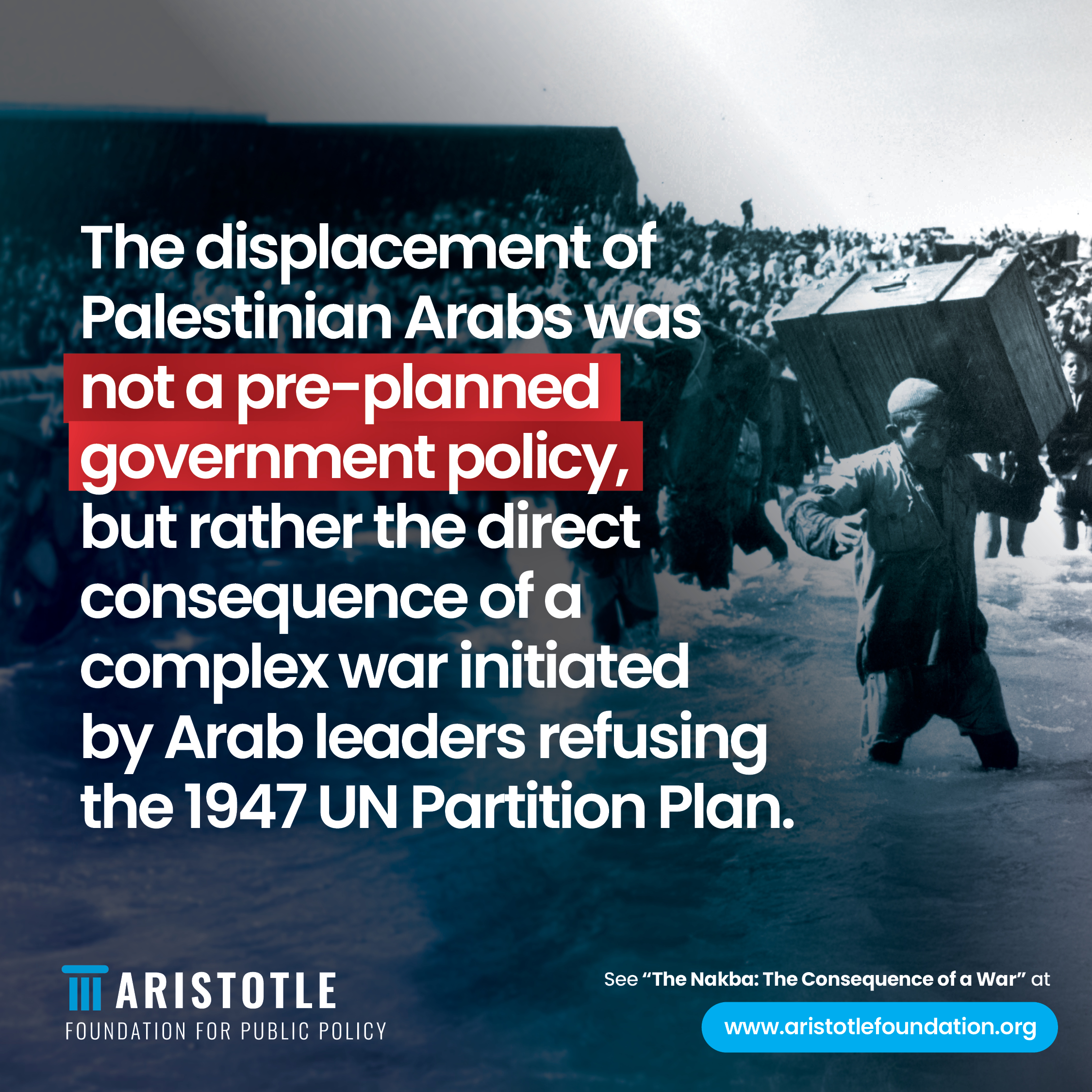
Rather than a deliberate policy of the Israeli government, Palestinian Arabs had their own refusal to accept the partition settlement and their subsequent military defeat to blame for their perceived need to leave their homes. Those who remained in Israel were able to live as full citizens and thrive alongside the Jewish population.
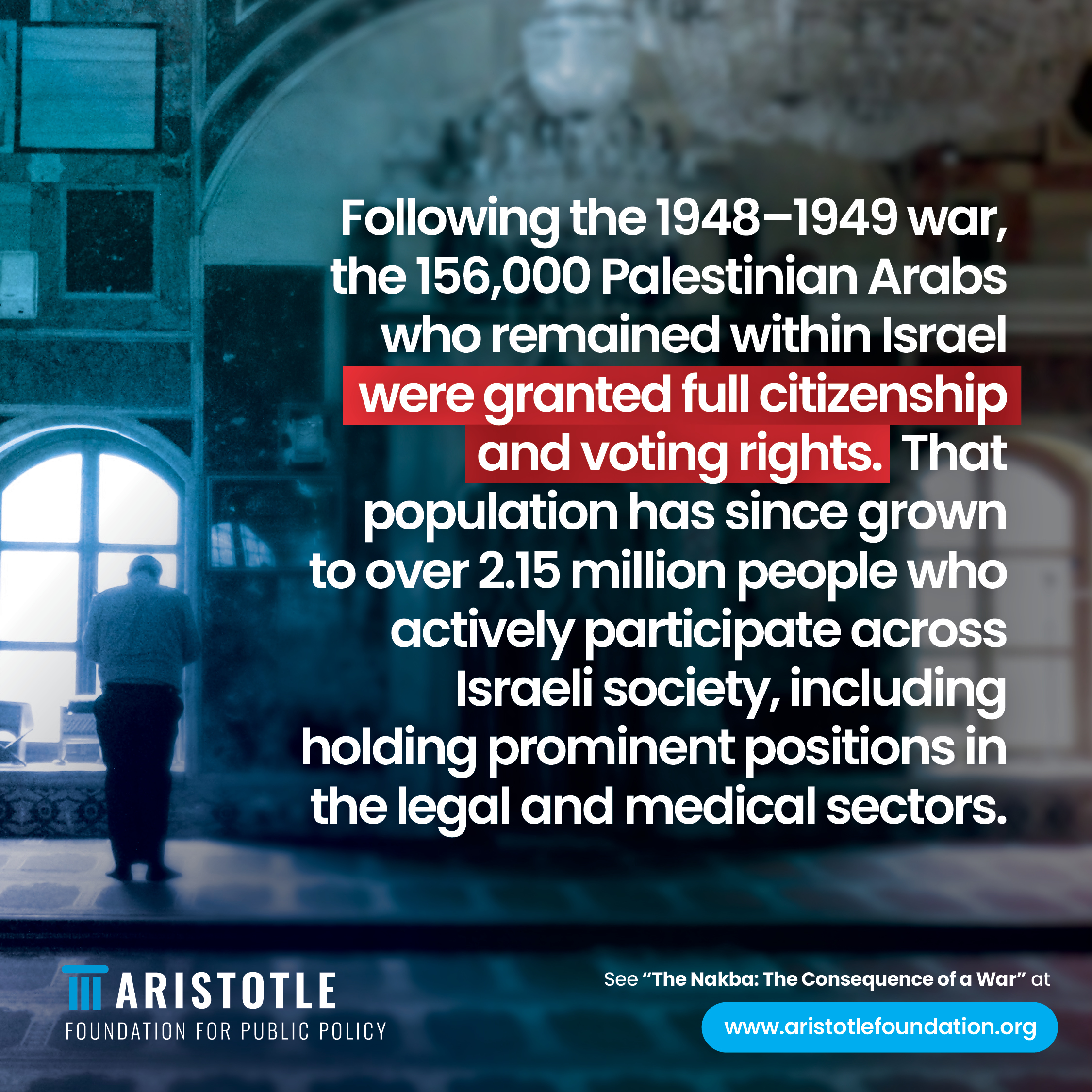
The ultimate evidence of the incorrectness of the Canadian Museum for Human Rights’ characterization of the events is the utter destruction of Jewish communities in North Africa and the Middle East, and the continued thriving and participation of Arabs in Israeli life. In 1949 there were 156,000 Arabs living in Israel. Today, 21.1 percent of Israel’s population is Arab, totalling 2.15 million people.
Rather than focusing solely on criticism of Israel for its supposedly shameful treatment of Arabs, it is important to recognize that Jews by and large showed restraint and generosity to Arabs in their midst, something that Jews could not hope for in the surrounding countries. Wars always cause refugees, and the human costs of war must be laid at the feet of the aggressors, in this case the Palestinian Arabs themselves.
In late June 2026, the Canadian Museum for Human Rights in Winnipeg, a museum of the Canadian Heritage Portfolio, opened an exhibit designed to illustrate the Nakba as an example of the denial of human rights to Palestine Arab refugees during the period of 1947-1949, which encompasses the civil war in Mandatory Palestine and the Arab-Israeli war, sometimes referred to as the Israeli War of Independence. In short, the Nakba is interpreted by Palestine Arabs and their supporters as the “catastrophe” that occurred during the war, when Israeli victories resulted in the mass flight of some 700,000 Arabs from the boundaries of Mandatory Palestine or the areas occupied by the Israeli armed forces in the civil war from late November 1947 to the Arab invasion of Israel in May 1948, to the armistices of Israel and the invading Arab countries in early 1949. The Canadian Museum for Human Rights purports to tell that story.
The reality of the Nakba was that some of those 700,000 Arabs fled of their own accord in fear of the war itself and some were expelled by Israeli forces. The Nakba is also taken to mean the destruction of Palestine Arab society, the establishment of a Jewish state in virtually all of Mandatory Palestine, and the seizure by Israel of the property, homes, villages, etc., of the fleeing Palestine Arabs. The Nakba is presented by Palestine Arabs and their supporters as a planned, coordinated strategy of the Jewish Agency and the State of Israel to destroy Palestine Arab society. In numerous public utterances the Museum administration claimed that an exhibit showing the Nakba was but a demonstration of the cruelties experienced by Palestine Arabs at the time of the birth of the State of Israel.
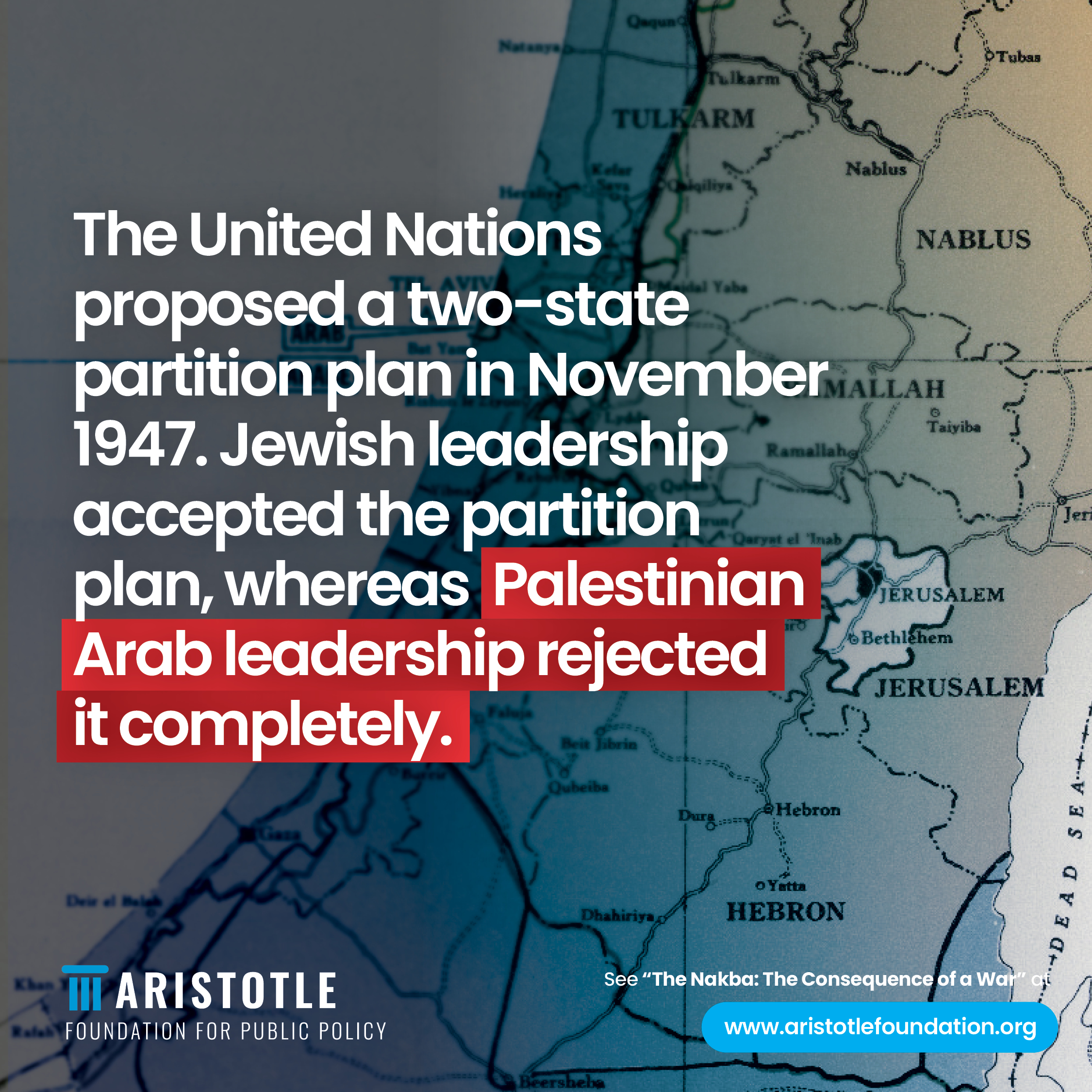
In the preparation of the exhibit, no account was taken of the academic work of historians such as the Israeli scholars Benny Morris and Tom Segev regarding the nuances of the event. In their works there was no denial of the facts of the Nakba, but much historical evidence was presented of the ad hoc nature of the phenomenon and the brutal but undeniable fact that the Nakba was at its heart the result of a war started by the Palestine Arabs in November 1947 to throttle the Jewish State. The creation of that country had been accepted by the United Nations in the November 29, 1947 General Assembly vote on the establishment of two distinct states, one Arab and one Jewish. The Nakba was real, but the explanations offered by Palestine Arab proponents then and now was simplistic, propagandistic, and designed to hide the basic truth that a war begun by the Arabs to destroy Israel at its birth went horribly wrong for them and, as with wars throughout history, one result was that a majority of the hostile Arab population of Palestine fled or were expelled by the victorious Israeli forces.
The preparation of the exhibit was done without consultation with any Israeli historians despite two prominent historians, Benny Morris and Tom Segev, writing significant academic studies on the roots of the mass departure of the Palestine Arabs. The exhibit credulously accepted the decades old story of Palestine Arabs that the flight of those Arabs and destruction of their society was the result of a coordinated and planned action carried out by the new State of Israel. The exhibit’s one-sided nature was demonstrated by the resignation of Ottawa lawyer and professor Mark Berlin from the museum’s board and the assessment of Marc Miller, the Minister responsible for the Museum, who visited the exhibit just before it opened and criticized it as being one sided.1 The purpose of this study is to point out that throughout history, stretching at least as far back as the Peloponnesian War between Sparta and Athens, wars have created refugees, and that the ultimate cause of the population movements that arise out of wars must be laid on the backs of those who start those wars in the first place.
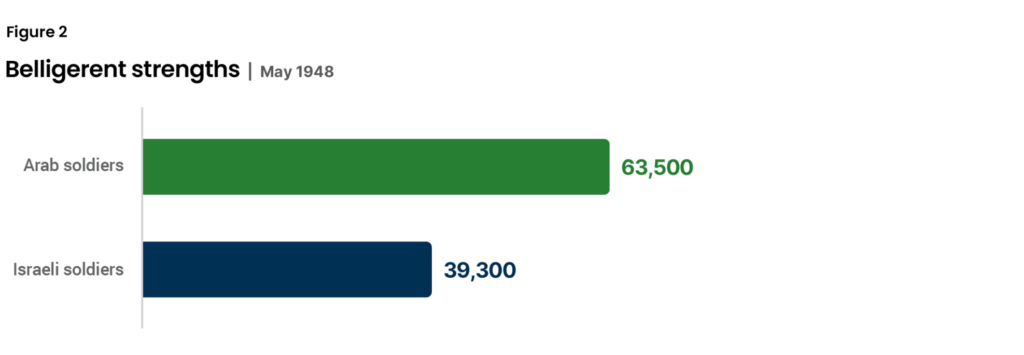
The United Nations vote on the partition of Palestine into a Jewish and an Arab state took place in New York on November 29, 1947. Following that vote, a civil war broke out in Palestine between the Jewish and Arab communities. The Jewish fighting organizations were the Haganah, the largest and best equipped force that answered to the Jewish Agency in Palestine; the Irgun Zvai Leumi, a paramilitary guerilla organization affiliated with the Zionist Revisionists founded by Zeev Jabotinsky; and the “Stern Gang,” a Zionist terrorist fighting group led by Avraham Stern. The Arab armed force was primarily represented by the Arab Liberation Army, led by Fawzi al-Qawuqji, and was aided by irregular armed groups based in almost every Arab village in Palestine (Figures 1 and 2). That war was waged until May 14, 1948, when David Ben Gurion, Chairman of the Jewish Agency in Palestine, declared the independence of the State of Israel within the Jewish areas approved by the UN General Assembly on November 29, 1947. The following day, Israel was invaded by the regular armies of Egypt, Jordan, Syria, Lebanon, and Iraq, with Saudi Arabia and Yemen also providing forces. This second phase of armed conflict continued until early 1949 when armistice agreements were signed between Israel and the invading Arab countries.
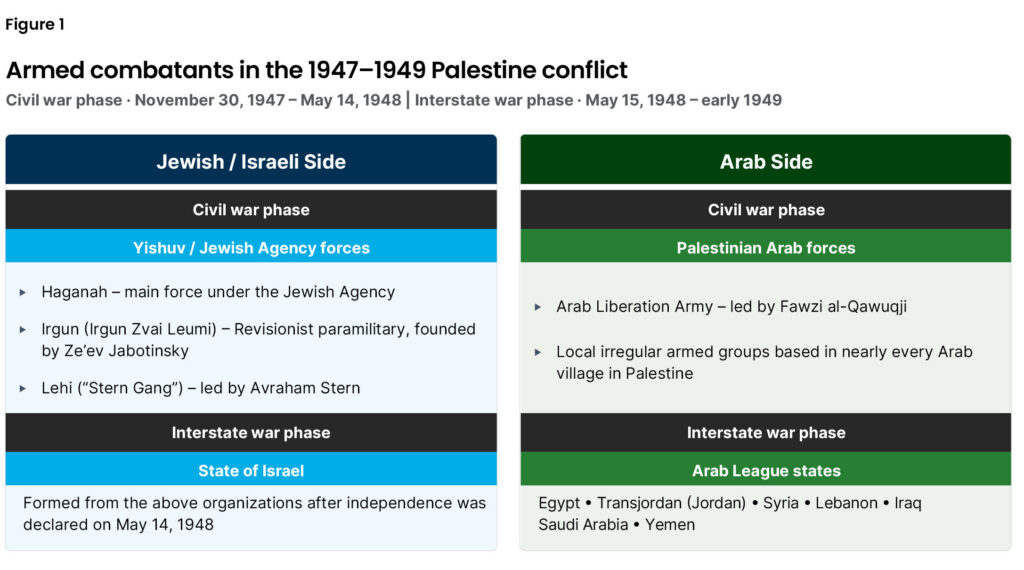
Source: Publisher’s internal rendering based on authors’ original research.
Source: Publisher’s internal rendering based on Benny Morris, The Birth of the Palestine Refugee Problem, 1947-1949 (Cambridge: Cambridge University Press, 1989).
In the course of the 13 months of armed conflict, some 700,000 Arabs living in Palestine fled or were expelled by Jewish/Israeli forces to surrounding Arab countries, where most were lodged in “temporary” refugee camps. These camps were overseen by the United Nations Relief and Rehabilitation Administration (UNRRA), the function of which still exists under different organizations that have a responsibility to care for the Arab refugees with a number of assigned missions, from living quarters to medical care.
Today the transfer of much of the Arab population of Palestine during the armed conflict is referred to by many as the “Nakba” or “catastrophe.” But, in fact, the original use of “Nakba,” as applied by Constantine K. Zurayk in his essay “The Meaning of the Disaster” (published in the summer of 1948 and translated from the Arabic in 1956) was much broader than the alleged expulsion of the 700,000 Arab refugees. Any analysis of what the Nakba was, its origin, its historical context, and its evolution, must begin with an analysis of that document. The Nakba must also be examined within the context of the two-phased war, the actions of the Jewish leadership during that war, the geography of the fighting, and the expulsion or forced transfer of some 800,000 Jews from Arab countries of North Africa and the Middle East to Israel. Finally, the Nakba must be seen as another inevitable outcome of a war or conflict that produced large population transfers in other places in modern times. Historical studies of modern warfare clearly show that “civilian” populations have fled fighting out of a variety of factors, from fear of harm to the actions of other nations/groups who have deliberately forced them to flee.
Zurayk’s essay was designed to explain why the Arab nations were losing the Arab-Israeli war. His explanations ranged from the aggressiveness of the “Zionists,” their global power (reminiscent of the Protocols of the Elders of Zion), and the Nazification of Jewish youth, to the unpreparedness of the Arab world for the struggle. He argued that the Arabs were disunited, militarily weak, and unaware of the great danger that Zionism posed not only to the Arabs of Palestine, but to the entire Arab world. Further, Arabs were ruled by dictators incapable of mobilizing the masses for effective warfare. For Zurayk, the Nakba (disaster) was the entire defeat of the Arab invasion and not just the expulsion of the 400,000 or so Arabs from Palestine at the time of writing. The essay is replete with antisemitic attacks by Zurayk. Zurayk also repeated the myth that the modern Jews were not connected to the ancient Hebrews but were descended from the “Khazars,” an Eastern European people of Turkish descent who lived in the North Caucasus and near the Volga River and had adopted Judaism in the 8th or 9th century. Modern scholarship rejects these claims but they are repeatedly made by opponents of Zionism who deny any links between the rise of Zionism in the late nineteenth century and the Hebrew people of the Bible. As such, Zurayk denied the legitimacy of the Balfour Declaration of 1917, denied any legitimacy of Zionism, advocated for a unitary Arab state in Palestine, and advocated for a pan-Arab struggle to defeat the Zionist enterprise.
What Zurayk was saying, in short, was that the Nakba (the word used in the Arabic title of the essay) was not just the dispossession of the Arabs of Palestine up to the summer of 1948, but the entire Zionist enterprise. In his view Zionism and Israel were illegitimate, were being forcefully imposed by a global conspiracy of the Jews, and would only be defeated—inevitably in his view—by a sweeping, top down, reordering of Arab society and government and the development of effective military power to wipe Zionism off the map. Thus, those who mark the Nakba as a key event in the establishment of Israel are not only advocating the return to Israel of the 1948 Arab refugees and their descendants, but also the elimination of Israel itself.
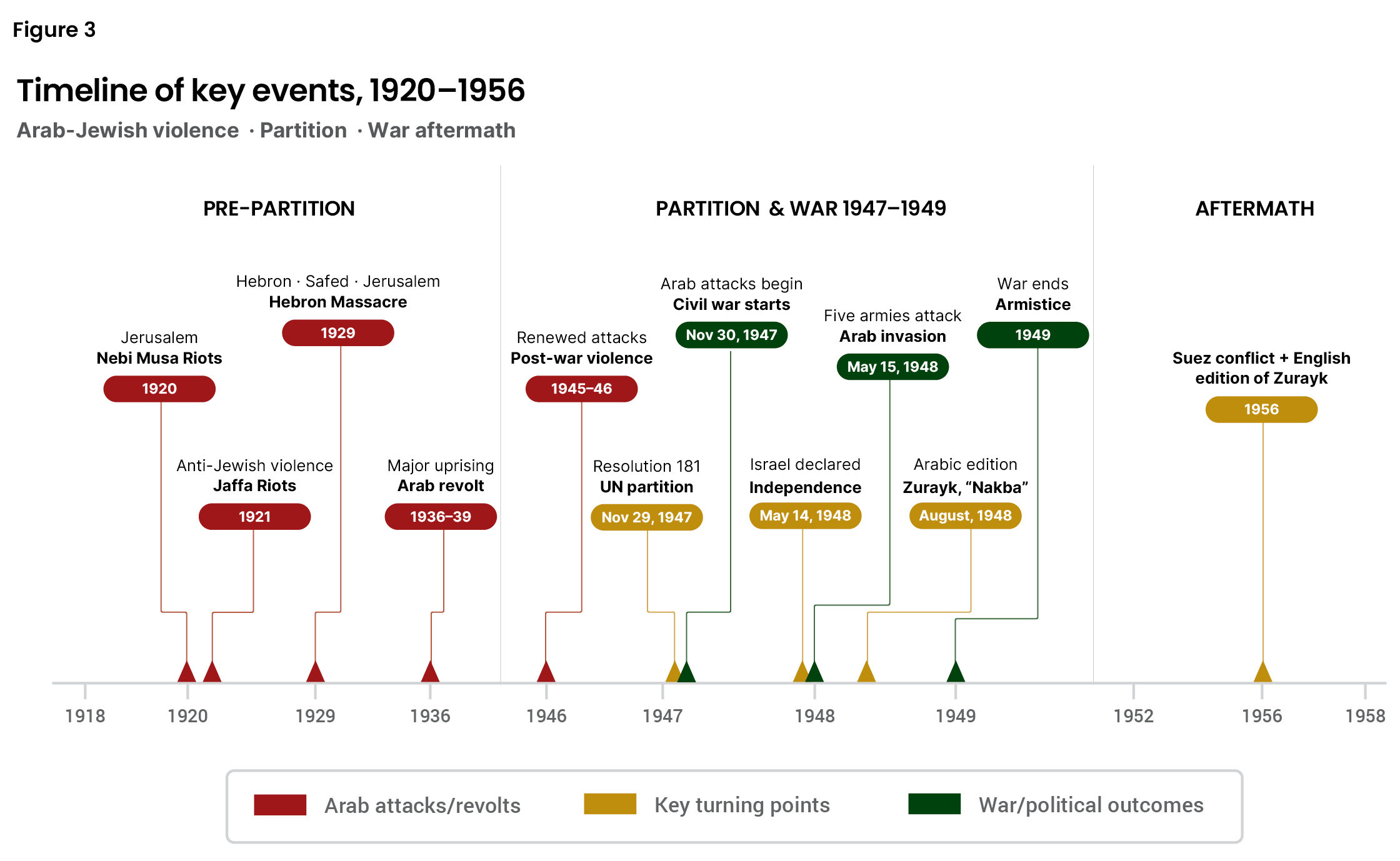
To understand the mass flight of some 700,000 Arabs from what was to become the State of Israel on May 14, 1948, it is necessary to examine the two-phased war that erupted the day after the UN partition vote on November 29, 1947. The initial Arab attacks against Jewish towns, settlements, and cities that began the civil war were not the first manifestations of Arab violence against Zionist settlement. Prior to 1947 there were major bouts of violence toward Jews in 1920 (the Nebi Musa Riots), 1921 (Jaffa Riots), 1929 (Hebron massacre plus attacks in Safed and Jerusalem), and 1936–1939 and 1945–1946 (Arab Revolts) (Figure 3). In the period after 1930, as the Jews became more militarily active, Jews responded to attacks from Arab villages that were perceived as origins of attacks against Jews. Nevertheless, the record of violence after 1920 was overwhelmingly a record of Arab attacks against Jews. Indeed, the Zionist enterprise was met with extreme violence from 1920 to 1948, even though there were no Jewish seizures of Arab land prior to 1947 and all the land settled by the Jews was either unowned or was purchased from Arab landowners. In a very real sense, the Arab attacks that followed the partition vote must be seen as a continuation of an Arab policy of Anti-Zionist violence.
Source: Publisher’s internal rendering based on authors’ original research.
Modern Jewish Zionist settlement brought a mere trickle of Jewish pioneers to Palestine that only increased after the rise of Hitler and the National Socialists in 1933. In that decade almost a quarter of a million Jews arrived in the Holy Land. The pattern of Jewish settlement up to 1939 saw the formation of primarily agricultural settlements (kibbutzim and moshavim) on the coastal plain, the Jezreel Valley, lower Galilee and in Tel Aviv, West Jerusalem, and Haifa (Figure 4). In Jerusalem, the Jews were concentrated in the Jewish Quarter of the walled city and the “new city” to the west around the Yemin Moshe area. Haifa was a mixed city, but Jews were concentrated on the lower slopes of Mount Carmel. Tel Aviv (established as a suburb of Jaffa in 1909) was almost entirely Jewish. The agricultural settlements were placed on land purchased from Arab landowners using the Jewish National Fund that had been established at the Fifth Zionist Congress in 1901.
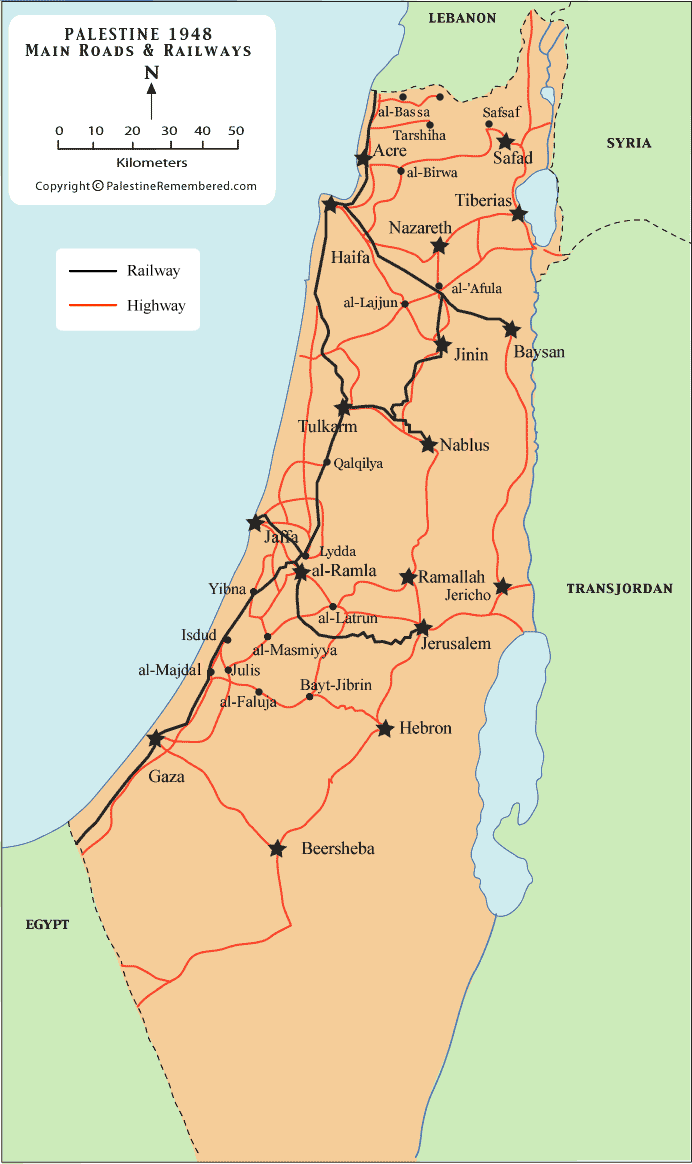
Settlements in Palestine were tied together by a road network that was dominated by old Arab settlements positioned on high ground (Figure 5). The method of building on high ground is a common feature in countries that have seen a lot of war, such as Sicily, Italy, and Spain. Because the Jewish settlers did not expel Palestinian Arabs from their settlements, they were required to build their new towns on lower ground that could be dominated by the established Arab towns. The result of this patchwork pattern of Jewish settlement was that the Arabs could isolate Jewish settlements in a time of war and destroy the Jewish communication system. Throughout the 1947–1949 war Jews were forced to send “armoured” truck convoys (civilian trucks with steel and plywood mounted on the sides) from one location to another, dodging Arab bullets and suffering losses to maintain their supplies and communications.
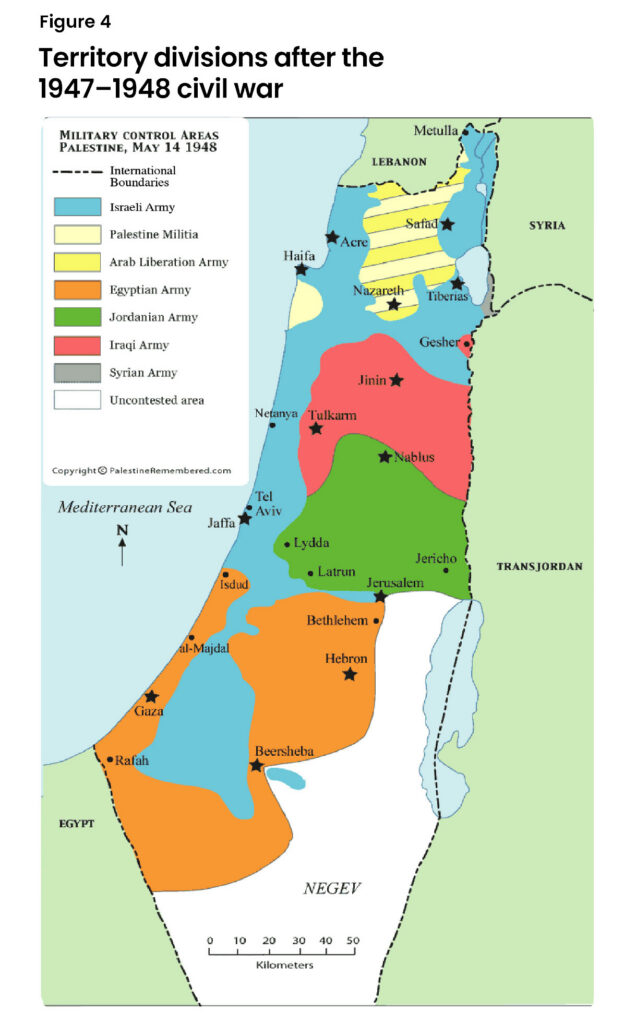
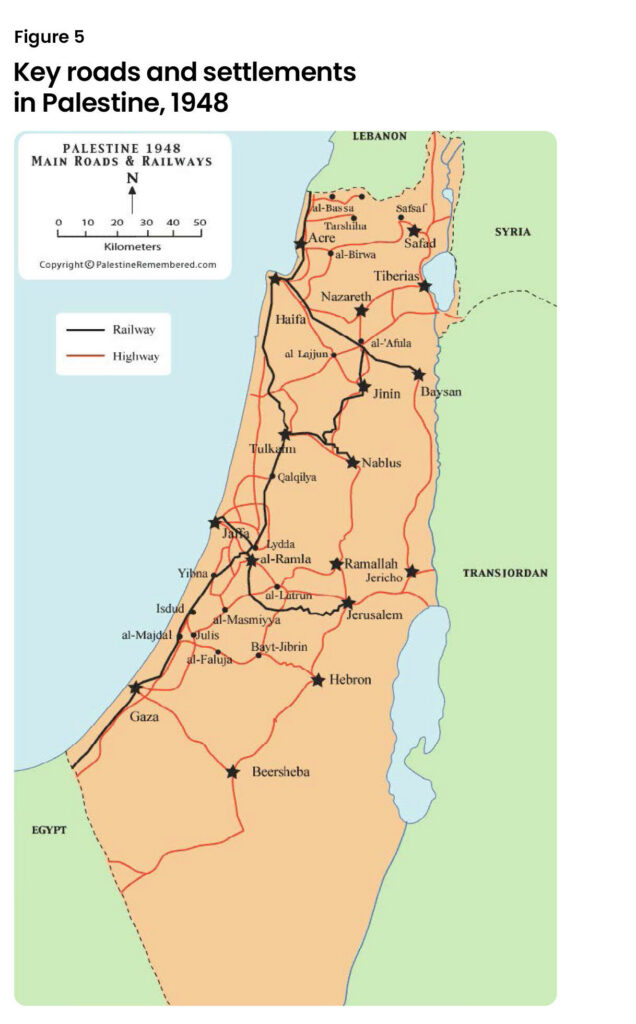
Sources: Publisher’s rendering based on “Palestine Maps: Israeli Controlled Areas As Of May 14 1948, prior to entry of any single arab army,” Palestine Remembered, accessed July 20, 2026, https://www.palestineremembered.com/Acre/Maps/Story565.html (Figure 4); “Palestine Maps: Main Roads And Railways Before Nakba,” Palestine Remembered, accessed July 20, 2026, https://www.palestineremembered.com/Maps/New/Palestine1948MainRoadsAndRailways.gif (Figure 5).
The Jewish fighting forces knew that if contiguity was not re-established between Jewish settlements, and especially between Jerusalem and Tel Aviv and the coastal plain, the Jewish state envisaged by the UN Partition Plan would evaporate into thin air. The three Jewish fighting forces agreed to a plan drawn up by the Haganah to (a) secure the Jewish areas granted by the UN Partition Plan, (b) open up the supply roads between Jewish areas, and especially between Jerusalem and Tel Aviv, and (c) prepare for an expected upcoming invasion of Jewish Palestine by the armies of surrounding Arab countries upon Israel’s expected declaration of independence in May. Some writers have also argued that the plan was primarily intended to drive Arabs out of Palestine. The fact that the Arab refugees did not leave in one human flood suggests that this interpretation is untrue. Zurayk himself, writing in the summer of 1948, observes that, to that point, refugees numbered around 400,000 people. An additional 300,000 were still to flee in the remaining months of 1948.4
The village of Deir Yassin lay atop a main road to Jerusalem, approximately 7 kilometres to the west of “new” Jerusalem. Although the village had earlier made an agreement not to interfere with the Jewish traffic flowing on the road below, by March/April there was continuing sniping from the town into the Jewish convoys passing below. As part of Plan Dalet, a combined force of Irgun and Lehi fighters were assigned to neutralize the town and they attacked on April 9, 1948. The town was populated with some 700 people; it is estimated that the Irgun/Lehi force massacred some 120 to 200 people, throwing bodies down wells, committing heinous atrocities, and acting like a murderous gang of criminals rather than a disciplined military force. According to Israeli historian Benny Morris, in his 1989 book The Birth of the Palestine Refugee Problem, 1947–1949,5 news of the massacre spread widely in the Palestinian Arab villages, causing many thousands to flee eastward in fear that similar massacres would take place in other Arab localities. Although the massacre was condemned by the Haganah and the Jewish Agency, it is understandable that Arabs would flee a perceived threat. It is important to point out that on April 13, 1948, very soon after the Deir Yassin massacre, a convoy of Jewish medical personnel proceeding from the hospital at the Hebrew University on Mount Scopus, in northeast Jerusalem, was attacked by Arab irregulars and a massacre of the convoy passengers—mainly Jewish medical personnel—occurred there. We see from this incident that fighting in the civil war was vicious in this period, with both sides carrying out indefensible acts.
Benny Morris’s first book on the plight of the Arab refugees—published in 1989—was groundbreaking in Israel because it exploded at least one Zionist/Jewish myth that some mysterious Arab authorities had called for the wholesale abandonment by the Arabs of their homes, villages, and towns to clear the way for the imminent invasion of Jewish Palestine by surrounding Arab countries. Morris’s book attributed the flight of the refugees in 1948 to a variety of factors, most of which were local. There were most certainly direct expulsions as we will demonstrate below. The usual byproducts of war, however—civilian panic, fear, collapse of community leadership, and the fighting itself—were the most significant reasons. He points out that news of the Deir Yassin massacre was certainly a major factor, but that the Arabs of Haifa, who fled the city in large numbers in late April, 1948, do not seem to have been motivated by the Deir Yassin massacre. Haifa Arabs fled following the loss of a battle for control of the heights of the city market.
In his first book on the Palestine refugee question, Morris painted a picture of a complex phenomenon that took place over several months. Much depended on local military actions. Refugee flows were directly affected by weak leadership of the Arab community—divided by clan, geography, religion, and other factors—a fact also stressed by Zurayk. Morris’ main conclusions were that about 700,000 Palestine Arabs had been displaced in one way or another, that there was no single coordinated plan by the Jewish fighting forces or the Yishuv leadership to expel the Arabs, and that the causes of the flight were Israeli military attacks (such as Deir Yassin), direct expulsions in some communities, collapsing civilian leadership among the Palestine Arabs—rivalry, competition, different aims, lack of coordination, no central military leadership—and panic and confusion among the Arab population. While Morris blamed Israel for the displacement of refugees, the most important factor in refugees fleeing Palestine was the twelve-month war. The simple but brutal fact is that wars displace civilian populations. From ancient times, refugees in their millions have fled from wars. In 1940 alone, hundreds of thousands of refugees fled Holland, Belgium, and France. Then there was the expulsion of millions of ethnic Germans from Central Europe following the defeat of the Nazis, and the murder and displacement of millions of Muslims and Hindus during the partition of India in 1947.
In 2004, Morris published a second book on the issue titled The Birth of the Palestine Refugee Problem Revisited.6 In the sixteen years between the two books, Morris did additional research and found that the IDF expulsions were more extensive than he first thought but that entreaties by Palestinian leadership to Palestinian Arabs to flee were also more extensive. He also found evidence that migration of Arabs from within the Ottoman Empire to Palestine in the late 19th and early 20th centuries was extensive, supposedly demonstrating that many Arabs who left Palestine in 1948 did not have deep roots in the area. Additionally, there was again no evidence of a pre-planned desire to expel Arabs on the part of the Jewish Agency or the Haganah. He also demonstrated that in Haifa, both the Jewish and Arab neighbourhoods were on the verge of flight until the decisive battle of April 22, 1948, when the Haganah turned the nascent battle into a probable defeat for the Arab community there, and the Arabs began a major withdrawal.
The British weekly news magazine The Economist, on October 2, 1948, described what happened:
On April 21st British Military and Police evacuated certain buildings, mainly in the commercial quarters of the town, which they had previously occupied, and withdrew to the British residential zone and to the Post, holding a narrow connecting link between these two districts. Upon the British withdrawal, the Haganah and certain Irgun Zvai Leumi units made a determined attack upon the Arab-held quarters of Haifa, and within twelve hours had completely overcome all Arab resistance. A considerable number of Iraqi and Syrian irregulars was killed and the Arab residents of Haifa fled, in a state of utter panic, to the (British-held) port area; to the Roman Catholic Monastery of Stella Maris on Mount Carmel, and to St. Luke’s Anglican Church compound in the German Colony. During the subsequent days, the Jewish authorities who were now in complete control of Haifa (save for the limited districts still held by the British troops) urged all Arabs to remain in Haifa, and guaranteed them protection and security. So far as I know, most of the British residents whose advice was asked by Arab friends told the latter that they would be wise to stay…. of the 62,000 Arabs who formerly lived in Haifa, not more than 5,000 or 6,000 remained…7
The story goes on to mention that the Arabs who fled went to Nazareth, Acre, and Beirut and that although the Jews wanted them to stay, they also did little to stop them. When the British left Palestine, some of their records were left behind. On May 2, 1949, Michael Comay, Director of the Commonwealth Division of the new Israeli foreign office, wrote Aubrey (later Abba) Eban, representative of Israel to the UN in New York, the following:
Amongst the British records in our possession are the C.I.D. reports from the Superintendent of Police for the Haifa District, from April 23rd to April 28th, i.e., the period during which we took Haifa and its Arab population left. They throw an interesting light on the whole event and provide further collaboration from official and secret British sources that the Arabs left of their own accord, that the British military authorities transported them out of Haifa and that we did everything possible to induce them to stay.8
Tom Segev, another of the “new generation of Israeli Historians,” also wrote about the Haifa fighting and about the ongoing debate within the Yishuv and the State of Israel in its first year as to what action to take regarding the Arab refugees.9 Segev’s version of events in Haifa does differ from Morris’ because it shows the almost utter chaos that occurred in Haifa at the time that the battle took place. It is clear from his perspective that, although some of the Jewish community in Haifa wanted the Arabs to stay, the fear in the Arab community outweighed whatever humanity the Jewish community displayed, and most of the Haifa Arabs left, some to Lebanon and Syria, others to the Galilee.10
Tom Segev’s book differs from that of Morris by focusing on the period after the war ended. He does describe the contradictory actions regarding the expulsion of Arabs during the war, as well as repeating Morris’s version of events in Nazareth, but stresses the discussions that took place in 1949 among the Israeli leadership and between Israel and some of its recent antagonists regarding policies to adopt toward the Arab refugees. With both Syria and Egypt there did at first appear to be signs that these two states might “absorb” the refugees in return for other considerations, but Israeli leadership largely took the “disappearance” of the 700,000 Arabs as a blessing and were not willing to accommodate their return. A main reason, Segev points out, is that tens of thousand of Holocaust survivors and Jews from Arab countries were beginning to crowd into Israel, and there was literally no place to put them in Israel aside from the maabarot, the overcrowded and underserviced refugee camps thrown up wherever there was space. Sanitary conditions in these camps were deplorable, the new state had hardly any resources to devote to the refugees, and the new arrivals languished in the camps where crime, poverty, hunger, and lack of privacy prevailed. Jewish Agency representatives scoured abandoned Arab towns and villages to find living space for these refugees, some of it in deplorable condition, to shift the arrivals out of the camps and into more habitable space.11
Former Canadian mortar officer Ben Dunkelman volunteered to fight with the Haganah in July 1948 and was given command of their 7th Armoured Brigade due to his experience. Fighting in central Palestine, Dunkelman was tasked with capturing the city of Nazareth. Nazareth had significant populations of Christian and Muslim Arabs, as well as a smaller Druze community. As a condition of surrender Dunkelman promised that no Arabs would be expelled from Nazareth, which then required him to refuse orders from command authority to expel the Arab population.12 Benny Morris indicates that David Ben Gurion supported this refusal because he was worried about the scandal that would result from the expulsion, as the name “Nazareth” had deep significance for Christians worldwide, leading to more scrutiny of events in that quarter. To this day Nazareth contains a significant Arab population despite the numerous wars between Israelis and their neighbours over the decades.
A detailed list of the fate of other Arab population centres is included in Morris’ second book, but, before examining that larger picture, it is necessary to point out that after the Jordanian Arab Legion besieged the Jewish quarter of the old city of Jerusalem, they overcame resistance from several hundred Jewish fighters assigned to defend the Jewish quarter and forced their surrender. Subsequently over a thousand inhabitants of the Jewish quarter were escorted by the Arab Legion to West Jerusalem (i.e., expelled), while several hundred of the defenders were placed in a prison camp in Jordan, where they remained until they were returned in a prisoner exchange after the war. Thereafter the Jewish quarter was laid waste: old synagogues and cheders (schools) were blown up, Jews were not allowed to pray at the Western Wall, and many Jewish graves on the Mount of Olives were desecrated and their stones removed and used for paving stones in Arab Jerusalem.
Elsewhere in Palestine, Jewish settlements, towns, kibbutzim, and Moshavim were overrun in the fighting and another 18,000 or so Jews were driven out of Gush Etzion (a bloc of four settlements south of Jerusalem) and the settlements of Atarot, Neve Yaakov, Kfar Darom Nitzanim, and some smaller places. These Jews became refugees just like Arabs who were similarly displaced. While Arabs who were forced to leave could find refuge in Arab areas a few kilometers away or flee to neighbouring countries, the Jews who survived their expulsions often had to be assimilated into other settlements and were just as likely to be unable to return to their homes in the areas that were annexed or controlled by Arab countries or the Palestinian Arabs.
A peculiar event took place in central Israel/Palestine in July 1948 when the Israelis were making yet another attempt to clear Arab opposition, in this case the Jordan Arab Legion, from the Tel Aviv-Jerusalem Road. Two Arab towns near the Lod airport—Ramle and Lydda—stood in the way, literally astride the road. Yitchak Rabin (who later became Prime Minister of Israel) was commander of the Harel Brigade and led Israeli forces in the area. As commander he was responsible for the displacement of the 50,000 Arab residents of the two towns. The rationale was that if Israeli forces continued to attack to the east to clear the road, this large group of Arabs would be left in their rear. When he wrote his memoirs in 1979 he was obliged by Israeli law to submit his manuscript to a military censor before publication. The censors ordered him to exclude a portion of his book dealing with the expulsion. The section of the book that was excised reads as follows:
While the fighting was still in progress, we had to grapple with a troublesome problem, for whose solution we could not draw upon any previous experience: the fate of the civilian population of Lod and Ramle, numbering some 50,000…Not even Ben Gurion could offer any solution, and during discussions at operational headquarters, he remained silent, as was his habit in such situations. Clearly we could not leave Lod’s hostile and armed population in our rear, where it could endanger the supply route to Yiftach [another brigade], which was advancing eastward. We walked outside, Ben Gurion accompanying us. Allon repeated his question: “What is to be done with the population?” B.G. waved his hand in a gesture which said, “Drive them out!”Allon and I held a consultation. I agreed that it was essential to drive the inhabitants out. We took them on foot towards the Bet Horon Road, assuming that the [Arab Legion] would be obliged to look after them, thereby shouldering logistic difficulties which would burden its fighting capacity, making things easier for us.
“Driving out” is a term with a harsh ring…Psychologically, this was one of the most difficult actions we undertook. The population of Lod did not leave willingly. There was no way of avoiding the use of force and warning shots in order to make the inhabitants march the 10 to 15 miles to the point where they met up with the legion.
The inhabitants of Ramle watched and learned the lesson. Their leaders agreed to be evacuated voluntarily, on condition that the evacuation was carried out by vehicles. Buses took them to Latrun, and from there, they were evacuated by the Legion.13
There are two points which this expurgated section of Rabin’s memoirs raises. First, the same David Ben Gurion who refused to agree with the expulsion of the Arab population of Nazareth in April 1948 ordered the expulsion of the Arab population of Lod and Ramle in July 1948. The reason? Nazareth is closely tied to Christian history as a place where Jesus dwelt in his youth and the birthplace of his mother Mary. It was in 1948—and is today—a centre of Christian pilgrimage even though the town was populated equally by Muslims. Ben Gurion realized the importance of not alienating the Christian world by throwing the Arabs out. Yet in Lod and Ramle, he did the opposite. It was later in the war, which by then had become a full-scale conflict and, most important, there was in his mind an important military reason for the expulsion. Second, this event shows that there was no overriding policy of expulsion, but that expulsion, when employed, was rooted in local, usually military, considerations. This also leads to the conclusion that if Palestinian Arabs had not first made war on the Yishuv, and later the Arab states had not joined the war, there would have been no expulsions. The war itself lay behind most, if not all of the 700,000 Arabs fleeing their homes in Mandatory Palestine, either by expulsion or voluntary departure.
Morris’ second book treated the refugee question in far greater detail than Segev, but, like his first book, it was rooted in careful research in Israeli archives. What sets it apart is that it is the only English-language, full-length study of the Arab refugee issue based on primary Israeli research. As such, it deserves greater attention.
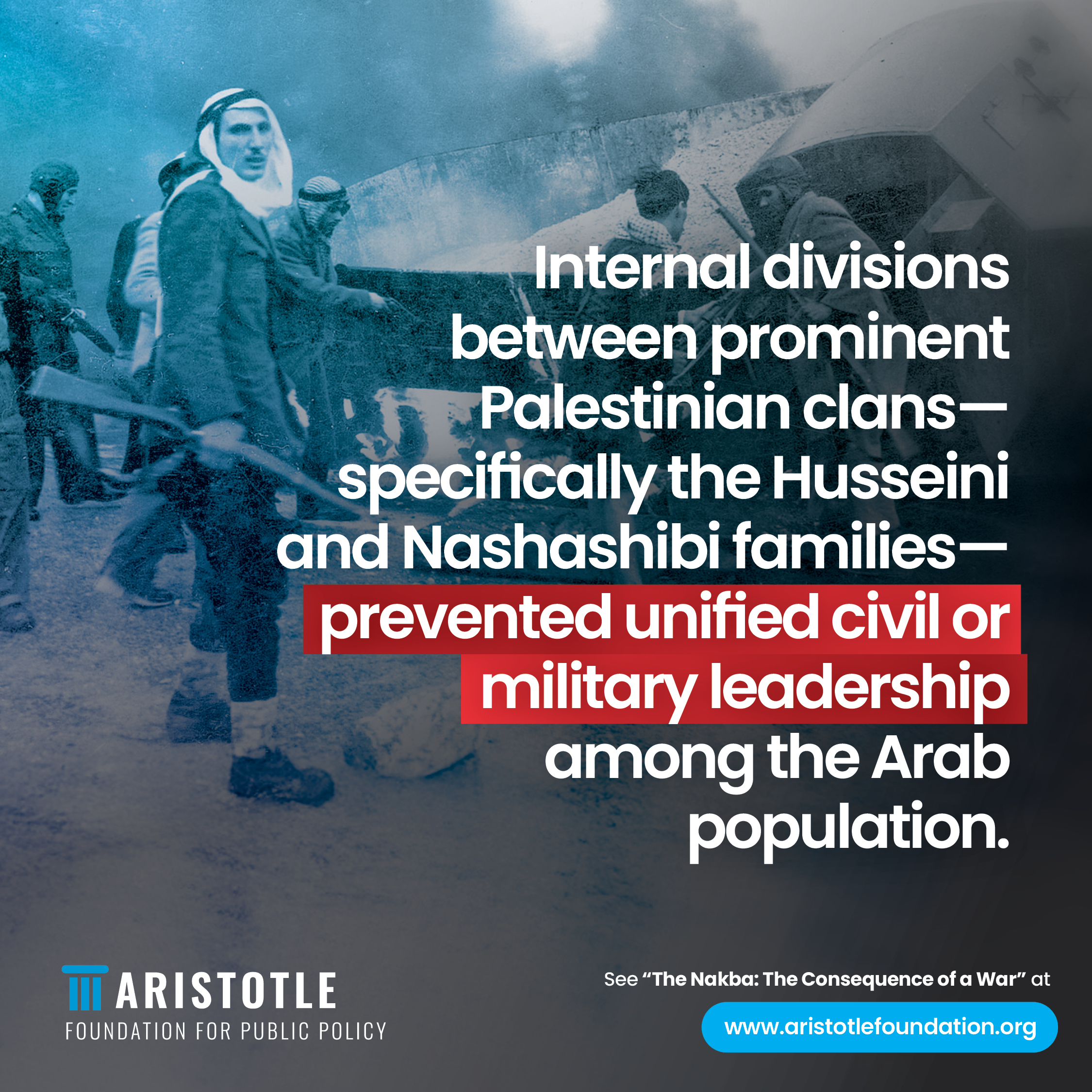
One of Morris’s key findings was that the weakness of Palestinian Arab civil institutions was a main cause of lack of leadership in the Palestine Arab community. This weakness was combined with the existence of two main groups, clans, or parties who were at odds with each other, the Husseinis—connected to the former Mufti of Jerusalem—and the Nashashibis. Haj Amin al-Husseini, leader of the Husseini clan, spent much of the Second World War in Berlin and was a strong supporter of Hitler and the Nazis. The Husseini clan was strongly opposed to Zionism and advocated violence to oppose Zionist settlement, culminating in the riots and uprisings of 1920, 1929, and 1936–1939. The Nashashibi clan was also anti-Zionist but somewhat more willing to engage both the British Mandate authorities and the Zionists (Figure 6). However, their opposition to each other was strong and that prevented any unity of action among the Palestine Arab community in planning and executing the war.
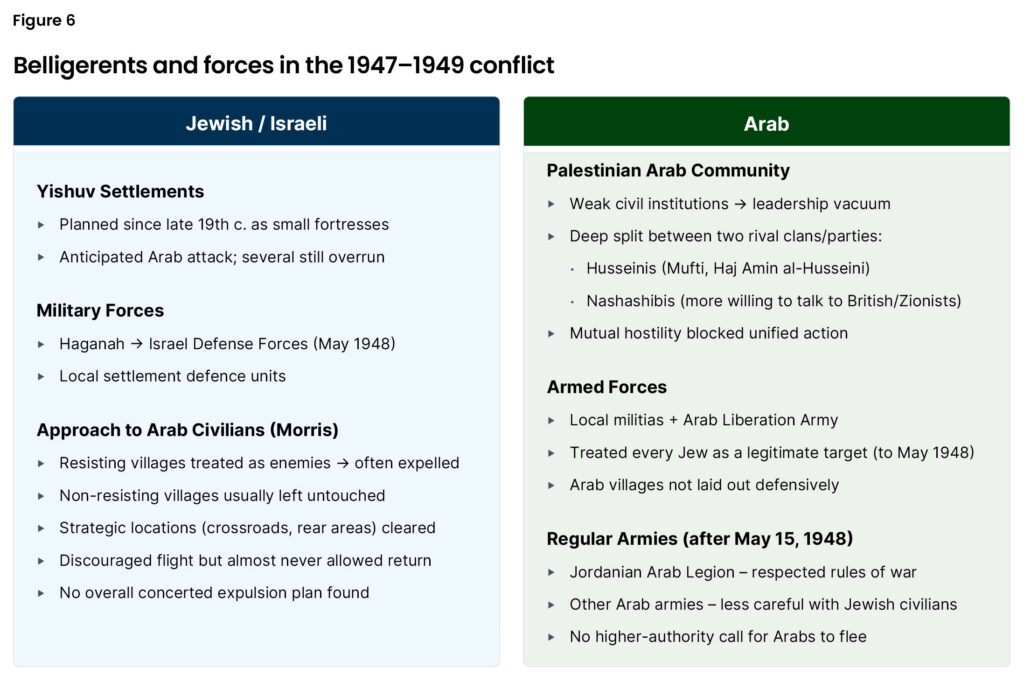
Source: Publisher’s internal rendering based on Benny Morris, The Birth of the Palestine Refugee Problem, 1947-1949 (Cambridge: Cambridge University Press, 1989).
Morris pointed out that the Jewish settlements that had been built since the late nineteenth century had almost always been planned with the eventuality of Arab attack; although each one was a small fortress, several were still overrun by Arabs. The Arab villages were not laid out in any defensive manner. From the beginning of the fighting in late November 1947 until the Arab state’s invasion in May 1948, Arab militias—including the Arab Liberation Army—considered every Jew to be a legitimate target, thus accounting for the extreme violence of almost all the confrontations that took place. After the Arab invasion, different Arab armies took different approaches to Jewish civilians. The Jordanian Arab Legion respected the rules of war and treated Jewish civilians as refugees, while other Arab armies were not so careful regarding Jewish civilians. Morris also found no call from some higher Arab authority for Arabs to flee and no concerted plan of the Jewish/Israeli forces to deal with Arab civilians. In general, Arab villages that showed strong resistance to Jewish/Israeli forces were treated as enemies—and in many cases their populations expelled—while those that showed no resistance were almost always left untouched. The one exception to this rule was that an Arab village that was strategically located at an important crossroad, or behind Jewish/Israeli fighting forces, was considered a military danger and its population forced out. Although there were several instances of Jews/Israelis trying to discourage Arabs from leaving their homes, the same Jews/Israelis almost never allowed any refugees to return. Overall this was true of the Jewish Agency/Israeli government that followed it. Combined with the insistence of the UN and western states that all the refugees be allowed to return home, especially after the fighting ceased, this established the semi-permanent status of the Arab refugees in Syria, Lebanon, and Egypt. In Jordan, which annexed the West Bank after the war, Arab refugees were allowed to establish themselves and even claim Jordanian citizenship. Many did, but many also chose to languish in refugee camps, provided for by UNRWA, in hopes of a return to their old homes.14
In general, both phases of the war, before and after the declaration of independence were a life-or-death struggle for the Jews/Israelis and they began planning for the violence shortly after the end of the Second World War. Representatives of the Yishuv combed North America, Great Britain, Western Europe, South Africa, and Czechoslovakia looking for weapons, equipment to manufacture weapons, and former Second World War veterans who might be enticed to Palestine/Israel, either through pay or adherence to the idea of a nascent Jewish state. The Arabs of Palestine did no such thing. The war was not a life-or-death struggle for them until their villages found themselves on the front line, wherever it was. Morris estimated that around 400 Arab villages or towns were “depopulated” between 1947 and 1949, but not because of an overall strategy or design, and that the displacements took place at different times and had different causes related directly to the military situation in any given place.
At the time of the outbreak of the war, tens of thousands of Jews lived in Arab countries around or near the Mediterranean Sea principally in North Africa, Egypt, Syria, and Iraq. These Jewish communities had lived in those countries for millennia. Between 135,000 to 150,000 Jews lived in Iraq at the time of the 1948 war, making up an estimated 25 percent of Baghdad’s population—with roots going back nearly 2,600 years, to Ancient Babylon and the Babylonian Exile.
After the establishment of the state of Israel, anti-Jewish measures were widely imposed on the Iraqi Jewish community. Restrictions on Jewish life, commerce, religious practice, etc., in 1949–1952 drove the great majority of these Jews to flee. Tens of thousands were brought to Israel, while others settled in North America and Western Europe. A multi-millennia Jewish presence was virtually extinguished in just a few years. Those who fled to Israel were eventually absorbed, given Israeli citizenship, and began to play important parts in Israeli life. There was neither desire nor expectation that they would return to Iraq, unlike the desires and expectations of the Palestine Arab refugees in 1948. Thus the Iraqi Jews were a part of the population transfer of Palestine Arabs to the Arab countries and of Middle Eastern and North African Jews to Israel and other places.
There were approximately 75,000 to 80,000 Jews living in Egypt in 1948. The Jewish community there goes back at least to the founding of Alexandria, over 2,200 years before, and grew from the time of the first-century Roman Dispersals. Fast-forward to the Jews’ expulsions from Spain and Portugal in 1492 and 1497, respectively, and when Egypt came under the rule of the Ottomans in 1517, thousands of Jews resettled in Egypt from all over the empire. In the 19th and early 20th centuries more Jews settled in Egypt, drawn by an expanding economy. The Jewish community there suddenly experienced harsh discrimination after the 1948 war, throughout the early 1950s and the Suez crisis of 1956, and largely emigrated to Israel, North America, Australia, Western Europe, Latin America, and Australia.
A similar fate befell the Jews of Morocco. Before the 1948 war, about 250,000 to 300,000 Jews lived there, with roots stretching back, again, two thousand years. Some had settled from the Spanish and Portuguese expulsions of the 1490s. After Israel was established, discrimination in all facets of daily life, education, business, government, and religious practice led tens of thousands to emigrate to Israel.
In total, over 800,000 Jews in the Arab world were eventually chased from their homes, most going to Israel (Figure 7). There, they were welcomed, granted citizenship, and integrated into Israeli society. The process was slow and episodes of discrimination continue to occur to the present. But they were not restricted to refugee camps, left in a state of semi-permanent existence, made wards of UNRWA or given constant hope that one day they would return to their respective homelands. A Middle Eastern and North African Jewish community that had existed in some cases for over 2000 years disappeared leaving virtually nothing of their former lives behind them. In essence, as 700,000 Arabs left Mandatory Palestine and Israel, 800,000 Jews left Arab lands and settled in Israel. This process was not unlike the population transfer of some 20,000,000 Hindus and Muslims to and from India and Pakistan in 1947 when that partition took place, except the level of violence in Palestine was far less.
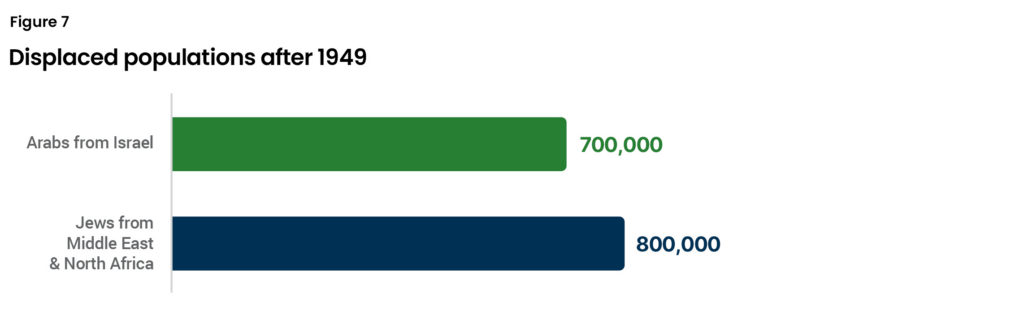
Source: Publisher’s internal rendering based on authors’ original research.
The reason why the movement of almost a million Jews from the Arab world to Israel received almost no political or diplomatic attention—as opposed to the 700,000 Arabs who left Palestine/Israel—was that Israel welcomed them, did its best to accommodate them despite the large numbers that arrived compared to the total population of Israel, and did not hold them as political hostages in refugee camps to show the world the evil deeds that the Arabs had done to the Jews.
Jewish refugees to Israel were treated completely differently than Palestinian Arab refugees to the Arab states. The Arabs left because of the war, but why did the Israelis refuse to let them back in? Because Arab nationalism, born in the nineteenth century, was and is completely antagonistic to Zionism. That antagonism could not be healed by the meeting of Haim Weizman and Emir Faisal ibn Hussein in Paris in 1919. Indeed, the meeting was followed within one year by the Arab riots of 1920. In 1929 and 1936 Arabs in Palestine had again opposed Zionism with extreme violence. That might be understood since they saw themselves losing their land, religion, and civilization in Palestine to Jewish interlopers. But understood or not, the Arab answer to Zionism was violence. The new State of Israel considered those who had fled as either neutral to the Jews at best, or violently opposed to them at worst, and they could not be allowed to return to the new state.
The first census conducted by Israel in late 1948 and early 1949 showed some 156,000 Muslim, Christian, Druze, and Bedouin Arabs living inside the borders of Israel. Today their descendants number 21.1% of Israel’s population or 2.15 million people. The relationship between the Jewish majority and the Arab minority has certainly had its challenges, but they remain full citizens with the right to vote and participate in Israeli society. They are particularly prominent in the medical and legal communities; one member of the High Court of Israel is an Israeli Arab.
What then can we conclude from this brief history? First, that the Arab refugees left for several complicated reasons, including weak leadership and military unpreparedness, but the root cause of their flight was the war itself. The Arabs met the growing Zionist movement with violence from the beginning. In the years after the First World War, there was plenty of room in the British Palestine Mandate to accommodate both peoples. The newly arriving Jews were mainly interested in establishing agricultural settlements. This was in keeping with an important tenet of early Zionism, that living and working on the land was the key to reestablishing Jewish “normalcy,” as a people who worked the soil. All the land the Jews settled was cast off land owned by wealthy Arab landowners, who were happy to receive healthy recompense for land they considered unusable.15
The seizure of Arab lands by Jews/Zionists did not begin until the spring of 1948 as a necessary military measure to unblock important roads that connected Jewish settlements. Many, though not all, Arab villagers opposed the Jews with violence, blockades, and ambushes. The villages that produced these violent reactions were considered enemy locations to the Jews/Zionists. As is common in war, towns or villages that resisted were destroyed, and those that were welcoming were left alone. This is a pattern that has repeated itself throughout history—from Cyrus the Great to Alexander the Great to Genghis Khan.
Thus military defeat at the hands of the Jews/Israelis was the major factor leading to their catastrophe, and what Palestinians and their supporters call the Nakba today was nothing less than the birth of the State of Israel by armed force in reaction to Arab violence before and after the declaration of independence. After the departure (through flight or expulsion) of the bulk of the Palestine Arab population, the Arab refugees were treated by virtually all of the Arab nations as symbols of the heartlessness and murderous intent of the Jews and kept as symbols of their cruelty and ambitions to rule the world, as Zurayk proclaimed in his 1958 essay.
The Palestinian Arab community has had great success in convincing many that the Nakba was a Jewish calumny forced on the Arabs out of Jewish belief in their superiority and the Jewish/Zionist intention to control world affairs. This closer examination of the facts reveals this narrative to be completely false. Though some Arabs did flee and others were forced to leave through military necessity, Palestinian Arabs as a whole were not driven out of Israel, and their thriving community is the best proof that the claims made by Nakba activists are false.
Please see PDF for references
David J. Bercuson, PhD, is a senior fellow with the Aristotle Foundation for Public Policy and director emeritus of the Centre for Military, Security, and Strategic Studies at the University of Calgary.
Logan Jaspers, BA, is a visiting fellow with the Aristotle Foundation for Public Policy and an incoming Master of Arts (Thesis) student in Political Science at the University of Calgary. Jaspers holds a Bachelor of Arts (Honours) in Political Science from the University of Calgary and has worked as a research assistant and administrative intern with the University of Calgary Jewish Community.
The Aristotle Foundation for Public Policy is a new education and public policy think tank that aims to renew a civil, common-sense approach to public discourse and public policy in Canada.
A Canada where the sacrifices and successes of past generations are cherished and built upon; where citizens value each other for their character and merit; and where open inquiry and free expression are prized as the best path to a flourishing future for all.
We champion reason, democracy, and civilization so that all can participate in a free, flourishing Canada.
Ideas—what people believe—come first in any change for ill or good. We will challenge ideas and policies where in error and buttress ideas anchored in reality and excellence.
The Aristotle Foundation for Public Policy is a registered Canadian charity and all donations will receive a tax receipt. To maintain our independence, we do not seek nor will we accept government funding. Donations can be made at www.aristotlefoundation.org.
The Aristotle Foundation for Public Policy has internal policies to ensure research is empirical, scholarly, ethical, rigorous, honest, and contributes to the advancement of knowledge and the creation, application, and refinement of knowledge about public policy. Our staff, research fellows, and scholars develop their research in collaboration with the Aristotle Foundation’s staff and research director. Fact sheets, studies, and indices are all peer-reviewed. Subject to critical peer review, authors are responsible for their work and conclusions. The conclusions and views of scholars do not necessarily reflect those of the Board of Directors, donors, or staff.