
In Canada, depending on the province, between 20 percent and 56 percent of students cannot read by Grade 4. This is critical because learning to read after Grade 3 is rare.1 Case in point: Today’s Grade 10 students are two to three years behind in reading, compared to their peers 25 years ago.2 Parents, school leaders, and provincial education ministries need to be asking why so many students are struggling to read, and why teachers are struggling to teach them.
This report has two parts. The first section examines the research on early literacy—i.e., what works when teaching children to read—and contrasts what is most effective with the outmoded teaching methods schools employ. The second section explores resistance to reform and difficulties in shifting the status quo.
Before considering instructional methods, there is a foundational factor of literacy development that shapes student success or failure before they read a single word: the extent of their vocabulary and background knowledge. The differences in student vocabulary have come to be known as “the knowledge gap” and carry implications for a student’s ability to comprehend new texts.3
A knowledge-rich curriculum provides the basis for reading success. E.D. Hirsch makes this case in his seminal book Cultural Literacy.4 Cultural literacy is the core background information that proficient readers draw upon to make sense of texts, enabling them to understand not only explicit meaning but also implied ideas and broader context.5 That is because each author or text presumes some shared background knowledge with the reader.
Prior knowledge has a greater impact on reading comprehension than reading ability. For example, when given a brief commentary on a baseball game, students with low reading abilities but high knowledge of baseball perform better than students with conversely high reading abilities and limited knowledge of baseball.6 When the reader’s background knowledge is minimal or non-existent, they struggle to comprehend the meaning of the text. (Of course, students with both high reading ability and high topical knowledge are the most successful.)
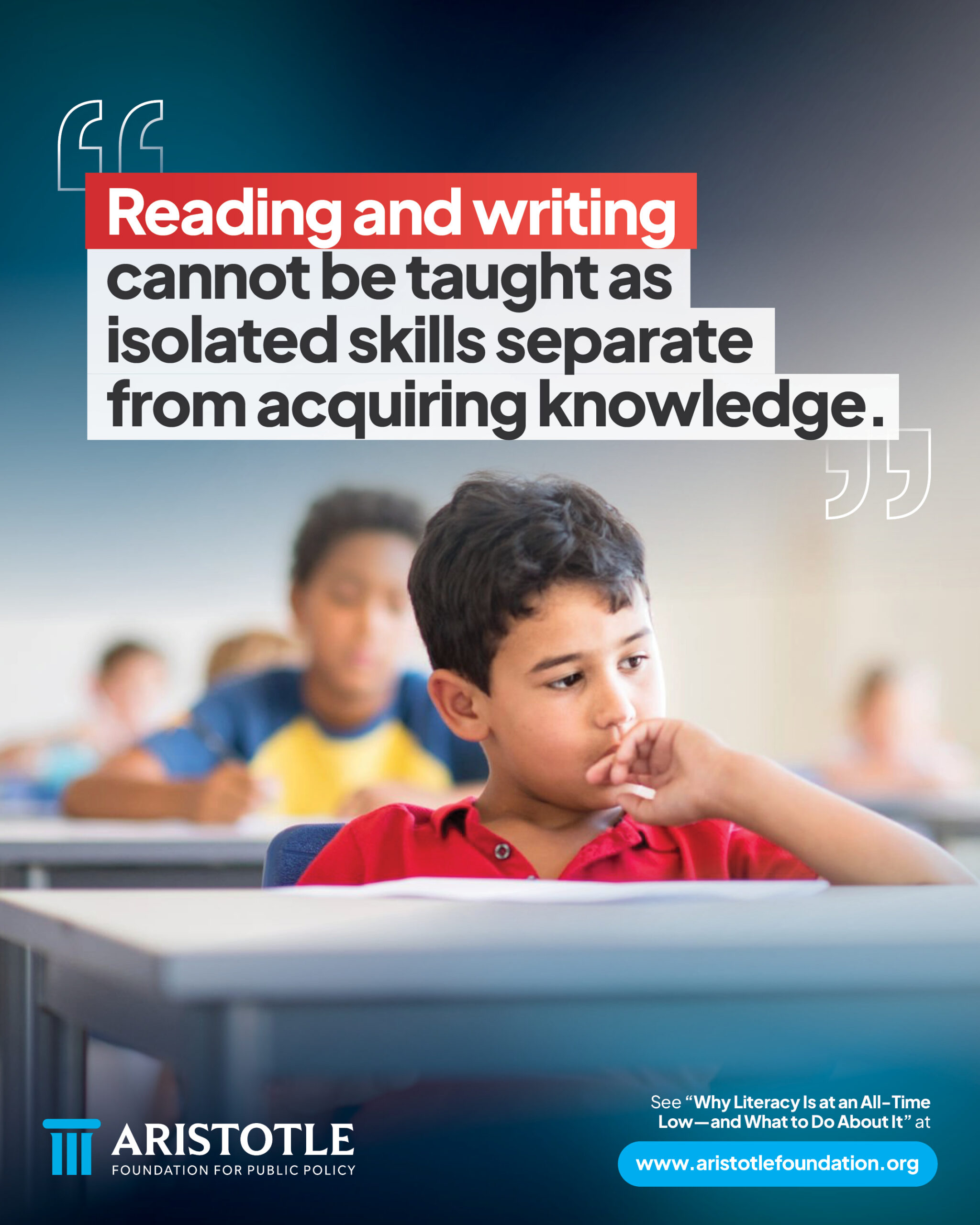
For students to become truly literate, they need knowledge to make sense of the words they decode. Hirsch concludes that reading and writing cannot be taught as isolated skills separate from acquiring knowledge. A “cumulative, coherent curriculum is essential to learning to comprehend spoken and written language.”7 Building on Hirsch’s work, others—like Natalie Wexler—note that students need a comprehensive, general-knowledge base in order to interpret new texts with ease.8 The Ontario Human Rights Commission’s Right to Read inquiry asserts that “students [also] need explicit instruction in text structures (genres), reading comprehension strategies, and the knowledge base of different domains to support reading comprehension.”9 Students who acquire a lot of background knowledge are in a better position to retain and absorb more knowledge.10
Therefore, teachers must be equipped and trained to effectively utilize a knowledge-rich curriculum, or else efforts to improve literacy will be futile. One of the problems in Canada is that many provincial education ministries, education faculties, teachers’ unions, and school boards promote pedagogies such as discovery learning or inquiry-based learning (discussed below), which place far less emphasis on content acquisition.
When students read, they are decoding the words on the page and using language comprehension to understand what those words mean. Morphological awareness refers to understanding morphemes, such as root words, prefixes, and suffixes. Jamie Metsala, a professor of education at Mount Saint Vincent University, was one of the experts who served on the OHRC Right to Read panel. In a study by Metsala and Erin Sparks in 2023, morphological awareness emerged as the strongest oral language predictor of reading comprehension in early elementary students. They also observed the importance of syntactic awareness, which is the ability to manipulate grammatical structure, and phonological awareness, which is the ability to perceive and manipulate speech sounds. A student who is unable to decode a given word will be unable to comprehend the text. Speaking, listening, and decoding words were all linked to how well students understood what they read.11
Metsala’s concern is that too few teachers know this superior, evidence-based approach to reading instruction, in large part because the education faculties in the universities are not teaching it. The OHRC report notes that “With a few small exceptions, teachers educated in Ontario English-language public faculties have not been taught evidence-based approaches to teach early reading.”12 Two literacy approaches—structured literacy, recommended by the OHRC Reading at Risk report, and balanced literacy, the method most frequently adopted by provincial ministries of education—have been in contention in the academic space for decades, and while structured learning has been dominating in research, it has not yet been widely adopted in practice.
Since the 1980s, Canadian education has embraced balanced literacy as the leading approach to teaching reading and writing skills. Balanced literacy relies on cueing systems instead of word decoding and phonic skills. The idea is to learn literacy like infants learn language. The assumption is that both are natural acquisitions and learners “just catch on.”
Balanced literacy emphasizes exposure to books and texts, advertising itself as a wholesome method that nourishes a love of reading. Yet it often frustrates young readers because of a lack of sufficient direct instruction. Balanced literacy founder Dr. Ken Goodman described his approach as a “psycholinguistic guessing game.”13 For example, a teacher might instruct, or “cue,” her students to guess new words based on a picture on the page or what they understand the text to be about thus far. The method is sometimes referred to as the “three cueing” system. There is no training of morphological or syntactic awareness, nor practice of decoding skills. Experts note that this strategy is particularly disadvantageous to students learning English as a second language; they find it much harder to guess what unfamiliar words mean.
Louisa Moats explains that approaches derived from whole-language learning models, like balanced literacy, remain widely used, but they fail the students who need to benefit most from evidence-based reading instruction. Balanced literacy methods do not combine reading and writing practice with systematic, skills-focused teaching. Only programs that teach every aspect of reading, along with writing and oral language, can effectively prevent and address reading difficulties in children at risk.14
Research is clear that optimal literacy learning happens through explicit, systematic construction of decoding skills and phonological and morphological awareness.15 This is known as structured literacy. Alongside explicit instruction, structured literacy requires frequent evaluation to respond to students who need additional assistance. When researchers compare the two approaches, structured literacy outperforms balanced literacy.16 The OHRC inquiry states “Reading science does not support approaches that rely on teaching children to read words using discovery and inquiry-based learning such as cueing systems. Many children fail to learn to read when these approaches are used in classrooms.”17 All students learn better with structured literacy, but it is necessary for those students who face additional challenges, such as dyslexia.
One often overlooked yet pervasive barrier to learning literacy is the use of inefficient instructional methods that can undermine student learning. An area of educational research devoted to the science of learning has the answers. This means applying neuroscience and psychology to intersect with education—in other words, understanding how learning happens by understanding how the brain works. The science of learning should inform teaching practices and guide Canadian curricula. Presently, it is a powerful but largely unused tool in the school toolbox.18
Knowledge is the foundation, structured literacy is the evidence-based content of teaching, and the science of learning is the delivery method of content. But some students will still struggle to grasp the complexity of literacy, and this is where reading interventions become vital to their success.
George Georgiou, the architect of Alberta’s recent early reading curriculum and screening regimen and the director of the University of Alberta’s Reading Research Lab, has developed a successful intervention program consisting of small-group reading practice four times a week for half an hour over several months.19 Following the COVID-19 school shutdowns in 2020, Georgiou and his team analyzed existing reading interventions, but ultimately designed their own based on science of learning (SoL) research. The key to the success of his program is in developing decoding skills through phonological awareness. Georgiou’s strategy employs the SoL understanding of one-on-one or small-group teaching for targeted instruction that can identify precisely what literacy skill individual students are struggling with. The earlier that struggling students are identified, the better.
A 2026 study of a thousand students in five provinces—the “biggest reading intervention in Canadian history”—saw 80 percent of students improve by a year and a half in five months, with half the students requiring no further intervention.20 Georgiou’s use of structured literacy to transform struggling readers into competent ones provides compelling evidence of what works in a Canadian context.
The research is clear on what leads to literacy. And, yet, there is resistance to implementing such an approach.
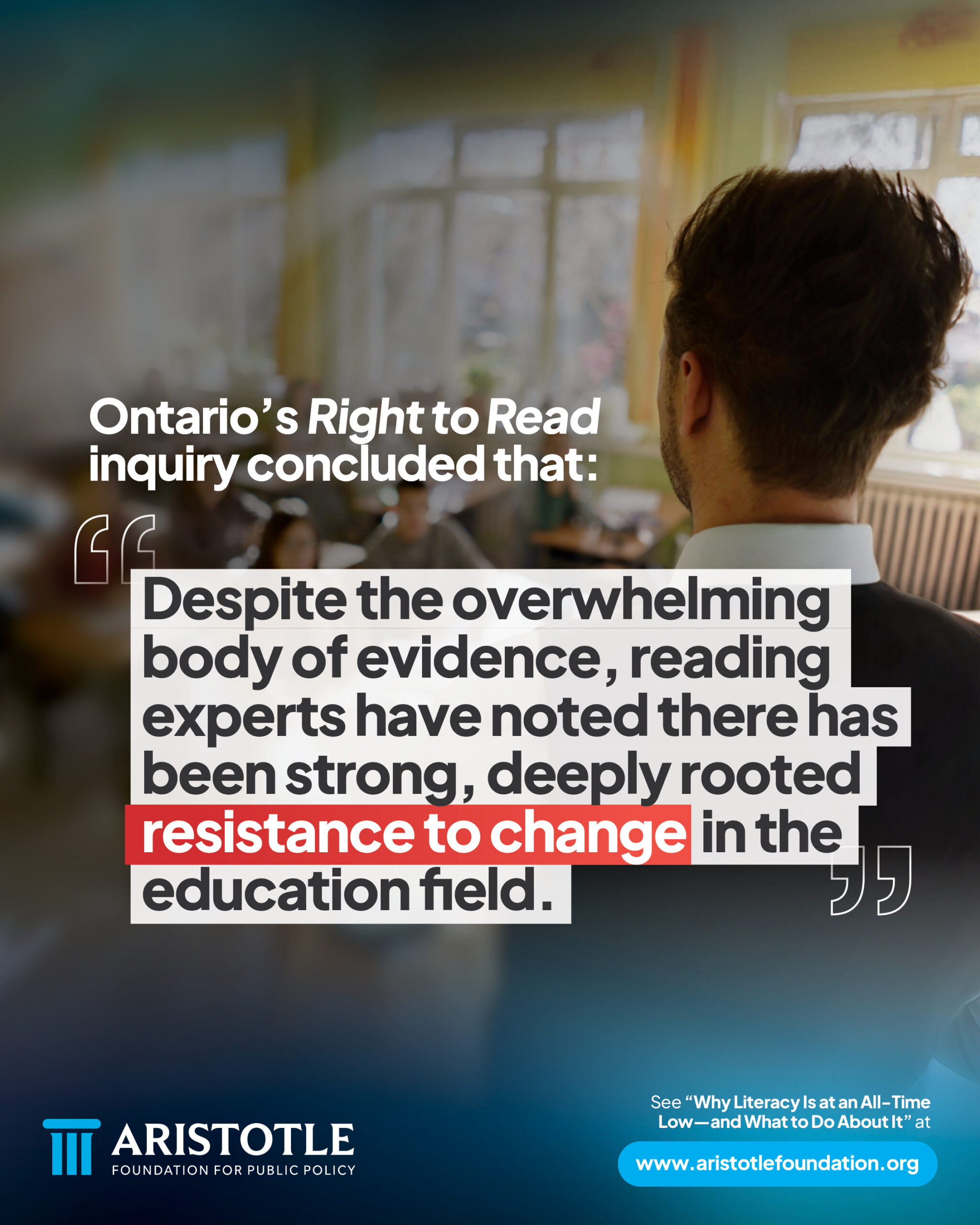
The OHRC noted in its initial report that one reason why the decades of science-backed studies of literacy have not been introduced earlier into Canadian school systems is because, “Despite the overwhelming body of evidence, reading experts have noted there has been strong, deeply rooted resistance to change in the education field.” This is not unique to Canada.21 It is rather common to jurisdictions in other OECD countries that have adopted the “discovery learning” or “inquiry-based” model of teaching, sometimes also known as “21st century learning” (which is nothing more than clever rebranding of old, discredited methods).
[I]n each decade since the mid-1950s, when empirical studies provided solid evidence that the then popular unguided [instructional] approach did not work, a similar approach popped up under a different name with the cycle then repeating itself. Each new set of advocates for unguided approaches seemed either unaware of or uninterested in previous evidence that unguided approaches had not been validated. This pattern produced discovery learning, which gave way to experiential learning, which gave way to problem-based and inquiry learning, which now gives way to constructivist instructional techniques.22
Discovery learning downplays the need to acquire knowledge as a precondition for developing generic thinking skills.23 Because content knowledge is deemed less important, standardized tests and assessments also fall by the wayside, making it more difficult for teachers, parents, and students to know whether they are making meaningful progress.24 The knowledge-rich curriculum, recommended by Hirsch, Wexler, and Bennett,25 and supported by the OHRC Right to Read report, is rejected. “Personalized learning,” which depends on each teacher adapting their entire lesson plan to each students’ unique needs and interests, dominates instead.26 This is where the idea arises that each teacher supposedly knows best what to do in each circumstance.
This plays out in public policy. When Ontario attempted to introduce early intervention screening, for example, the mandate was watered down because the Elementary Teachers’ Federation of Ontario and the Ontario English Catholic Teachers’ Association made a formal complaint to the Ontario Labour Relations Board, claiming that mandating early intervention screening—i.e., following the preponderance of evidence—undermined their “professional judgment” as teachers.27
The notion that a policy benefiting students should not be implemented because it conflicts with teachers’ “professional” judgment is a common refrain. Dyslexia BC advocated for the BC provincial government to follow the OHRC’s recommendation and mandate the structured literacy approach to education. Yet the BC Teachers’ Federation responded negatively: “We think teachers have the professional judgment and the expertise to determine the ways that the students in their particular classroom need to experience literacy reading and writing.”28 When the CBC asked if teachers in Nova Scotia will continue to use balanced literacy, a representative from the Department of Education replied, “teachers know their students as individual learners and plan appropriate next steps of instruction to meet the individual student’s needs.”29 Yet the OHRC found that literacy rates are so low precisely because Ontario teachers did not know the latest science-based approaches to learning. And they did not know them because the faculties of education had failed to teach it to them, and school boards were either not aware of the evidence or were simply ignoring it.30
But falling literacy rates—and even worse numeracy rates—suggest that the “teacher-knows-best” approach yields inferior outcomes. Canadian declines have long been in the making and precede covid learning loss by at least a decade. In other words, there are structural reasons for Canada’s decline in literacy (and mathematics and science).
One structural reason identified by the OHRC is the stranglehold that ineffective teaching pedagogies, such as discovery learning, have over the faculties of education and the teachers’ unions that influence the teachers in the classroom. Alicia Smith, Dyslexia Canada’s executive director, points out that Dyslexia Canada had to partner with Ontario’s Ministry of Education to develop necessary teacher training and screening tools “because the universities here essentially made it clear that they were not ready to move forward and provide training to teachers on evidence-based instruction.” And despite the grassroots support in British Columbia to move ahead with the structured literacy approach, Smith reports that “The roadblock is within your universities and, to a certain extent, bureaucrats within your Ministry of Education.”31
Dyslexia Canada created a website (last updated in August 2025) that tracks each province’s progress toward adopting structured literacy.32 Only four out of ten provinces are listed as having removed cueing strategies from the curriculum and instructional guidance (Alberta, New Brunswick, Nova Scotia, and Ontario). But none of those four have updated licensing requirements for teachers mandating that they be proficient in the structured literacy approach. And although Alberta has mandated evidence-based curriculum and screeners, no province has made it a requirement that schools use evidence-based interventions. With respect to Ontario in particular, the website states:
The Right to Read Inquiry found that teacher preparation programs in Ontario were severely lacking in instruction on the science of reading. The OHRC made strong recommendations for the Ontario College of Teachers (OCT) to update its standards to ensure all teacher candidates learn evidence-based practices for reading instruction. In 2023, a year after the release of the inquiry, the OCT published new standards for university teacher preparation programs, but the document did not reference Right to Read or fulfill the Commission’s recommendations.33
This lack of sufficient follow-through helps explain why reading proficiency rates have shown little improvement or declined in recent years.
For literacy to improve, Canadian provinces need to prioritize evidence-based teaching strategies for reading, use a knowledge-rich curriculum, apply science-of-learning principles, and implement early and rigorous reading interventions. The Ontario Human Rights Commission’s Right to Read inquiry outlined 157 recommendations grounded in research to address long-standing gaps in literacy instruction, yet a 2024 OHRC review found that most recommendations had not been fully implemented in Ontario, and, with the possible exception of Alberta, responses in other provinces remain limited.
One of the greatest impediments to progress is the resistance by faculties of education to change how they train teachers. Teachers’ unions can also frustrate ministries of education even when the ministries try to implement the science-based recommendations.
Without immediate action, students will continue to enter later grades and adulthood without foundational literacy skills, limiting their opportunities and long-term success.
David Livingstone, PhD, is a senior fellow with the Aristotle Foundation for Public Policy, retired professor of liberal studies and political studies, and an honorary research associate at Vancouver Island University (VIU). Prof. Livingstone has edited two books: Liberal Education and Civic Well-Being in Canada: A Reappraisal of “Bankrupt Education” (Palgrave Macmillan) and Liberal Education, Civic Education, and the Canadian Regime: Past Principles and Present Challenges (McGill-Queen’s Press).
David Hunt, MPP, BBA, is the research director at the Aristotle Foundation for Public Policy. Hunt has authored and/or directed dozens of peer-reviewed research papers. His work has been presented at numerous conferences and to various levels of government, cited in major media, and used as evidence in court.
Pio Tran is a research intern at the Aristotle Foundation for Public Policy and an honours undergraduate student in the philosophy program at the University of British Columbia.
The authors would like to publicly acknowledge the research assistance of Ava Peacock; we are grateful for your contributions.
Who we are
The Aristotle Foundation for Public Policy is a new education and public policy think tank that aims to renew a civil, common-sense approach to public discourse and public policy in Canada.
Our vision
A Canada where the sacrifices and successes of past generations are cherished and built upon; where citizens value each other for their character and merit; and where open inquiry and free expression are prized as the best path to a flourishing future for all.
Our mission
We champion reason, democracy, and civilization so that all can participate in a free, flourishing Canada.
Our theory of change: Canada’s idea culture is critical
Ideas—what people believe—come first in any change for ill or good. We will challenge ideas and policies where in error and buttress ideas anchored in reality and excellence.
Donations
The Aristotle Foundation for Public Policy is a registered Canadian charity and all donations will receive a tax receipt. To maintain our independence, we do not seek nor will we accept government funding. Donations can be made at www.aristotlefoundation.org.
The Aristotle Foundation for Public Policy has internal policies to ensure research is empirical, scholarly, ethical, rigorous, honest, and contributes to the advancement of knowledge and the creation, application, and refinement of knowledge about public policy. Our staff, research fellows, and scholars develop their research in collaboration with the Aristotle Foundation’s staff and research director. Fact sheets, studies, and indices are all peer-reviewed. Subject to critical peer review, authors are responsible for their work and conclusions. The conclusions and views of scholars do not necessarily reflect those of the Board of Directors, donors, or staff.
SUBSCRIBE TO OUR NEWSLETTER