
Aristotle Notes
📊 Why does knowing about multigenerational homes matter?
The Canadian population has changed profoundly over the past 35 years. Today, Canada is an increasingly older society. The share of individuals aged 65 and older rose from 11.3 percent in the 1990s to 18.9 percent in 2023, reflecting a notable increase in the proportion of older adults in the population. This also affects how families live in Canadian society. Understanding multigenerational family households is essential to understanding family structure in society. Families play a key role in maintaining members’ well-being by providing social, emotional, financial, and physical care.
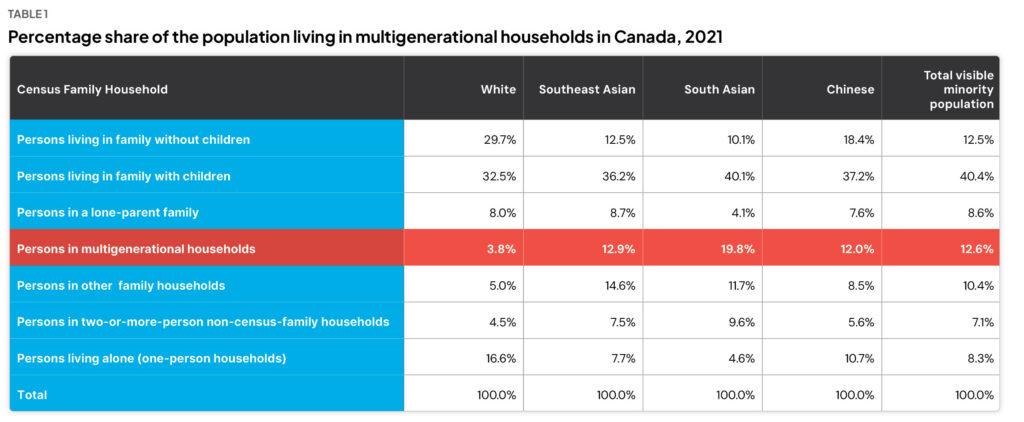
According to Statistics Canada data, there are clear differences in household and family living arrangements across racial groups in Canada (see Table 1). White people are more likely to live independently, with16.6 percent living alone, compared with 7 percent of Southeast Asians, 5 percent of South Asians, 10.7 percent of Chinese people, and 8 percent of the total visible minority population.
White people are also more likely to live in families without children (29.7%) than visible minority groups, particularly South Asians (10.1%) and Southeast Asians (12.5%). In contrast, South Asians (40.1%), Chinese people (37.2%), and Southeast Asians (36.2%) are more likely than white people (32.5%) to live in families with children.
Multigenerational households are substantially more common among South Asians (19.8%), Southeast Asians (12.9%), and Chinese people (12.0%) than among white people (3.8%), indicating stronger tendencies toward extended family living arrangements. While the proportion living in lone-parent families is relatively similar for white people (8.0%), Southeast Asians (8.7%), Chinese people (7.6%), and the total visible minority population (8.6%), South Asians have the lowest share (4.1%). Overall, the white population is more likely to live alone or in smaller family households. In contrast, visible minority groups, especially South Asians and Southeast Asians, are more likely to live in households with children and multigenerational family arrangements. People live in multigenerational households for many reasons; in some cases, out of necessity, and in others, by choice.
Source: Immigration, Refugees and Citizenship Canada, 2026a.
“Special Interest Profile, 2021 Census of Population,” Statistics Canada, March 20, 2024, https://www150.statcan.gc.ca/n1/en/catalogue/98260009.
Aristotle Notes is a series of concise, accessible fact sheets designed to inform public dialogue and elevate everyday discussions. By delivering clear, reliable data and essential context, these notes equip media professionals, students, and citizens alike with the facts needed to navigate complex topics in our society.