



Aristotle Notes
📊 Why the drug crisis in Canada matters
Drug-related deaths have reached high numbers in recent years. The drug crisis in Canada creates a unique challenge for society, government, and policymakers. Drug-related deaths place a significant burden on the healthcare system and communities. The economic impact of drug-related death is significant, costing hundreds of millions of dollars for federal, provincial, and municipal governments. According to the latest data available, in 2020 the drug crisis cost the Canadian economy $49.1 billion. Healthcare costs totalled $13.4 billion, and criminal justice costs totalled $10 billion.
In Canada, drug overdose deaths have risen dramatically over the last decade, increasing from 2,832 deaths in 2016 to a peak of 8,040 deaths in 2023 before declining to 5,630 deaths in 2025 (Table 1). Despite this recent decrease, overdose deaths remain substantially higher than pre-pandemic levels. Between 2016 and 2025, Canada recorded a total of 56,631 overdose deaths, averaging approximately 16 deaths per day in 2025. Ontario (19,411 deaths), British Columbia (16,503 deaths), and Alberta (11,344 deaths) accounted for the majority of overdose fatalities during the period, together representing over 80 percent of all reported deaths. The sharp increase observed in 2020 and 2021 coincides with the COVID-19 pandemic, when social isolation, disruptions to health services, and the growing presence of toxic substances in the drug supply contributed to rising mortality.
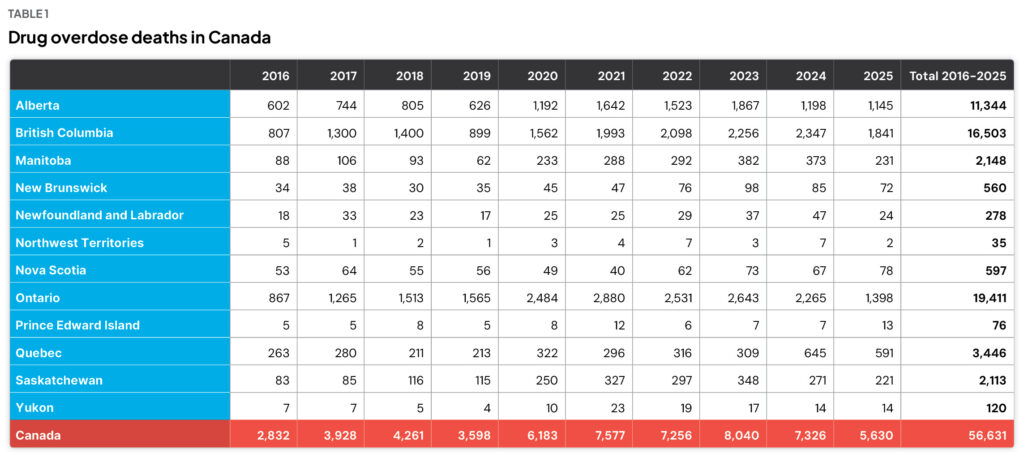
Source: Government of Canada, 2026.
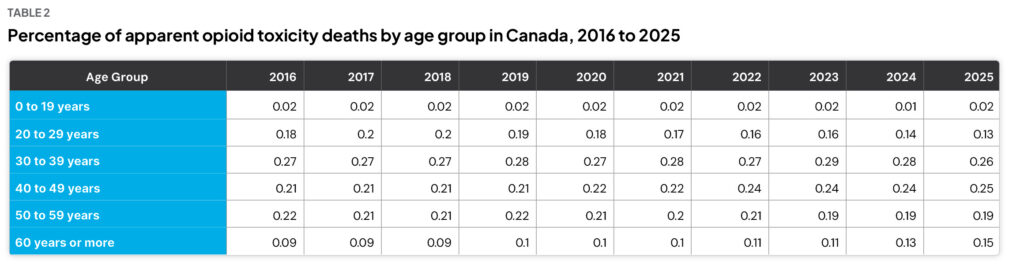
Source: Government of Canada, 2026.
Table 2 shows that apparent opioid toxicity deaths in Canada have been concentrated among adults aged 30 to 59 throughout the 2016 to 2025 period, although the age distribution has gradually shifted over time. Individuals aged 30 to 39 consistently accounted for the largest share of deaths, ranging from 26 to 29 percent, peaking at 29 percent in 2023 before declining slightly to 26 percent in 2025. The proportion of deaths among those aged 40 to 49 increased steadily from 21 percent in 2016 to 25 percent in 2025, making this group the second most affected by the end of the period. In contrast, the share among younger adults aged 20 to 29 declined from 18 percent in 2016 to 13 percent in 2025, suggesting a decreasing concentration of deaths among younger populations. Meanwhile, adults aged 60 years and older experienced the largest increase, rising from 9 percent to 15 percent over the decade, indicating that opioid-related mortality is increasingly affecting older Canadians.
“Lost Productivity Due to Substance Use Cost the Canadian Economy $22.4 Billion: New Report,” Canadian Centre on Substance Use and
Addiction, March 29, 2023, https://www.ccsa.ca/en/lost-productivity-due-substance-use-cost-canadian-economy-224-billion-new-report.
Canada, Health science, research and data, “Opioid- and Stimulant- related Harms in Canada: Key findings” (Government of Canada, June
15, 2026), https://health-infobase.canada.ca/substance-related-harms/opioids-stimulants/.
Aristotle Notes is a series of concise, accessible fact sheets designed to inform public dialogue and elevate everyday discussions. By delivering clear, reliable data and essential context, these notes equip media professionals, students, and citizens alike with the facts needed to navigate complex topics in our society.