



Aristotle Notes
📊 Why knowing about post-secondary education and employment matters
Post-secondary education is a major investment for young people that can shape their career paths and life trajectories, but the return can vary significantly.
Labour market outcomes following postsecondary graduation vary considerably by field of study (Table 1). Graduates in architecture, engineering, and related trades ($65,500) and mathematics, and computer and information sciences ($65,000) reported the highest salaries, while those in visual and performing arts and communications technologies ($43,000), as well as personal, protective, and transportation services ($45,200), earned the lowest incomes. Education (94%) and health and related fields (88%) had the highest proportions of graduates working in jobs related to their studies, indicating strong alignment between education and employment. Job satisfaction remained relatively high across most disciplines, with the highest levels reported among graduates in personal, protective, and transportation services (87%), mathematics, computer, and information sciences (85%), and architecture, engineering, and related trades (85%). In contrast, graduates from other instructional programs (69%) and visual and performing arts and communications technologies (75%) reported lower satisfaction levels.
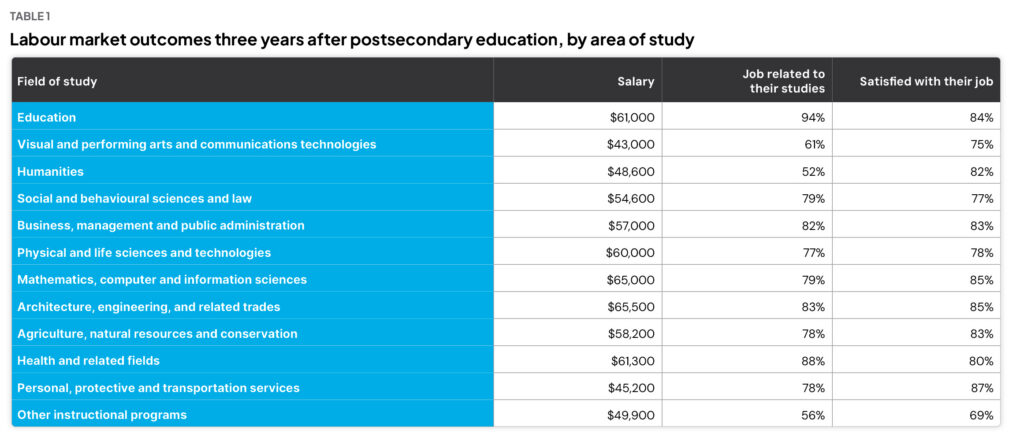
Source: Statistics Canada, 2025. Note: Data are from the 2023 National Graduates Survey (class of 2020). “Job related to their studies” refers to graduates who reported their job was “Closely related” or “Somewhat related” to their educational program. “Satisfied with their job” refers to graduates who reported they were “Very satisfied” or “Satisfied” with their overall job. Salaries are estimated gross annual earnings – median.
The data indicate that humanities graduates aged 25 to 34 often work in sales, service, administrative, and retail occupations, with notable differences by field of study and gender (See Table 2). Among liberal arts and sciences/liberal studies graduates, men most often worked in sales and service occupations (30.4%), while women most often worked in administrative occupations (20.5%). A distinct pattern emerges among Bible/biblical studies graduates: men were most likely to work in trades, transport, and equipment operator occupations (24.9%), while women were concentrated in sales and service occupations (33.9%). Overall, these findings suggest that humanities graduates pursue a diverse range of career paths, often extending beyond occupations directly tied to their field of study. Table 3 indicates that most Canadian graduates who completed their studies in 2020 were generally positive about their employment situation in 2023, although perceptions varied across different aspects of work. Job satisfaction was the highest-rated measure, with 82 percent of graduates reporting satisfaction and only 7 percent expressing dissatisfaction. Similarly, 79 percent were satisfied with their job security, suggesting most graduates felt confident about their employment stability. In contrast, satisfaction with salary was notably lower: 58 percent were satisfied, 25 percent dissatisfied, and 18 percent neutral.
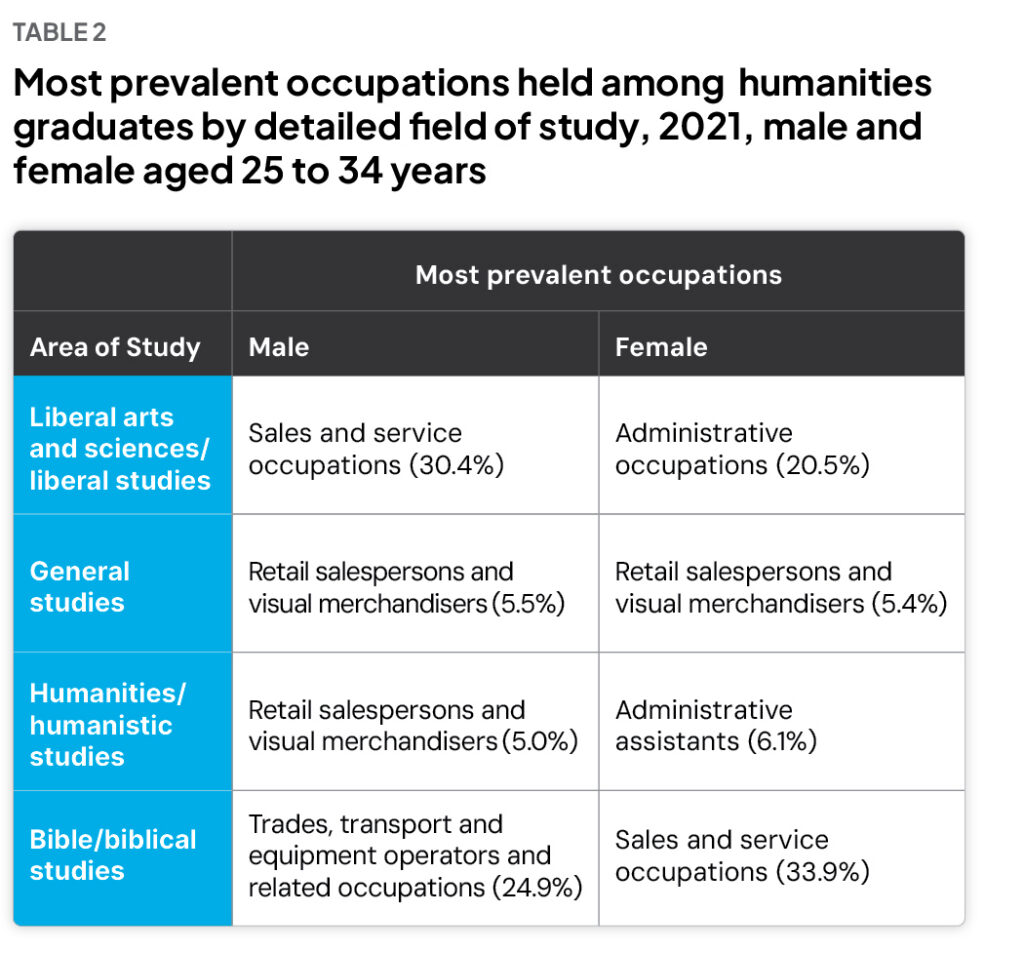
Source: Marc Frenette and Tomasz Handler, 2024.
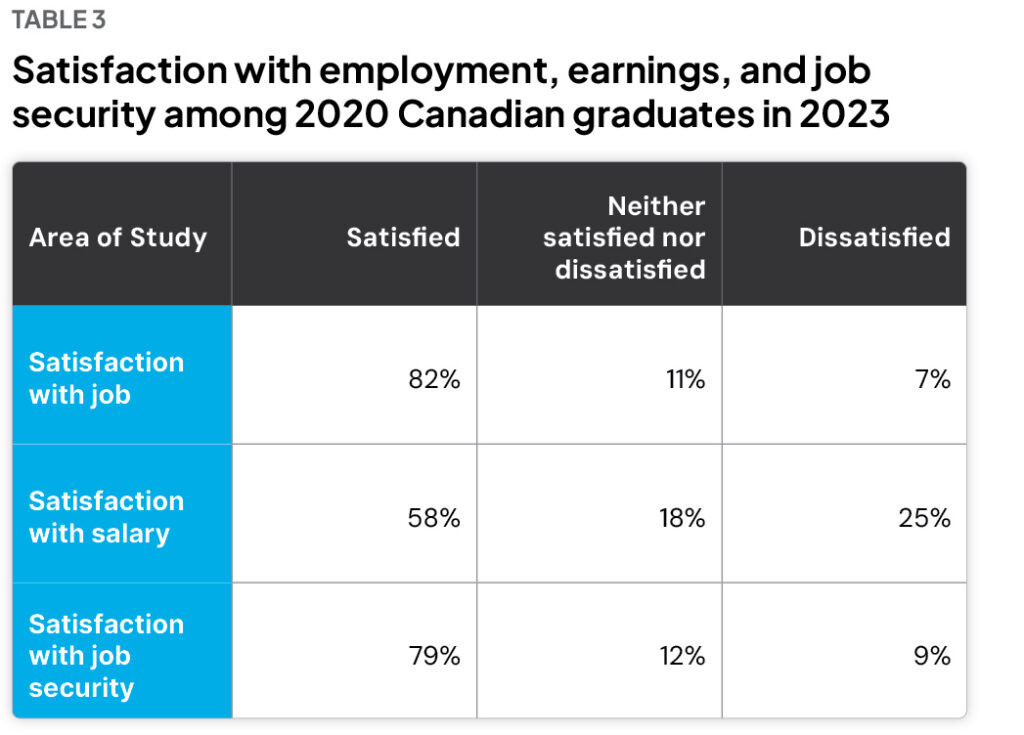
Source: Brittany Etmanski, 2025
Brittany Etmanski, “International Student Graduates’ Labour Market Early Outcomes: Results from the National Graduates Survey,” Insights on Canadian Society, Statistics Canada (February 5, 2025), https://www150.statcan.gc.ca/n1/en/pub/75-006-x/2025001/article/00002-eng.pdf.
“Labour Market Outcomes Three Years After Postsecondary Education, by Province of Study: Table 37-10-0251-01,” Statistics Canada, May 2, 2025, https://www150.statcan.gc.ca/t1/tbl1/en/tv.action?pid=3710025101.
Marc Frenette and Tomasz Handler, “Most Prevalent Jobs of Young Master’s Degree Graduates by Detailed Field of Study,” Economic and Social Reports 4, no. 8 (August 28, 2024), https://www150.statcan.gc.ca/n1/pub/36-28-0001/2024008/article/00001-eng.htm.
Aristotle Notes is a series of concise, accessible fact sheets designed to inform public dialogue and elevate everyday discussions. By delivering clear, reliable data and essential context, these notes equip media professionals, students, and citizens alike with the facts needed to navigate complex topics in our society.