
Aristotle Notes
📊 Why language matters
Language is more than the primary means of human communication; it also shapes how we think and act. Thus, language forms culture and, in turn, plays a vital role in shaping a nation’s identity and fostering unity among its people. Language is central to cultural heritage, democratic inclusivity, and effective governance. However, it is even more critical in Canada, given two policy extremes: (1) illiberal language laws that privilege one shrinking minority group over all other Canadians, and (2) the increasing accommodation of myriad non-official languages in official documents and government services at taxpayers’ expense.
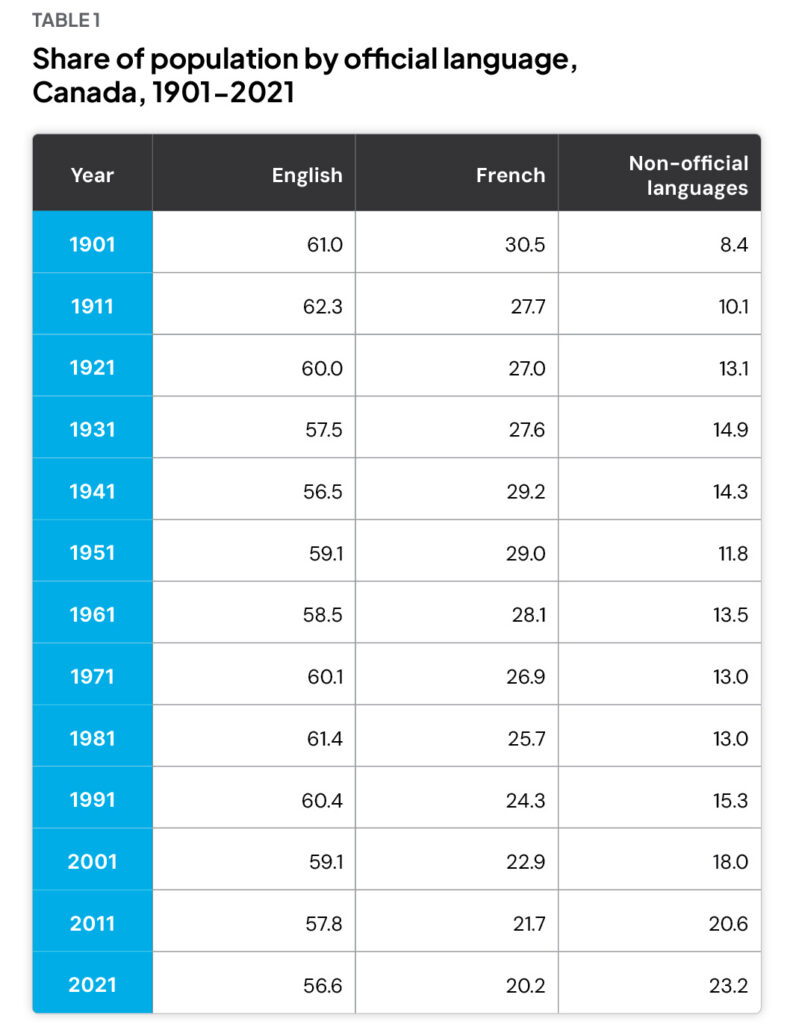
Though indigenous languages have a rich history (with over 70 spoken across the country), English and French are Canada’s two founding, and thus official, languages. These two languages represent the mother tongue of nearly 77 percent of Canadians. Although dominant, this share has fallen considerably from its 1901 census high of 91.5 percent. Since the early 1980s, the share of the population whose mother tongue is neither an official nor an indigenous language has nearly doubled. The proportion of Canadians whose mother tongue is English has historically hovered around 59 percent of the population, with a high above 62 percent in the 1911 census, a low of 56.5 percent in 1941, and 56.6 percent in the most recent census in 2021 (see Table 1). By contrast, the share of people whose mother tongue is a non-official language has risen from 8 percent in 1901 to over 23 percent today. Consequently, one in five Canadians has French as their mother tongue, down from nearly one third in 1901.
Source: Statistics Canada, 2023a
In absolute numbers, as of 2021, 20.7 million people in Canada report English as their mother tongue, 7.4 million report French, and 8.4 million report a non-official language.
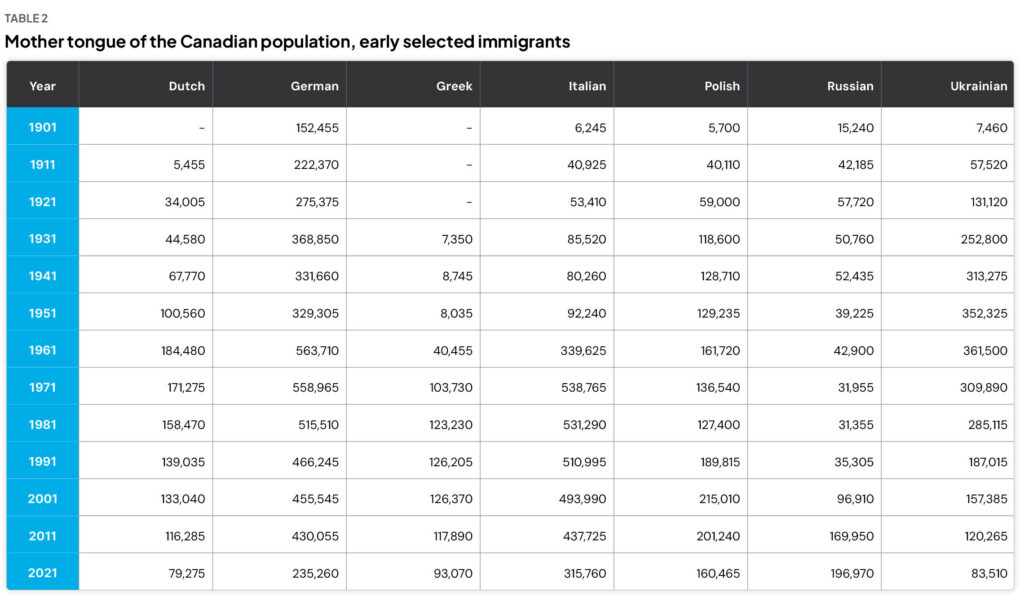
The number and composition of various non-official languages have also grown considerably. The 2021 census recorded around 200 languages as mother tongues. At the start of the 20th century, immigrant languages were limited primarily to European languages, as shown in Table 2.
After the Second World War, German immigration increased. In contrast, Ukrainian immigration declined slightly, and Canada welcomed nearly half a million Italians and a growing variety of immigrants, especially from southern Europe. But the English share of the population held fairly steady, as Canada also experienced considerable immigration from the Anglosphere in the post-war decades. Only in the early 1980s did the non-official-language share of the population begin its prolonged ascent.
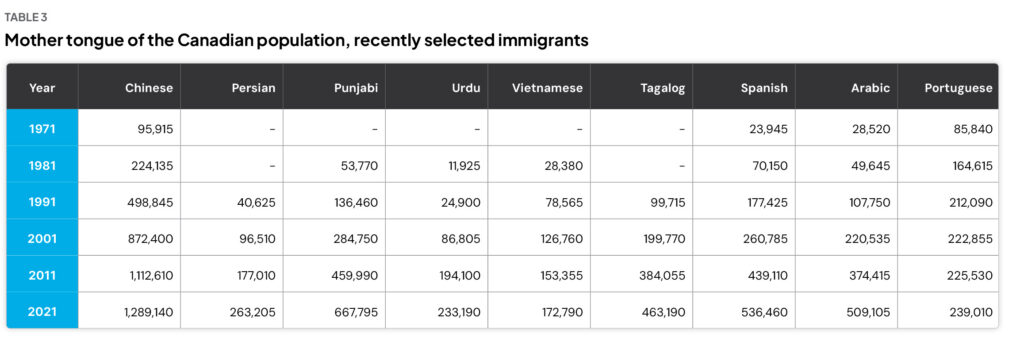
The 2021 census reflects Canada’s considerable immigration in recent decades—predominantly from Asia and, to a lesser degree, Latin America. Chinese is the mother tongue of nearly 1.3 million people in Canada: nearly six times as many as a generation ago (1981) and nearly forty times as many as in 1941. Almost 670,000 Canadians speak Punjabi as their mother tongue, an increase of more than twelve times in 40 years. Over half a million people in Canada speak Spanish and Arabic as their mother tongue—growing nearly seven times and over 10 times, respectively, in four decades (see Table 3).
Source: Statistics Canada, 2018 and Statistics Canada, 2023b. Note: Data that is unavailable is indicated by a dash (-).
Source: : Statistics Canada, 2018 and Statistics Canada, 2023b. Note: Data that is unavailable is indicated by a dash (-)
“The Evolution of Language Populations in Canada, by Mother Tongue, from 1901 to 2016,” Statistics Canada, 2018, https://www150.statcan.gc.ca/n1/pub/11-630-x/11-630-x2018001-eng.htm.
“Table 15-10-0031-01—Population by mother tongue and geography, 1951 to 2021”, Statistics Canada, 2023a, https://www150.statcan.gc.ca/t1/tbl1/en/tv.action?pid=1510003101.
“Table 98-10-0618-01—Mother tongue by immigrant status and period of immigration and number of languages known: Canada, provinces and territories, census metropolitan areas and census agglomerations with parts,” Statistics Canada, 2023b, https://www150.statcan.gc.ca/t1/tbl1/en/tv.action?pid=9810061801
Aristotle Notes is a series of concise, accessible fact sheets designed to inform public dialogue and elevate everyday discussions. By delivering clear, reliable data and essential context, these notes equip media professionals, students, and citizens alike with the facts needed to navigate complex topics in our society.