



Aristotle Notes
📊 Why subsidized housing matters
Canada’s growing housing affordability crisis has shifted the focus to subsidized housing. Housing is a key component of household access to resources such as community amenities, schools, employment, and social cohesiveness. In Canada, the expansionary immigration policy has also contributed to the housing crisis. Knowing the proportion of households living in subsidized housing across Canadian cities matters because it indicates housing affordability and demand for government housing.
According to Statistics Canada 2021 data, about 842,000 Canadians aged 15 and over lived in subsidized housing, representing 3 percent of that population. Of those residents, about 507,000 were women, and 335,000 were men. The number of private households living in subsidized housing varies across Canadian cities.1 It ranges from 2.5 percent in Calgary to nearly 7 percent in Thunder Bay, Ontario. Among other large metro areas, the proportion is 4.6 percent in Toronto, 5.8 percent in Ottawa-Gatineau, 4.2 percent in Vancouver, and 3.6 percent in Montréal (see Table 1).
1 The “number of private households” according to Statistics Canada means the total count of private dwellings that usual residents occupy. A private household is a person or group of people living in the same home who do not have another usual home in Canada or abroad.
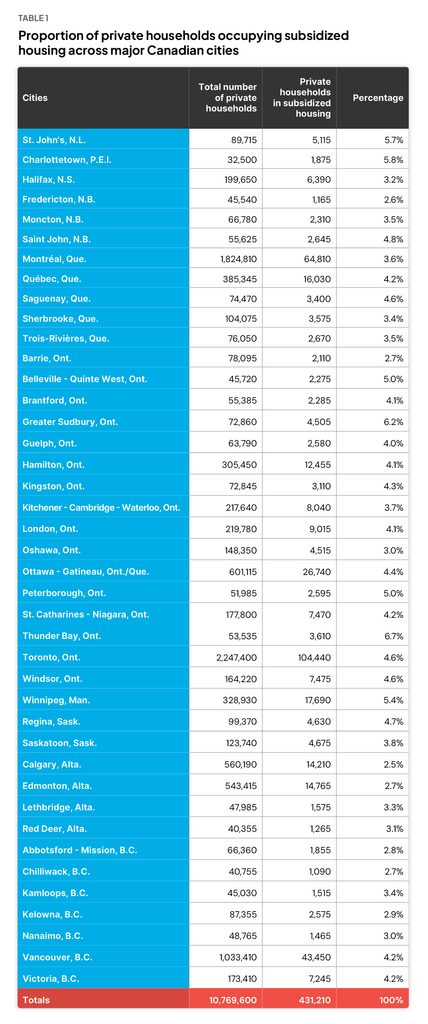
Source: Statistics Canada, 2023a. Note: The “number of private households” according to Statistics Canada means the total count of private dwellings that are occupied by usual residents. A private household is defined as a person or a group of people living in the same home who do not have another usual home in Canada or abroad.
Forty percent of households in subsidized housing are headed by prime working-age individuals aged 24 to 54. Younger age groups (under 24) account for a relatively small share across all provinces, generally ranging from 2 to 6 percent, and those 65 and above account for 31 to 47 percent across provinces (see Table 2).
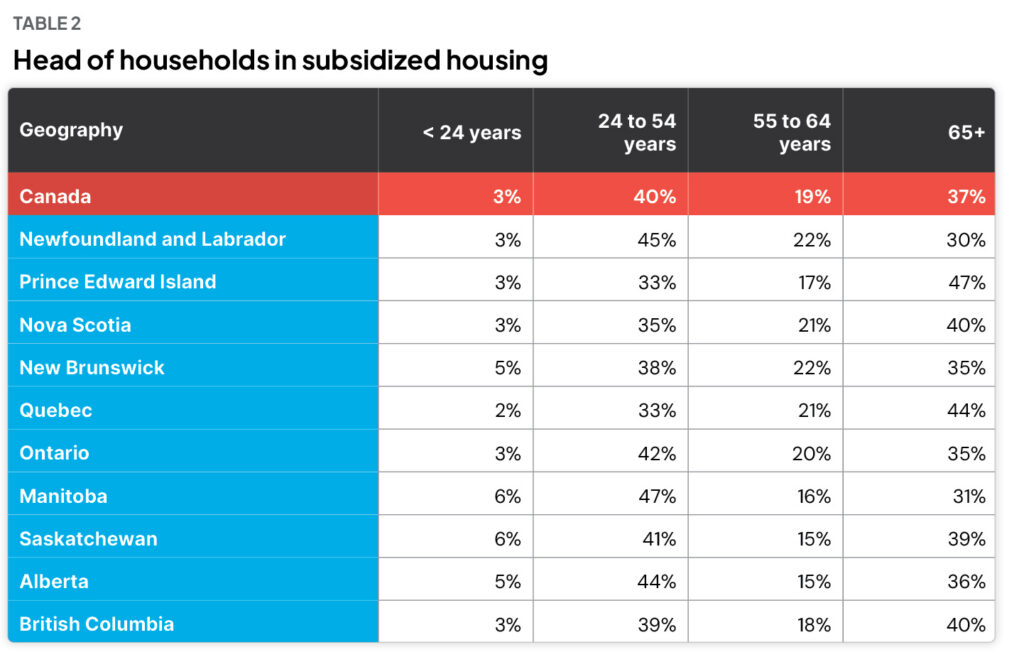
Source: Statistics Canada, 2023a.
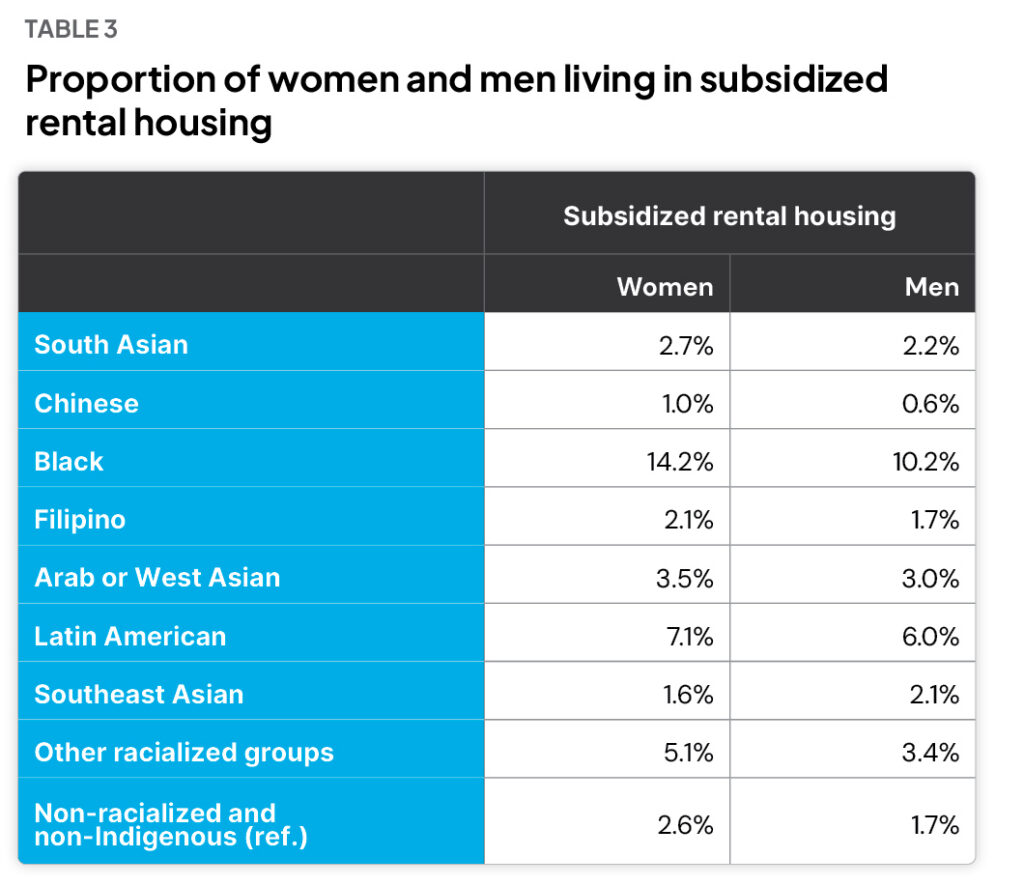
Source: Statistics Canada, 2023c.
Housing indicators by tenure including presence of mortgage payments and subsidized housing and household type including census family structure: Canada, provinces and territories, census metropolitan areas and census agglomerations—Table 98-10-0244-01,” Statistics Canada, October 4, 2023a, https://www150.statcan.gc.ca/t1/tbl1/en/tv.action?pid=9810024401. https://www.statcan.gc.ca/o1/en/plus/3646-look-subsidized-housing-canada.
“A Look at Subsidized Housing in Canada,” Statistics Canada, May 19, 2023b, https://www.statcan.gc.ca/o1/en/plus/3646-look-subsidized-housing-canada.
“Women Living in Subsidized Housing in Canada,” Statistics Canada, April 11, 2023c, https://www150.statcan.gc.ca/n1/pub/75-006-x/2023001/article/00004-eng.htm#t1.
Aristotle Notes is a series of concise, accessible fact sheets designed to inform public dialogue and elevate everyday discussions. By delivering clear, reliable data and essential context, these notes equip media professionals, students, and citizens alike with the facts needed to navigate complex topics in our society.