


Aristotle Notes
📊 Why knowing about teacher salary in Canada matters
Teacher salary plays an important role in the education system. In the age of AI and technology usage in education, teachers are becoming more important in delivering education.
Across Canada, becoming a certified public-school teacher entails significant time and financial investment. According to the latest available data, 422,151 teachers teach primary, middle, and high school across Canada.
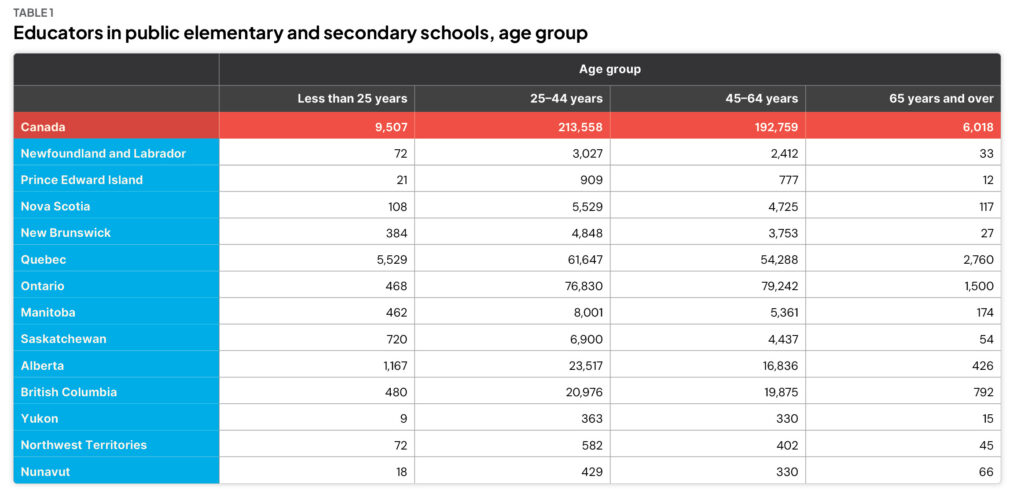
Table 1 shows that the Canadian public elementary and secondary school educator workforce is concentrated among the prime working-age population. Nationally, educators aged 25 to 44 years (213,558) represent the largest group, followed closely by those aged 45 to 64 years (192,759). In comparison, relatively few educators are under 25 (9,507) or aged 65 and over (6,018). This age distribution suggests that Canada’s teaching workforce is largely composed of experienced, mid-career professionals.
Provincially, Ontario has the largest number of educators overall, with 76,830 aged 25 to 44 and 79,242 aged 45 to 64, followed by Quebec with 61,647 and 54,288 in the same age groups. Alberta and British Columbia also have substantial numbers of educators, particularly among working-age adults. Quebec records the highest number of educators under age 25 (5,529).
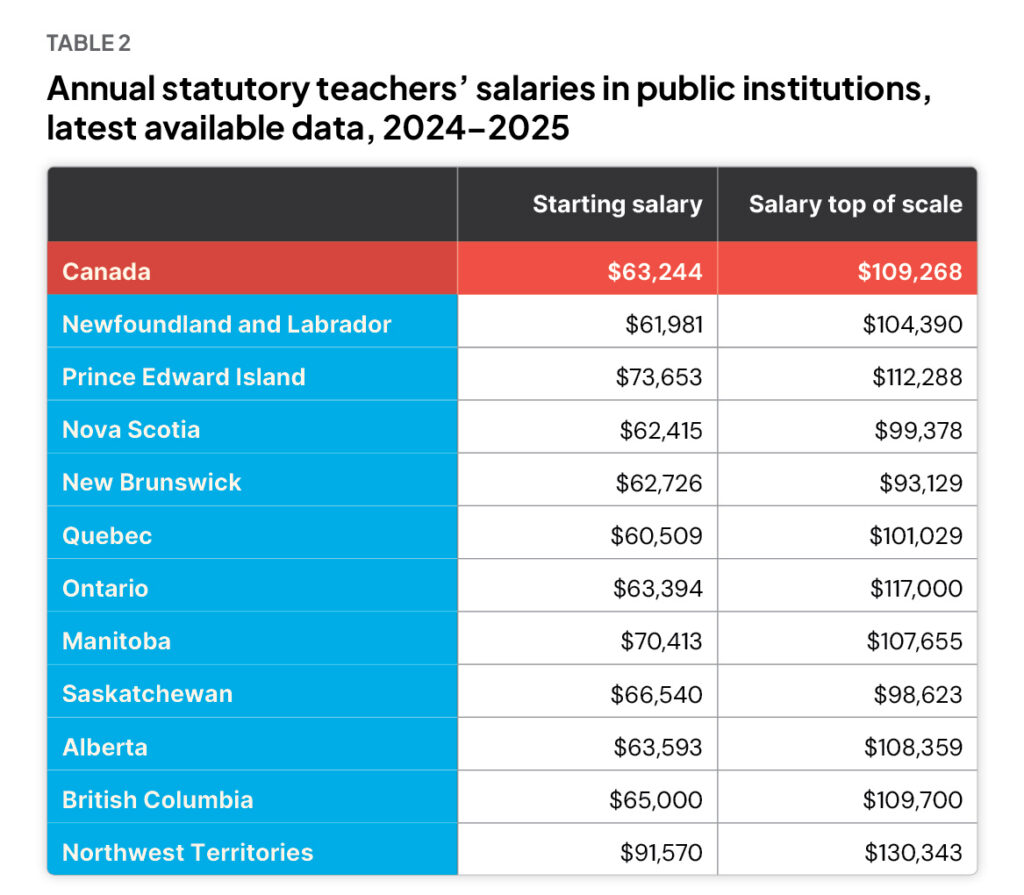
Table 2 shows that teachers’ statutory salaries in Canadian public schools were generally consistent across primary, middle, and high school levels in 2024—25, with no variation by level of education taught within each jurisdiction. Nationally, teachers earned a starting salary of $63,244 and could reach a top-of-scale salary of $109,268, highlighting significant earnings growth throughout a teaching career. Considerable regional differences exist, however. The Northwest Territories offered the highest salaries, with a starting salary of $91,570 and a maximum salary of $130,343, likely reflecting the challenges of attracting and retaining educators in remote northern communities. Among the provinces, Prince Edward Island ($73,653) provided the highest starting salary, while Ontario ($117,000) offered the highest top-of-scale salary. In contrast, Quebec had the lowest starting salary ($60,509), and New Brunswick had the lowest maximum salary ($93,129). Overall, the data indicate that while teachers across Canada can expect substantial salary progression over their careers, compensation levels vary considerably by province and territory, which may influence teacher recruitment, retention, and workforce mobility across jurisdictions.
Source: Statistics Canada, 2026
Source: Statistics Canada, 2026.
“Educators in public elementary and secondary schools, by work status, age group and sex: Table 37-10-0153-01,” Statistics Canada, October 28, 2025, https://www150.statcan.gc.ca/t1/tbl1/en/tv.action?pid=3710015301.
“Annual statutory teachers’ salaries in public institutions, by level of education taught and teaching
experience, Canadian dollars: Table 37-10-0243-01,” Statistics Canada, October 21, 2026, https://www150.
statcan.gc.ca/t1/tbl1/en/tv.action?pid=3710024301.
Aristotle Notes is a series of concise, accessible fact sheets designed to inform public dialogue and elevate everyday discussions. By delivering clear, reliable data and essential context, these notes equip media professionals, students, and citizens alike with the facts needed to navigate complex topics in our society.