Aristotle Notes
📊 Why the social religious composition of Canada matters
Religion is an important part of society. No matter what people believe, religion shapes individual identities and beliefs. On a national level, it affects culture, politics, and laws. It also influences daily habits, such as food and clothing choices. In communities, religion affects how people treat one another and shapes how society functions. In Canada, religious groups from many faiths are active across the provinces.
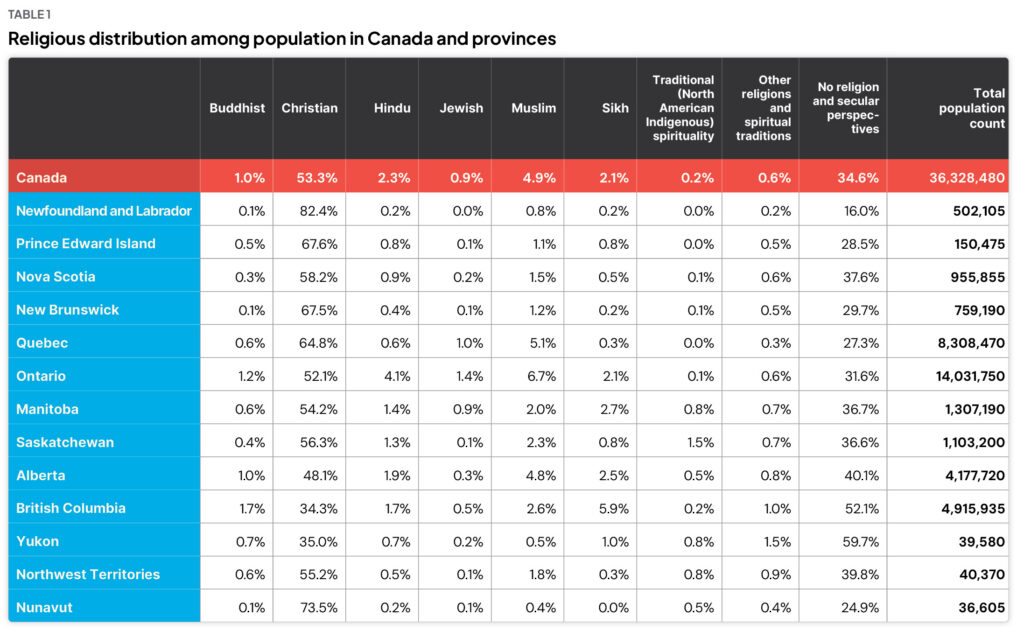
Canada’s religious makeup is changing. Table 1 shows that fewer Canadians identify as Christian, while other religions are growing more quickly. More people are also choosing not to adhere to any religion. Christianity remains the largest religion in Canada, at 53.3 percent of the population, but this varies by region. Newfoundland and Labrador has the highest percentage of Christians at 82.4 percent, while British Columbia has the lowest at 34.3 percent.
Major non-Christian religions like Islam (4.9%), Hinduism (2.3%), and Sikhism (2.1%) are mostly found in larger provinces such as Ontario, Quebec, Alberta, and British Columbia, and their presence in Canada is linked to immigration. A significant number of Canadians, 34.6 percent, report having no religion, and, in British Columbia, this number is even higher at 52.1 percent. These numbers show that religious affiliation varies widely by province, with some areas still mostly Christian and others moving away from Christianity.
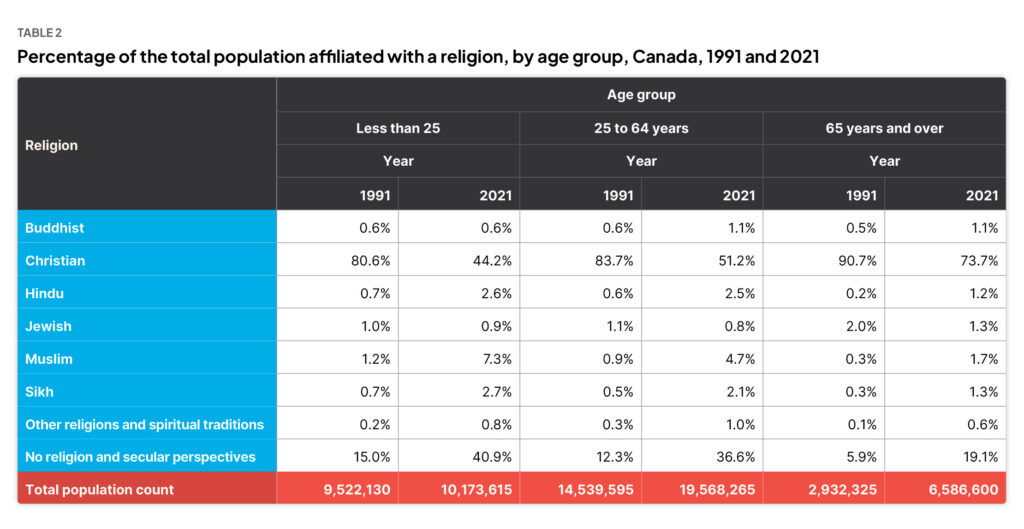
The data show major generational changes in religious affiliation in Canada from 1991 to 2021 (see Table 2). Christianity declined significantly in all age groups, especially for people under 25, where it went from 80.6 percent to 44.2 percent. For adults aged 25 to 64, the percentage of those identifying as Christian fell from 83.7 percent to 51.2 percent. At the same time, more Canadians reported having no religion: Among those under 25, those claiming no religion rose from 15 percent to 40.9 percent, and among adults aged 25 to 64, from 12.3 percent to 36.6 percent. Non-Christian religions like Islam, Hinduism, and Sikhism also grew in all age groups, a trend that is linked to higher immigration levels. The largest increases were among younger Canadians. The Muslim population under 25 increased from 1 percent to 7 percent, and the Hindu population from less than 1 percent to nearly 3 percent.
Source: Statistics Canada, 2023.
Source: Statistics Canada, 2023.
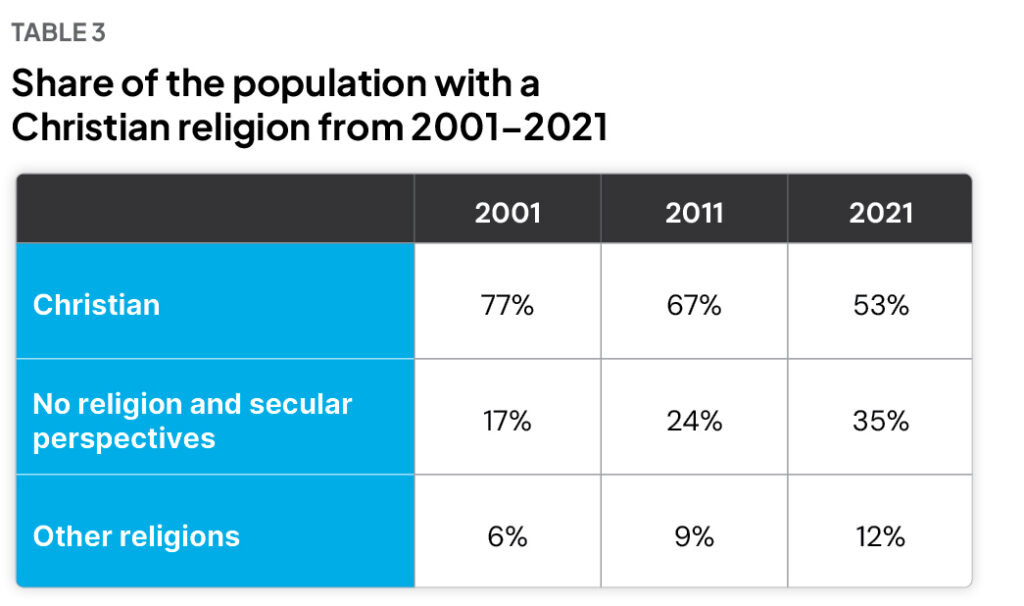
From 2001 to 2021, religious affiliation in Canada changed significantly. The percentage of Christians fell from 77 percent to 53 percent, while the share of people with secular views or no religion rose from 17 percent to 35 percent (see Table 3). Other religions also grew, rising from 6 percent to 12 percent. These changes show that Canada is becoming more religiously diverse and that a growing number of people prefer secular identities. Overall, the data show a move away from traditional Christian affiliation.
Source: Statistics Canada, 2022.
“The Canadian Census: A Rich Portrait of the Country’s Religious and Ethnocultural Diversity,” Statistics Canada, October 26, 2022, https://www150.statcan.gc.ca/n1/daily-quotidien/221026/dq221026b-eng.htm.
“Table 98-10-0353-01—Religion by gender and age: Canada, provinces and territories,” Statistics Canada, 2023, https://www150.statcan.gc.ca/t1/tbl1/en/tv.action?pid=9810035301.
Aristotle Notes is a series of concise, accessible fact sheets designed to inform public dialogue and elevate everyday discussions. By delivering clear, reliable data and essential context, these notes equip media professionals, students, and citizens alike with the facts needed to navigate complex topics in our society.