

It claims to oppose the Cowichan decision that threatens private property, but it’s been working against property owners for years
A City of Richmond letter to property owners in the Cowichan Aboriginal title area recognized by the B.C. Supreme Court has brought the judgment’s potential impacts into stark reality.
“For those whose property is in the area outlined in black,” the letter explained, “the Court has declared Aboriginal title to your property which may compromise the status and validity of your ownership.”
While Premier David Eby has been quick to disavow the decision, the reality is his government helped set the stage for it in multiple ways. Worse, it quietly supported a similar outcome in a related case, even after the concerning implications of the Cowichan judgment were well-known.
The problematic nature of the Cowichan decision has been well-established. It marks the first time a court has declared Aboriginal title over private property in B.C., and declares certain fee simple land titles (i.e., private property) in the area “defective and invalid.”
Understandably, the letter raised alarm bells not only for directly-affected property owners, but also for British Columbians generally, who recognize that the court’s findings in Richmond may well be replicated in other areas of the province in the future.
As constitutional law professor Dwight Newman pointed out in August, if past fee simple grants in areas of Aboriginal title claims are inherently invalid, “then the judgment has a much broader implication that any privately owned lands in B.C. may be subject to being overridden by Aboriginal title.”
In response to media questions about the City of Richmond’s letter, Eby re-stated his previous commitment to appeal the decision, saying, “I want the court to look in the eyes … of the people who will be directly affected by this decision, and understand the impact on certainty for business, for prosperity and for our negotiations with Indigenous people.”
While the words were the right ones, his government helped lay the groundwork for this decision in at least three ways.
First, the province set the policy precedent for the recognition of Aboriginal title over private property with its controversial Haida agreement in 2024. The legislation implementing the agreement was specifically referenced by the plaintiffs in the Cowichan case, and the judge agreed that it illustrated how Aboriginal title and fee simple can “coexist.”
Eby called the Haida agreement a “template” for other areas of B.C., despite the fact that it raised a number of democratic red flags, as well as legal concerns about private property rights and the constraints it places on the ability of future governments to act in the public interest.
While the agreement contains assurances that private property will be honoured by the Haida Nation, private property interests and the implementation of Aboriginal title are ultimately at odds. As Aboriginal law experts Thomas Isaac and Mackenzie Hayden explained in 2024, “The rights in land which flow from both a fee simple interest and Aboriginal title interest … include exclusive rights to use, occupy and manage lands. The two interests are fundamentally irreconcilable over the same piece of land.”
Second, the provincial and federal lawyers involved in the Cowichan proceedings were constrained by the government in terms of the arguments they were allowed to make to protect private property. In August, legal expert Robin Junger wrote, “One of the most important issues in this case was whether Aboriginal title was ‘extinguished’ when the private ownership was created over the lands by the government in the 1800s.”
The Cowichan judgment expressly notes that B.C. and Canada did not argue extinguishment. In B.C.’s case, this was due to civil litigation directives issued by Eby when he was attorney general.
Finally, provincial legislation implementing the United Nations Declaration on the Rights of Indigenous Peoples (UNDRIP) also played a role in supporting the judge’s conclusions, a point Newman wrote about in August. “They’re used in support of (even if not as the main argument for) the idea that Aboriginal title could yet take priority over current private property rights,”
In addition to setting the stage for the Cowichan decision, and despite their stated concerns with that judgment, the B.C. government has actively sought judicial recognition of Aboriginal title over private property elsewhere.
The overlaying of Aboriginal title over private property with the Haida agreement was already problematic enough prior to the Cowichan decision. However, even after the serious implications of the Cowichan decision were clear, the provincial and federal governments quietly went before the B.C. Supreme Court in support of a consent order that would judicially recognize the Aboriginal title over the entirety of Haida Gwaii.
The successful application had the effect of constitutionally entrenching Aboriginal title for the Haida Nation, including over private property, with the explicitly stated goal of making it near-impossible for future democratically elected governments to amend the agreement.
The reality is, the B.C. government claims to oppose the Cowichan decision even as it laid the groundwork for it, and it has actively pursued similar outcomes on Haida Gwaii. Repeated claims of seeking certainty and protecting private property have been belied by this government’s actions again and again.
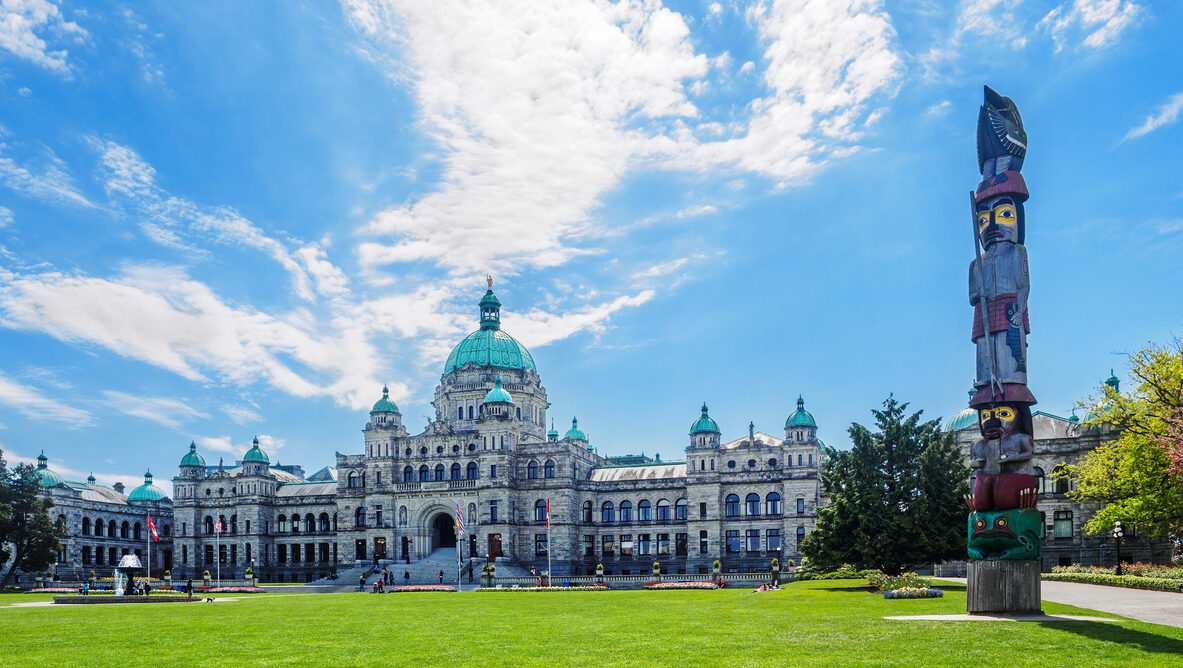
Caroline Elliott, PhD, is a senior fellow with the Aristotle Foundation for Public Policy and sits on the board of B.C.’s Public Land Use Society. Photo: iStock.
Like our work? Think more Canadians should see the facts? Please consider making a donation to the Aristotle Foundation.
SUBSCRIBE TO OUR NEWSLETTER