

*Actual* root causes from the UAE, Barry Cooper, and Waller Newell
One reason I founded the Aristotle Foundation for Public Policy is because I thought material explanations including the use of statistics and data—useful as they are for many analyses—were inadequate in analyzing many modern threats to reason, democracy, and ultimately to civilization.
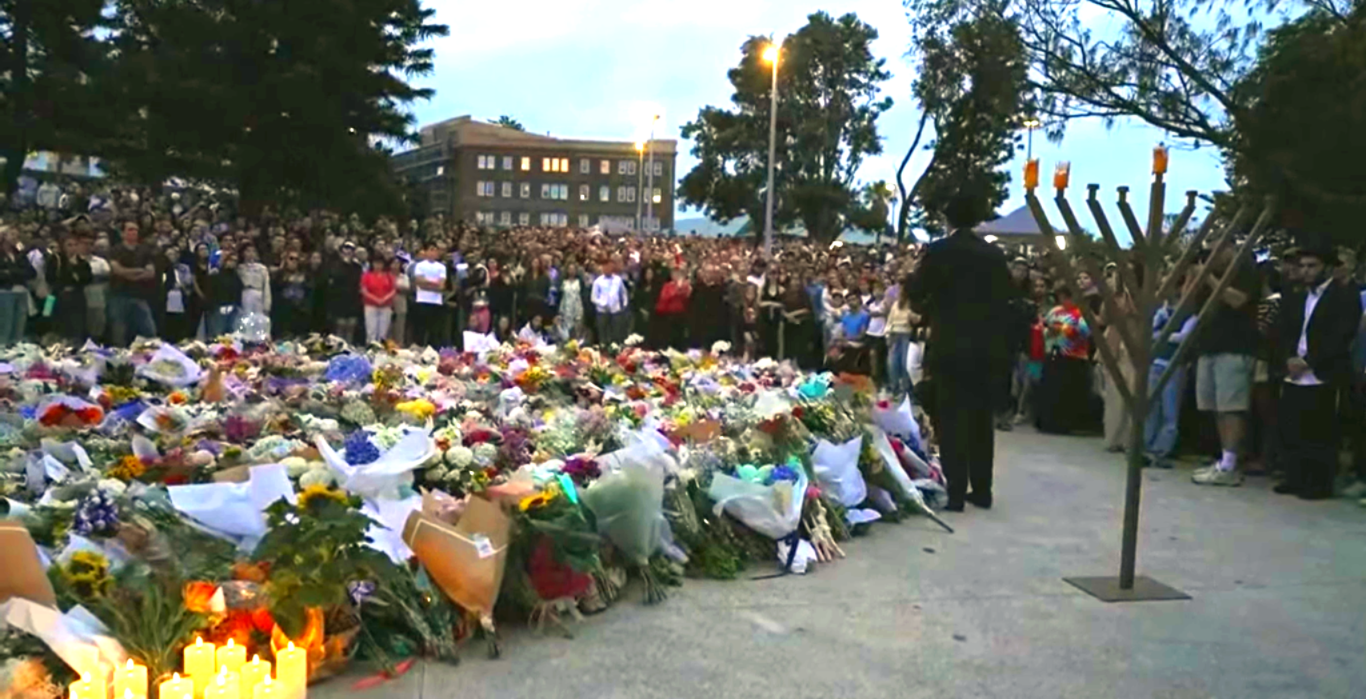
An horrific example just occurred in Sydney, Australia where terrorists attacked Jews celebrating Hannukah. As I write, 16 people have been killed.
The roots of terror, motivations for the same, and examples are diverse. In the 18th and 19th centuries, terrorists included anarchists and nationalists. In the 20th century, terror attacks came from Marxists, Nazis (before and after taking power in Germany), nationalists, and others.
In the late 20th century and into 21st, terror attacks came from cults, nationalists, Islamists, and even on occasion the most radical of environmentalists. (The Unabomber was an example of the latter. He was not the only one.)
A UAE commentator on Sydney’s terrorist attacks
The Islamist version came into view again Sunday. And a frank insight on the Sydney attack was broadcast on Sunday from UAE commentator AQ Almenhali. “When radical narratives linked to political Islam are tolerated, rebranded, and excused, someone eventually acts on them.”
Seven years ago, the United Arab Emirates Foreign Minister warned that the West and Westerners were dangerously naïve about modern terror: “There will come a day we will see far more radical extremists and terrorists.” The UAE minister explained why.
Barry Cooper on modern terror: The “spiritual” variety
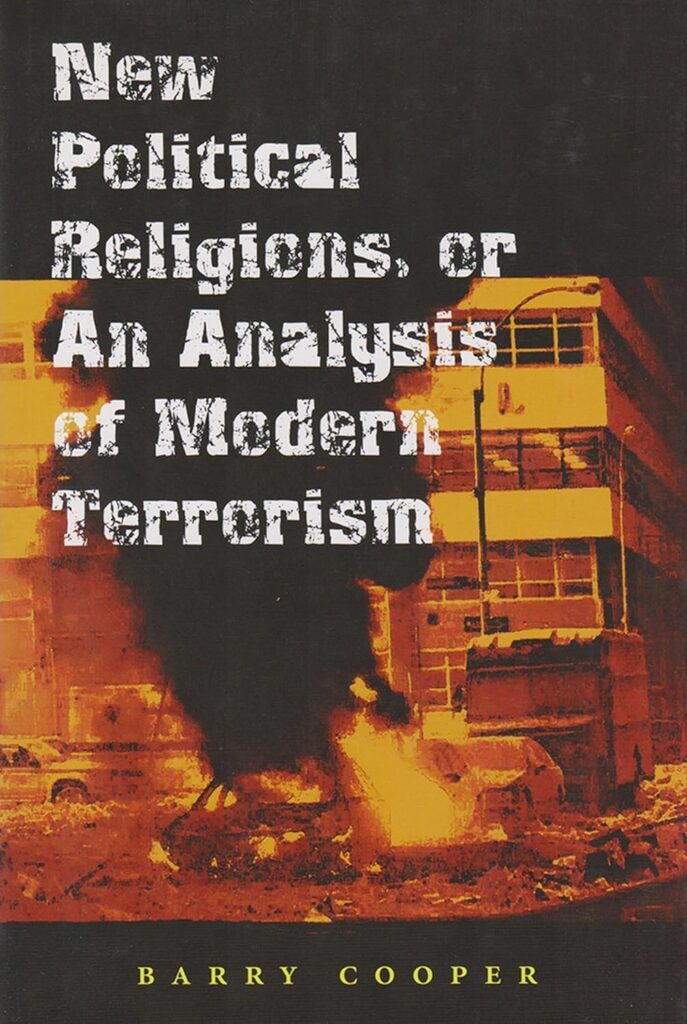
Two senior fellows at the Aristotle Foundation who are experts on terror have long explained, in-depth, the source of the just-noted radical narratives.
In the wake of the 9/11 attack, University of Calgary Political Science professor Barry Cooper wrote a 2004 book, New Political Religions, or an Analysis of Modern Terrorism. Drawing on insights from Eric Voegelin, Cooper argued that there was a “spiritual motivation” that was central to the actions of terrorists today.
By “spiritual,” Cooper did not mean that in narrow religious terms but in opposition to material explanations for terror, as in assuming poverty is a “root cause” for terrorism.
While such dynamics sometimes exist, Cooper wrote that “a more conceptually adequate approach is provided by Voegelin’s political science and, in particular, by his Schellingian term pneumopathology—a disease of the spirit.” Cooper then made a further distinction: “While terrorism has been used throughout the ages as a weapon in political struggles, there is an essential difference between groups who use these tactics for more of less rational political goals and those seeking more apocalyptic ends.”
As the publisher’s summary of New Political Religionsdescribes it, “Cooper argues that today’s terrorists have a spiritual perversity that causes them to place greater significance on killing than on exploiting political grievances.” Cooper gave two examples, Aum Shinrikyo, the terrorist organization that poisoned thousands of Tokyo subway riders in 1995, and Al-Qaeda, the group that launched the 9/11 terror attacks.
Cooper points out that this “spiritual perversity enables a human being, imagining himself empowered by God, to go on a campaign of mass destruction.”
Barry Cooper’s analysis was influential. New Political Religions was later found in Osama bin Laden’s library when U.S. special forces raided and killed him in his lair in 2011.
Waller Newell on the revolutionary tyrant: Young and bloodthirsty
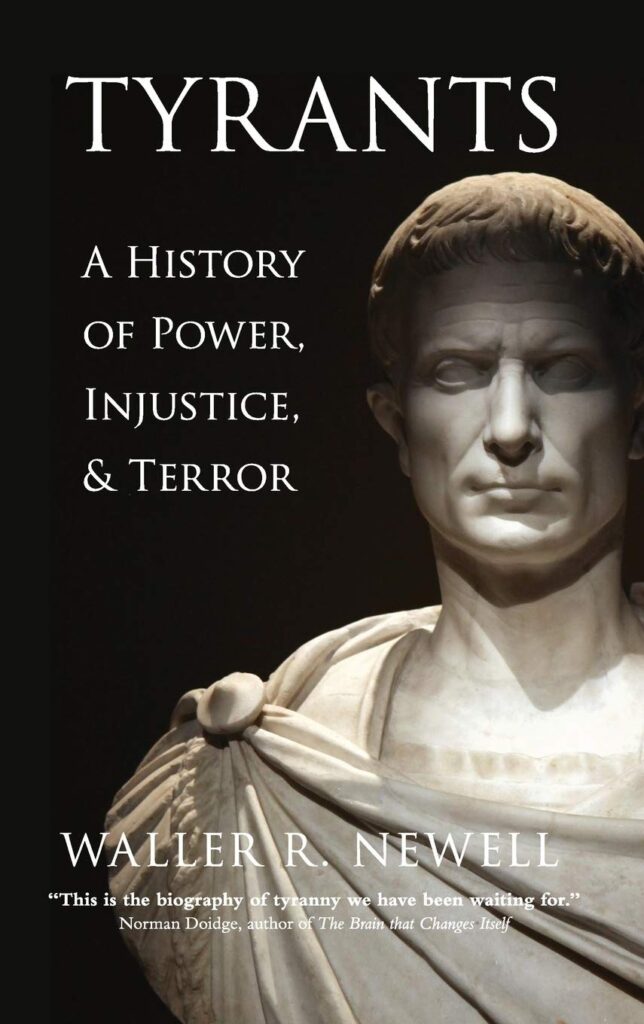
Another Aristotle Foundation Senior Fellow, Carleton University political scientist Prof. Waller Newell, has also published extensively on terror and tyrants. Here are some excerpts from my 2016 review of Newell’s book. It will give you a sense of his arguments.
“The third sort of tyrant is the most destructive and spills the most blood. This model is the millenarian, those with ambition to effect the wholesale transformation of society – a.k.a. the revolutionary utopian. ‘They are not concerned with serving actual people around them, even the downtrodden whom they claim to champion,’ writes Newell. Instead, ‘They worship the ideal of a purely virtuous collective for whose sake the endless vices and perfidy of the actual masses must be mercilessly uprooted.’”
“The world has experienced many such men – and they are almost always men, usually young – during the last two centuries or so. They first showed up at the French Revolution, when the Jacobins began to slice off heads and make blood run in Parisian streets in order to ‘purify’ the population in pursuit of their utopian aims.”
“In essence they borrowed their utopianism from Christianity, although Christ never commanded a heaven on earth. The Jacobins, in pursuit of an earthly paradise which included an end to injustice as they defined it, tried their hand at its creation in the here and now instead of waiting for the hereafter.”
“For French Jacobins, perfect equality of condition was the goal. For their ideological descendants Lenin, Stalin, Mao and Pol Pot, perfect communism; for Hitler, perfect racial purity. Today’s variety of a millenarian tyrant worships religious purity. They have been in full view for decades.”
“Newell points out that while today’s terrorists and tyrants may claim they mean to re-establish a pure form of Islam, they in fact are apostates. He observes that similar to the other two Abrahamic faiths that assume ‘human beings are servants of God and powerless to do good without him,’ this core Abrahamic view of God is betrayed by Islamists. Their crude revolutionary project which attempts to create heaven on earth is an assertion of ‘man’s absolute control over his own destiny.’ It is akin to challenging God’s authority, the elevation of man’s politics and power above divine power – blasphemy.”
The French intellectual connection
“Thus, in Newell’s view, these modern tyrant-terrorists take their inspiration less from Islam than from a uniquely destructive European tradition. For proof, he points to the Iranian intellectual, Ali Shariati (1933-1977), who studied comparative literature in Paris in the early 1960s. He was influenced there by the anti-Western, anti-Enlightenment work of Jean-Paul Sartre and the revolutionary anti-colonial writings of Frantz Fanon, the latter of which Shariati helped translate into Farsi.”
“‘This potent brew of violent struggle and passionate commitment to a utopian vision of a collectivist past reborn in the future deeply influenced Ali Shariati,’ writes Newell, who notes Shariati then went on to politicize the Shiite faith of his fellow Iranians ‘with the same existentialist creed of revolutionary violence and purification’ that he first found in France.”
“Newell identifies several characteristics common to these millenarians, whether they are in power or seeking power. They are most often young and male. Often – and this is depressing – students and student movements are the vanguard of millenarian tyranny. And they worship supposedly authentic culture which is why they and their followers seek to eradicate the “impure” contaminants (such as capitalists, Jews, or infidels) from their world.”
The terror attack in Sydney needs to be understood. Please share this posting.
Mark Milke, president and founder
Aristotle Foundation for Public Policy
For more on terrorism: