

NDP will find it difficult to run a campaign focused primarily on the threat from Washington, D.C. Eventually, the government will have to confront the issues it controls at home
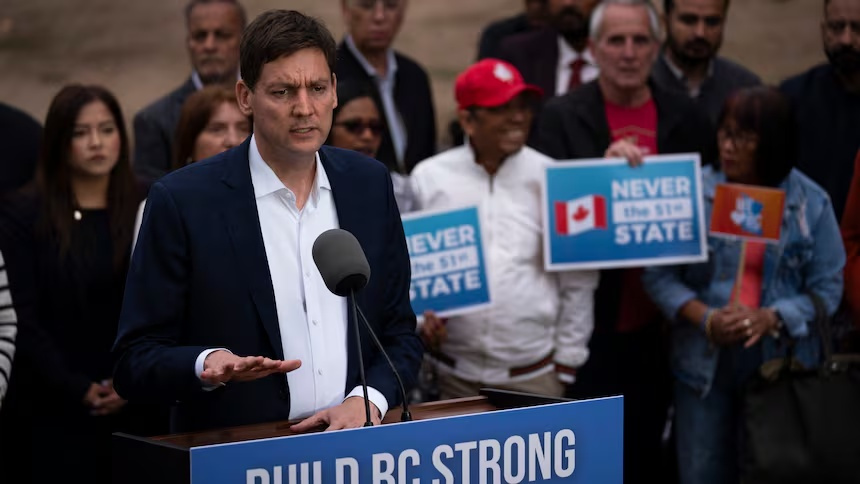
B.C. Premier David Eby called a provincial election last week, less than two years after narrowly winning the last election, saying another election is necessary because B.C. is facing an “existential moment.”
Speaking to reporters last week, he said: “Donald Trump is attacking our workers, he’s targeting our businesses, he’s threatening our ability to make decisions for ourselves.”
Like many Canadians, British Columbians are angry about the American government’s provocations. Eby is hoping voters will channel that frustration into another NDP victory. His government holds a slim, three-seat majority in the legislature, and an election fought against a divided opposition could allow his party to expand that majority.
An NDP victory in October could also give the government political staying power beyond the Trump presidency, which, barring an extraordinary constitutional crisis, will end after the 2028 U.S. presidential election.
Eby’s strategy is risky, however. An Angus Reid Institute poll released Sept. 17 found that 51 per cent of British Columbians feel like a “political orphan,” meaning they don’t strongly identify with any of the current parties.
In other words, a large portion of the electorate remains up for grabs. The other parties have an opportunity to convince those voters that provincial issues matter more than the conflict with Washington, D.C.
Those issues include continuing uncertainty about property rights and Indigenous land claims. The Declaration on the Rights of Indigenous Peoples Act (DRIPA), combined with the B.C. Supreme Court’s 2025 Cowichan Tribes v. Canada decision, has raised questions about how Indigenous title interacts with existing property rights.
In 2019, when Eby was attorney general, the NDP government amended the province’s implementing legislation to state that “the government must take all measures necessary to ensure the laws of British Columbia are consistent with the Declaration.” The B.C. Court of Appeal subsequently ruled in the Gitxaala case that the province’s mineral-claim system was inconsistent with DRIPA.
Meanwhile, Prime Minister Mark Carney has argued that approvals for major projects, including mines and pipelines to the West Coast, must be expedited to help Canada withstand U.S. tariffs. Yet it remains unclear how quickly such projects can proceed in B.C. while DRIPA is in force. Eby’s proposal to suspend the legislation was shelved after some members of his caucus opposed it, while the Union of B.C. Indian Chiefs warned of “collective resistance” and legal challenges.
The Cowichan Tribes decision adds another layer of uncertainty. The court described Aboriginal title as a “senior interest in land” relative to fee-simple titles derived from Crown grants. Fee simple is the most common form of private property ownership in Canada. The province has appealed the decision, but it could take years for the courts to resolve the issue.
Until then, questions remain about how competing claims to the same land will be treated. For homeowners and businesses that assumed their fee-simple title provided exclusive ownership, the uncertainty is significant. Investors and entrepreneurs generally avoid uncertainty, and the longer the legal questions remain unresolved, the more difficult it is to assess their potential economic consequences. Homeowners in Richmond, the area directly affected by the Cowichan ruling, are reportedly finding it difficult to remortgage their homes or to find willing buyers.
B.C. voters will also be considering the province’s finances. Provincial debt is expected to reach $189 billion by 2029, while the deficit is projected at $13.3 billion for 2026-27. Major rating agencies, Standard & Poor’s and Moody’s, have downgraded the province’s credit rating amid concerns about the deficit and spending. S&P cited a “less proactive management strategy” and weaker-than-expected commitment to addressing the province’s structural budget shortfall.
A lower credit rating increases borrowing costs. Meanwhile, the cost of servicing B.C.’s debt is already rising. Journalist Rob Shaw has reported that interest payments are expected to reach $6.5 billion, making debt servicing one of the government’s largest expenditures.
If borrowing costs continue to rise, the province will eventually face difficult choices: higher taxes, reduced public services, or both. None is likely to appeal to voters already dealing with their own economic pressures.
Eby’s election gamble may pay off, but the NDP will find it difficult to run a campaign focused primarily on the threat from Washington, D.C. Eventually, the government will have to confront the issues it controls at home.
With 51 per cent of British Columbians saying they feel like political orphans, the election may ultimately be decided by voters who aren’t firmly attached to any party. Their concerns extend well beyond Trump — and the NDP will have to persuade them that its record in B.C. deserves their support.
Professor David Livingstone is a senior fellow with the Aristotle Foundation for Public Policy. Photo Credit: CBC.
Like our work? Think more Canadians should see the facts? Please consider making a donation to the Aristotle Foundation.
SUBSCRIBE TO OUR NEWSLETTER