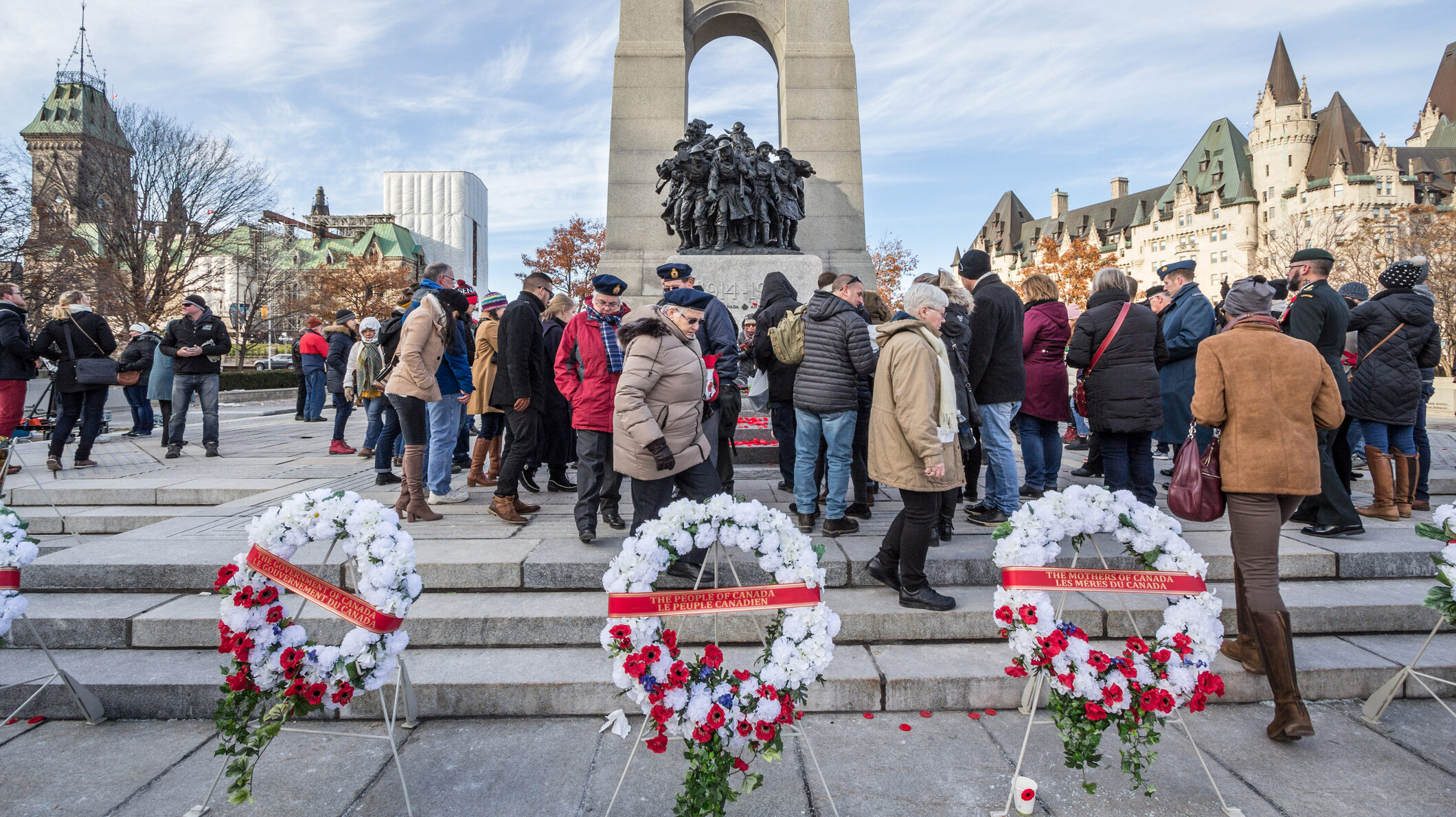

For more than a century, Canadians gathered every Remembrance Day to honour our veterans with wreath-laying, reverent song, and solemn prayer. But thanks to an updated decree issued by the Department of National Defence, any mention of “religious specific language, including references to God” by military personnel at any public event, including Remembrance Day ceremonies, remains strictly prohibited.
The ban on religious prayer in public military settings has been in effect since 2023, but the Defence Department doubled down and expanded the restrictions in July of this year.
A chaplain who utters a traditional prayer to God will be in violation. As will any military personnel who sing hymns traditionally sung on Remembrance Day, including “The Lord’s My Shepherd.” One wonders what the soldiers, airmen, seamen, and merchant seamen who fell in Canada’s wars would think about that—the vast majority of whom were Christian.
Forgetting God is the mandate this Remembrance Day.
Indeed, this administrative overreach remarkably united Canada’s disparate religious bodies. Protestant, Catholic, Jewish, and Islamic groups jointly condemned the move, viewing the policy as a blunt instrument of state erasure.
Rather than take ownership of a radical political agenda, military brass claim they are simply aligning policy with the Supreme Court of Canada’s 2015 Mouvement laïque québécois v. Saguenay ruling. That case involved an atheist who objected to an explicitly Catholic prayer leading a Quebec municipal council meeting.
The Supreme Court rejected the municipality’s argument that dissenters could simply arrive late, ruling that such opt-out policies publicly stigmatized non-participants. Ultimately, the top court unanimously ruled the municipal policy unconstitutional because it violated freedom of conscience.
By opting for the most extreme risk-averse interpretation of that ruling, National Defence bureaucrats ignored creative ways to balance the spiritual needs of Canadian Forces’ members with the text of the law.
This total ban prioritizes the single complainant who objects to any religious language, forcing the beliefs, history, culture, and comfort of everyone else to take a back seat.
Dr. Benjamin Berger, a leading Canadian constitutional scholar and author of “Law’s Religion,” argues that the military’s version of neutrality imposes its own exclusionary culture rather than providing a neutral blank canvas. Canada traditionally embraces a model of pluralism that respects multiple expressions in the public square. The new military policy enforces erasure, not accommodation.
Many chaplains complain the directive turns them into state bureaucrats dispensing platitudes divorced from their true beliefs, regardless of official assurances protecting private voluntary chaplaincy.
The Servatius v. Alberni School District No. 70 ruling offers vital insight into how Canada can balance these issues. In that case, the British Columbia Supreme Court ruled that a public school did not violate the rights of an evangelical Christian woman during a classroom cultural demonstration—the event involved a local indigenous smudging ceremony and a brief prayer by a guest hoop dancer.
The mere presence of the spiritual activity violated no rights because the school compelled no one to believe anything. The lawyers for the Christian mother drew heavily on the Saguenay ruling to argue for total secular erasure. The B.C. Court of Appeal upheld the decision, giving the Supreme Court of Canada an explicit blueprint for handling pluralism.
Scholars offer alternative frameworks that respect the court ruling while maintaining authentic faith expressions. Dr. Andrew Bennett, the former Canadian Ambassador for Religious Freedom, promotes a multi-faith rotational system where various traditions, including humanists, offer short invocations during major events.
Chaplains could use broadly inclusive faith language that also recognizes those who lack faith, rather than relying on a strict sectarian secularist framework. Alternatively, the military could host two separate ceremonial tracks—one with faith language and one without—and require members to opt in.
These scholars remind Canadians that the country lacks a historical tradition of radical secularization that mandates scrubbing faith from all public life (Quebec’s unique laicité via Bill 21 remains an anomaly in the broader Canadian experience). The new policy is also entirely alien to a military where many historic regiments maintain religious mottos, crests, and symbols. For instance, the Quebec Regiment (Les Voltigeurs de Québec) displays the Latin motto “Deus Nobiscum Quis Contra,” which translates to “If God is with us, who can be against us?”
David McGuinty, the Minister of National Defence, should be alert to the damage this new decree causes before Canadians once again attend a hollow ceremony on a hallowed day.
A top-down enforcement of secularism does not represent Canadian pluralism, and the minister should rescind this policy immediately before it breaks the trust of many who serve.
Joseph Quesnel is a senior fellow with the Aristotle Foundation for Public Policy. Photo: iStock.
Like our work? Think more Canadians should see the facts? Please consider making a donation to the Aristotle Foundation.
SUBSCRIBE TO OUR NEWSLETTER