FOR IMMEDIATE RELEASE
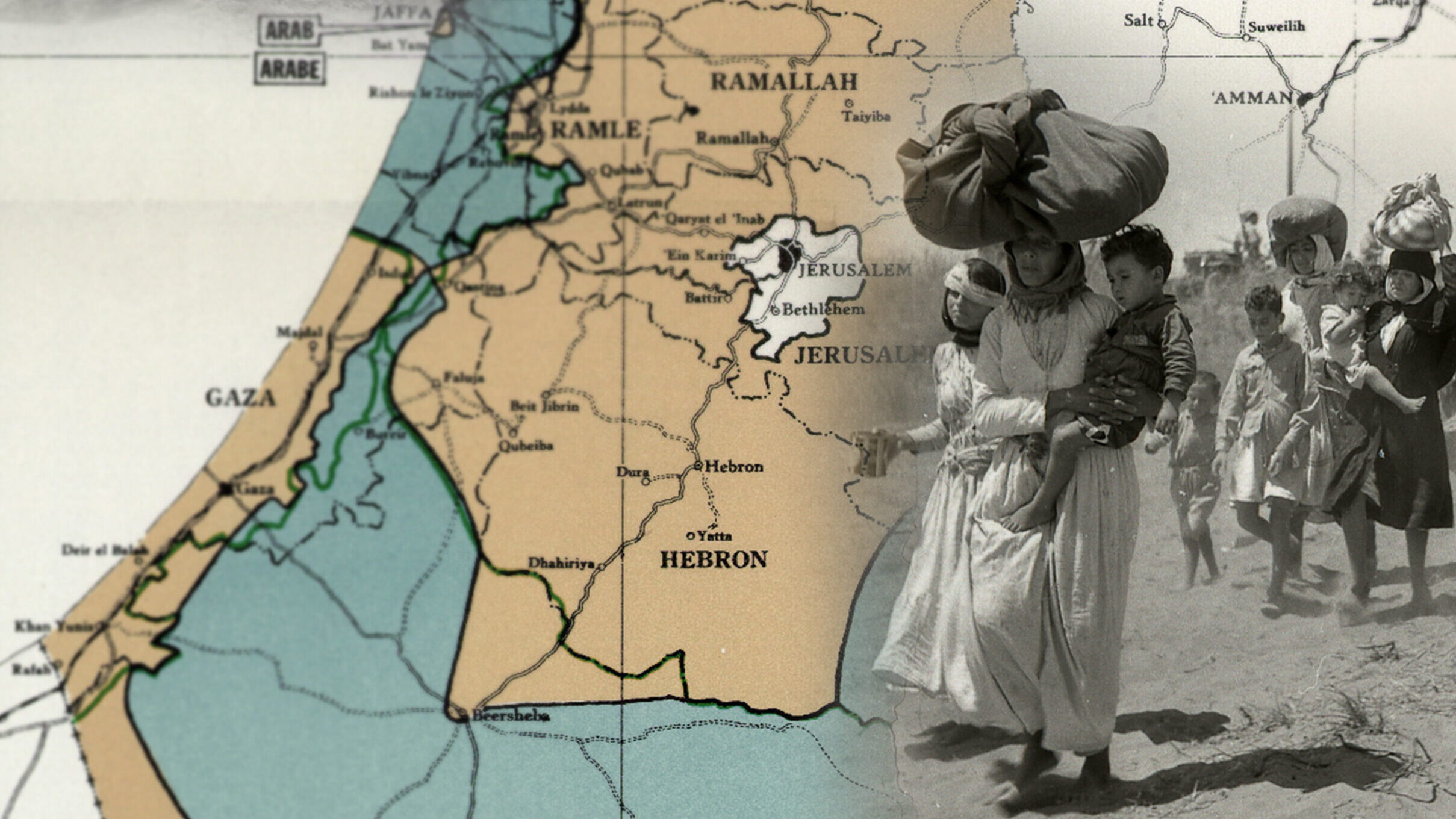
CALGARY — A new study released today by the Aristotle Foundation for Public Policy provides historical context on the civil war in Mandatory Palestine and the Arab-Israeli war that followed from 1947–1949, amidst the UN-prompted creation of the state of Israel in 1948. The report argues that population displacement was a consequence of warfare rather than an overriding policy of expulsion by Israeli authorities, noting that expulsion, when employed, was rooted in local, usually military, considerations. It challenges the Canadian Museum for Human Rights’ exhibit on the “Nakba,” which, the authors argue, presents a one-sided, inaccurate view of the events following the 1947 UN partition vote.
The study, The Nakba: The Consequence of a War, by University of Calgary professor and historian Prof. David Bercuson and Logan Jaspers, examines the conflict that began after Palestinian Arabs rejected the UN Partition Plan. It also reviews the concurrent destruction of ancient Jewish communities across North Africa and the Middle East, highlighting broader historical realities of war and population transfer.
Key Findings:
- The UN created an orderly plan for the partition of Palestine. The Jewish people accepted it, but the Palestinians refused to even consider the idea.
- After 13 months of violence, 700,000 Arabs had fled or been expelled from Mandatory Palestine and Israel, while 800,000 Jews were forced to flee North Africa and the Middle East and settle in Israel between 1948 and the early 1970s.
- Prior to 1947 there were major bouts of violence toward Jews in 1920 (the Nebi Musa Riots), 1921 (Jaffa Riots), 1929 (Hebron massacre plus attacks in Safed and Jerusalem), and 1936–1939 and 1945–1946 (Arab Revolts). In the period after 1930, as the Jews became more militarily active, Jews responded to attacks from Arab villages that were perceived as origins of attacks against Jews. Nevertheless, the record of violence after 1920 was overwhelmingly a record of Arab attacks against Jews.
- During the civil war, both sides carried out unsavoury acts, but Israelis always claimed a military reason for the removal of populations, either to bolster communication lines or stop regular attacks being launched from Arab population centres.
- Jewish authorities actively encouraged Arab populations to remain in the new State of Israel but did not try to keep Arabs from fleeing if they so chose.
“The attempt to paint Israeli actions and the existence of the Jewish state as a deliberate violation of human rights is inconsistent with the facts,” said Dr. Bercuson, senior fellow with the Aristotle Foundation for Public Policy. “Wars always cause refugees, and the human costs of war must be laid at the feet of the aggressors who start them.”
“The Canadian Museum for Human Rights ignored primary historical research and academic consensus in favor of a simplistic narrative,” notes Bercuson. “Thoughtful people should recognize the nuance of history: while 700,000 Arabs left during a war initiated by Palestinian leadership, 800,000 Jews were simultaneously driven out of the Arab world, and the Arab population remaining in Israel has thrived for generations.”
“Canada’s national institutions should ground their exhibits in empirical history and fact rather than biased narratives,” notes Bercuson.
The full report is available at aristotlefoundation.org.
To arrange for an author interview, note the contact below.
-30-
Media Contact:
Dami Itabiyi
Media and Marketing Coordinator, Aristotle Foundation
dami@aristotlefoundation.org | 403-401-3828