
BC’s First Nations have certainly been in the news recently: The BC Supreme Court’s 2025 Cowichan Tribes decision undermined private property rights, and the implementation of the Declaration of the Rights of Indigenous Peoples Act (DRIPA) undermined democratic accountability in the province. These cases are straining reconciliation efforts. Yet, despite these tensions, Canadians by and large wish to see indigenous Canadians prosper and succeed. The disagreement centres on how best to achieve those goals and whether governments have gone far enough in their reconciliation efforts.1 With that in mind, it is at least worth knowing just how much the federal government currently transfers to BC’s First Nations each year.
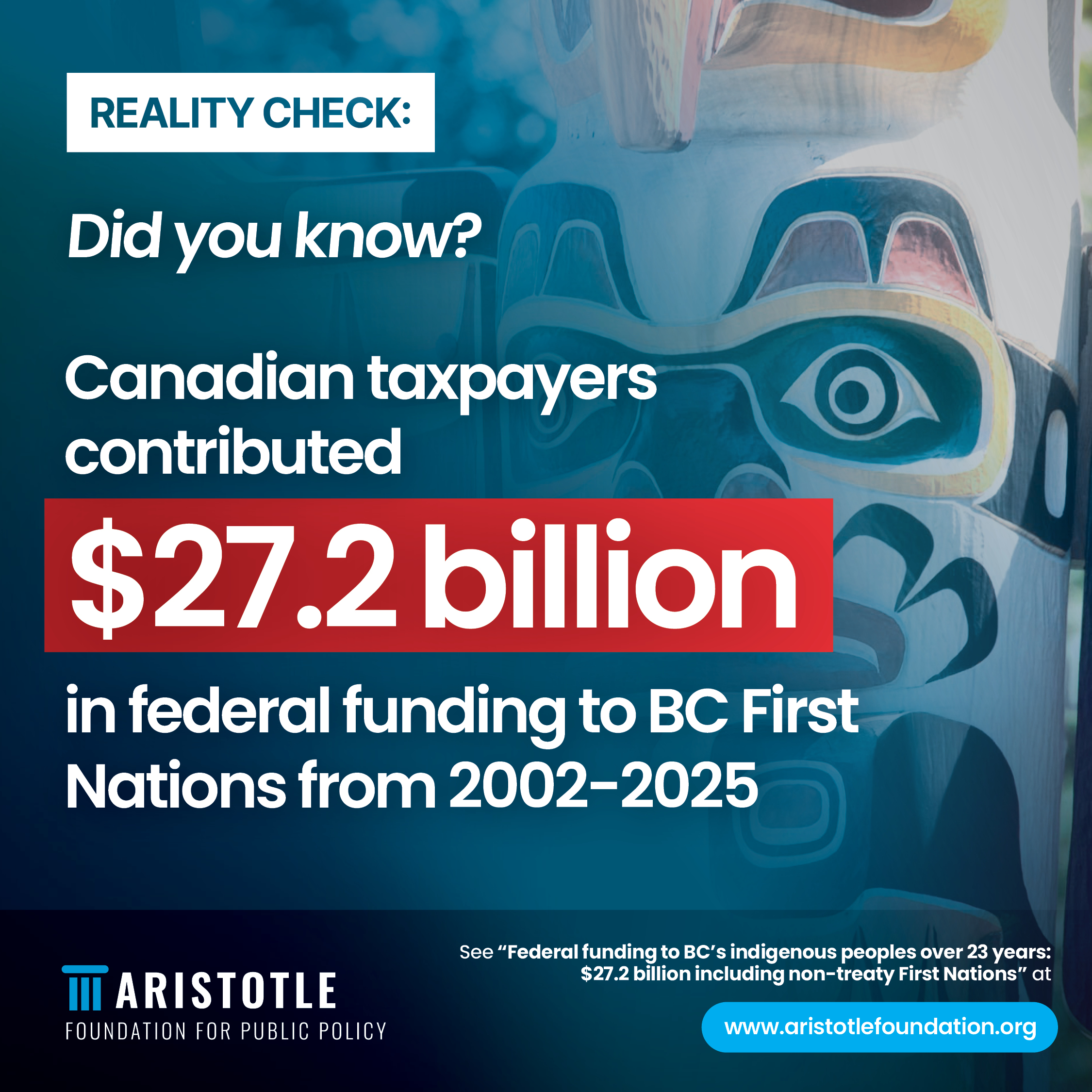
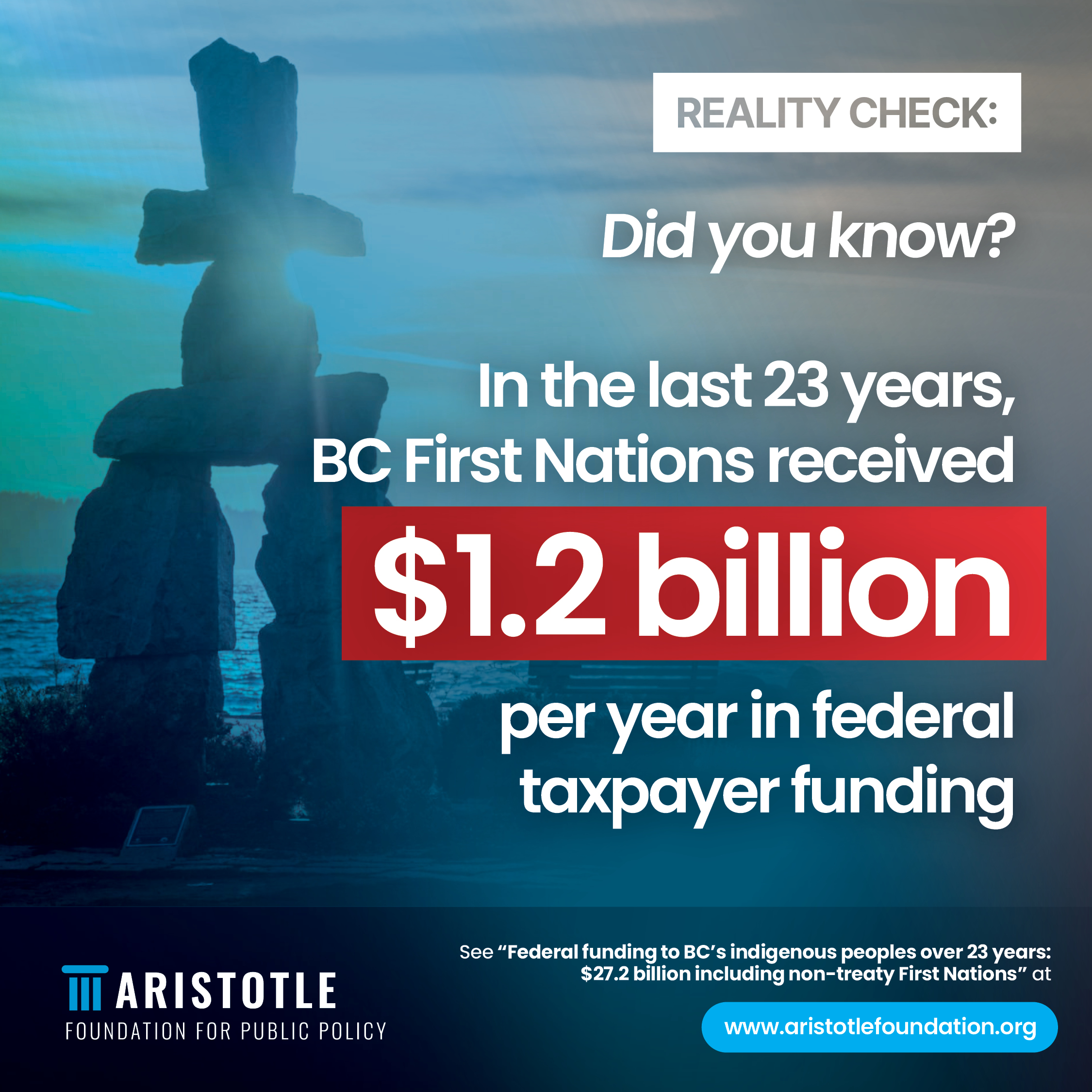
Between fiscal years 2001/02 and 2024/25, BC First Nations and individual indigenous British Columbians received $27.2 billion in total, or nearly $1.2 billion annually (inflation-adjusted to 2025 dollars). Of note, much of that federal tax money was given to BC First Nations and individual indigenous British Columbians absent treaties, which cover only a portion of the province. If nothing else, that is a significant contribution by Canadians toward reconciliation that should be accounted for in any discussions of reconciliation and claims upon other Canadians.
The Constitution Act, 1867 gives to Canada’s federal parliament exclusive authority to make laws regarding “Indians, and Lands reserved for the Indians.”2 Therefore, treaties are normally established between Canada’s indigenous peoples and the Crown, and the federal government is primarily, though not exclusively, in charge of providing support to indigenous communities. That support can take many forms, but one is direct transfers of federal funds to indigenous peoples.
Over 630 recognized First Nations governments or bands exist in Canada, and more than 200 of those are in the province of British Columbia alone.3 In 2021, the total population of indigenous people in BC was close to 290,000, representing roughly 5 percent of BC’s total population of close to 5.7 million people (Figure 1). Nearly 82 percent of those who identify as indigenous in BC do not live on reserve (Figure 2).
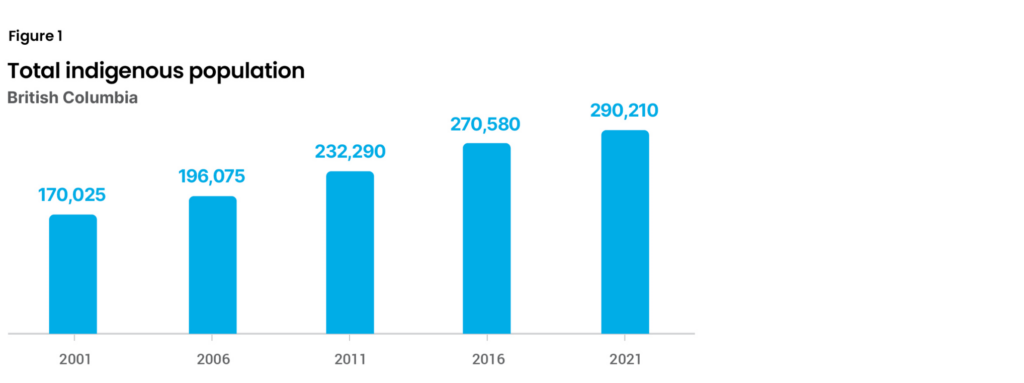
Source: Statistics Canada (2023), “Indigenous identity population by gender and age: Canada, provinces and territories, census metropolitan areas and census agglomerations—Table 98-10-0292-01,” Statistics Canada (November) <https://www150.statcan.gc.ca/t1/tbl1/en/tv.action?pid=9810029201> , and compiled by the authors from the information provided by the Census of Population, 2001 and 2006.
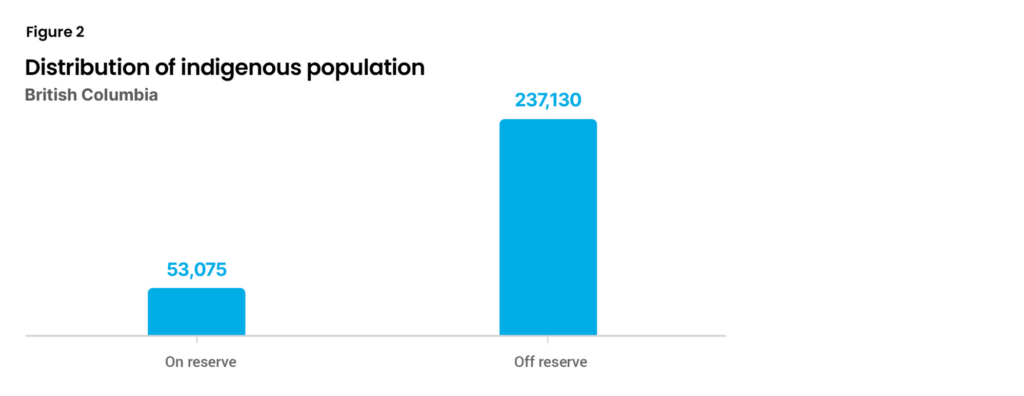
Source: Statistics Canada (2022), “Indigenous identity by Registered or Treaty Indian status and residence by Indigenous geography: Canada, provinces and territories—Table 98-10-0264-01,” Statistics Canada <https://www150.statcan.gc.ca/t1/tbl1/en/tv.action?pid=9810026401>.
Between 2002 and 2025, the federal government transferred a total of $27.2 billion (inflation-adjusted to 2025 dollars) to BC’s indigenous peoples (see Figure 3). The average annual transfer during that 23-year period was almost $1.2 billion.
By far the largest transfer originated from the Department of Crown-Indigenous Relations and the Department of Indigenous Services Canada ($24.6 billion) followed by the Department of Health ($1.3 billion), then the Department of Employment and Social Development ($746.3 million); the lowest came from the Ministry of Justice at $11.4 million over the entire reported period.a
Federal funding dropped significantly in 2004/05 just prior to the Liberal Party losing the 2006 federal election to the Conservatives. But the annual amount climbed back up to $917 million the year after. During Stephen Harper’s tenure in office (2006–2015), funding to BC indigenous groups and individuals remained steady, averaging just over $1 billion annually, consistent with what Paul Martin’s Liberals provided between 2002 and 2004 (the earliest period reported in this data set). With Justin Trudeau’s election in 2019, however, the amount transferred to BC’s First Nations rose dramatically. By 2022/23, it peaked at a lofty $2.74 billion, 240 percent higher than the average annual transfer during the preceding two decades.
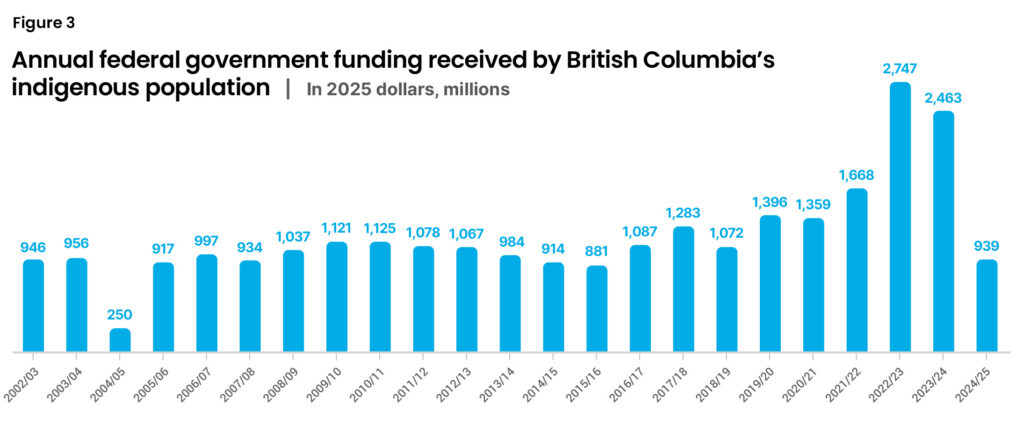
Source: Authors’ calculation from Public Services and Procurement Canada (2025), “Public Accounts of Canada 2025,” Government of Canada <https://www.canada.ca/en/public-services-procurement/services/payments-accounting/public-accounts/2025.html>; Library and Archives Canada (various years [2002–2024]), “Public Accounts of Canada,” Government of Canada <https://epe.lac-bac.gc.ca/100/201/301/public_accounts>; inflation-adjusted to 2025 dollars.
a The Ministry of Indigenous and Northern Affairs was dissolved and replaced in 2019 by two departments: Crown-Indigenous Relations and Northern Affairs Canada (CIRNAC) and Indigenous Services Canada (ISC).
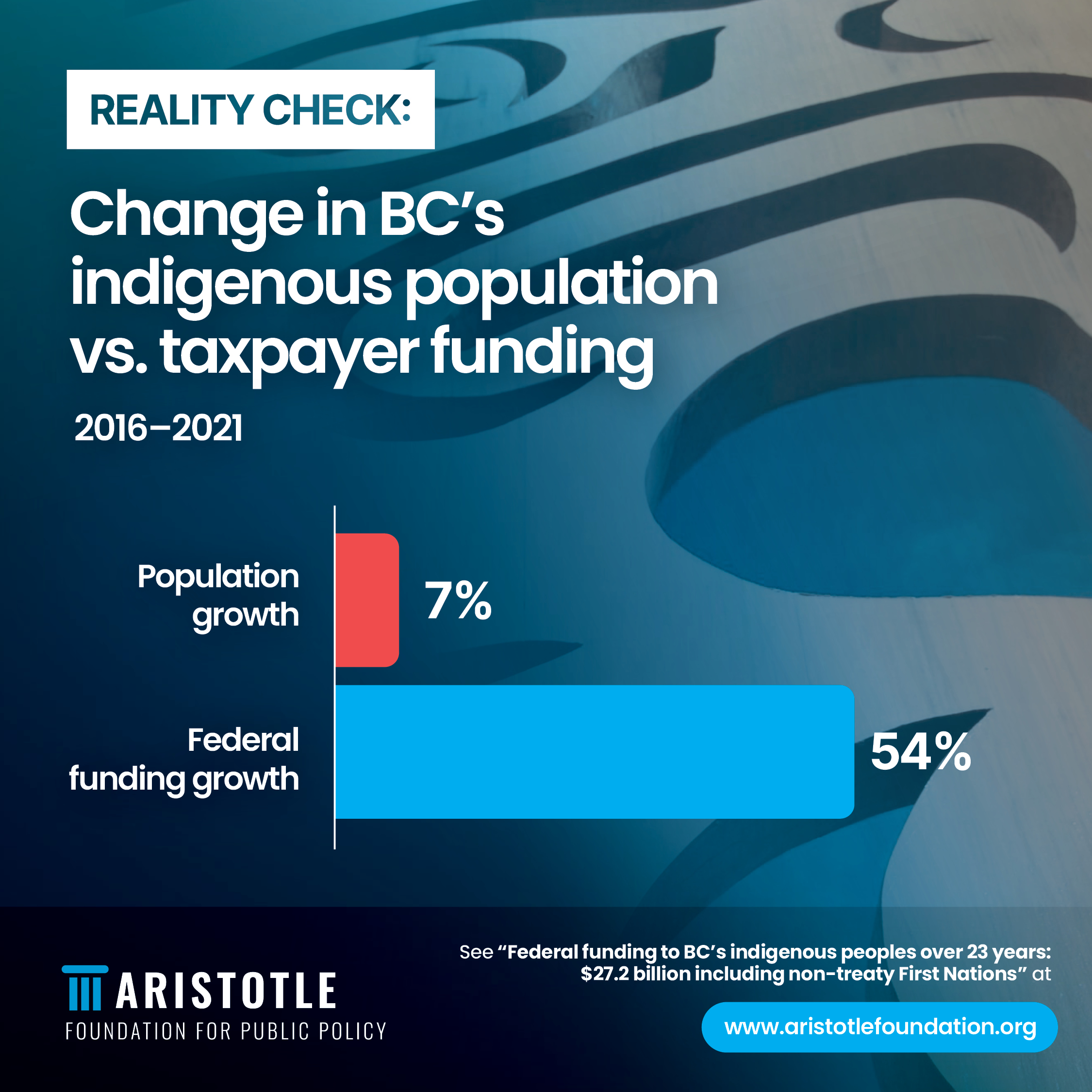
Between 2016 and 2021 alone, the amount the federal government sent to BC First Nations increased by 54 percent, even though BC’s indigenous population increased only 7 percent (Figure 4).
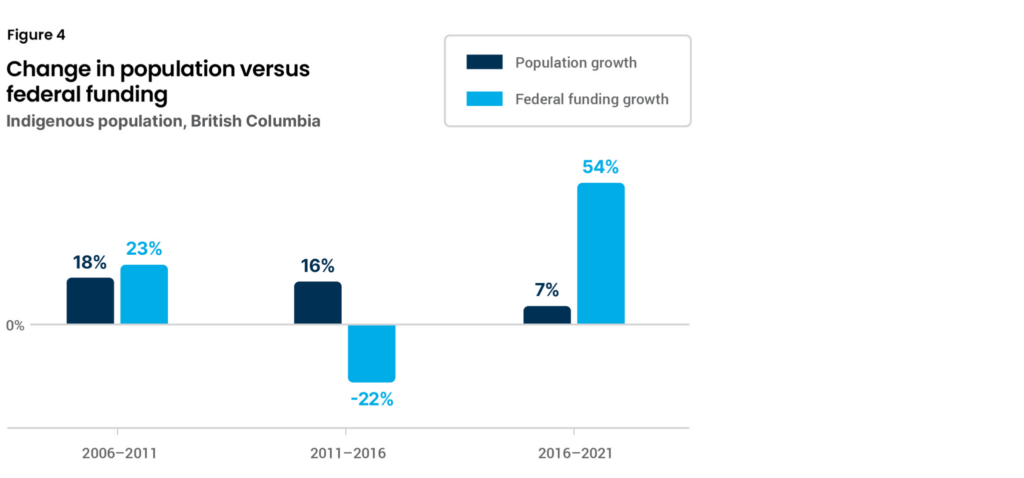
Source: Authors’ calculation from Library and Archives Canada (various years), “Public Accounts of Canada,” Government of Canada.
Of the 290,000 indigenous people living in BC (which includes registered Indians according to the Federal Indian Act, non-registered Indians, and Metis), only about 53,000 reported living on reserves. If federal transfers are primarily intended to support people living on reserves, then the communities on reserves are receiving significant funding from the federal government. But reporting it this way is, no doubt, misleading because some of the federal money supports programs that are off reserve. Yet even if only a portion of the $1.2 billion transferred goes to reserves, this would still be a significant wealth transfer from Canadian taxpayers to a relatively small population of BC’s indigenous people.
Federal transfers support housing, health and social services, and other programs. It is worth noting that this is in addition to money and services provided by the BC government. In 2021, for example, the budget for BC’s Ministry of Indigenous Relations was $178 million, an increase of $60 million over base funding.4 The additional funding was specifically earmarked to help First Nations implement the Declaration of the Rights of Indigenous Peoples Act.5 The 2026 budget estimates indicate total funding for the department increased to $186 million.6
In 2020, the BC government also announced a plan to share 7 percent of gaming revenue with BC’s First Nations, estimated to be worth $3 billion over 25 years.7 And BC boasts that it is the first province to fund housing for indigenous peoples in addition to existing federal housing transfers. The province plans to spend $550 million over 10 years on housing both on and off reserves. Note that this provincial spending on BC First Nations and individual indigenous British Columbians is not included in the total taxpayer spending of $27.2 billion over 23 years, which is drawn from federal data only.
Finally, it is worth noting that, in addition to the nearly $1.2 billion of federal support per year for BC First Nations, indigenous Canadians can also access government services provided to other citizens if they so choose. Living in remote communities would certainly make it more difficult to access these services. However, according to the latest population figures, only 18 percent of BC’s indigenous population live on reserves. And the 2021 census data indicate that 75 percent of people in BC who identify as indigenous live in urban areas where other services are available.8
In addition, registered Indians under the Indian Act are eligible to receive Old Age Security, the Guaranteed Income Supplement (for low-income seniors), and the Canadian Pension Plan.b
The Community Well-Being index is one way the federal government measures the well-being of indigenous peoples over time using different indices. It compares these values against the Canadian average and reports the “gap” between the two populations. Obviously, the expectation is that the gap will narrow or, ideally, vanish.c British Columbia’s First Nations Community Well-Being (CWB) score as of 2021 is 67, which places it among the higher performing regions in Canada (see Figure 5). BC’s score is:
b. Registered Indians can receive CPP after age 60 provided they contributed to the plan during their working years. On-reserve income is not taxed, so a person who earned all their income working on the reserve would need to contribute to CPP voluntarily to be eligible to draw on the fund after age 60. Off-reserve income is subject to taxation, and CPP contributions are then mandatory.
c. “The Community Well-Being (CWB) index measures socio-economic well-being for communities across Canada over time. It has 4 components: education, labour force activity, income and housing” (Canada, Indigenous Services Canada [n.d.], “About the Community Well-Being Index,” Government of Canada <https://www.sac-isc.gc.ca/eng/1421245446858/1557321415997>).
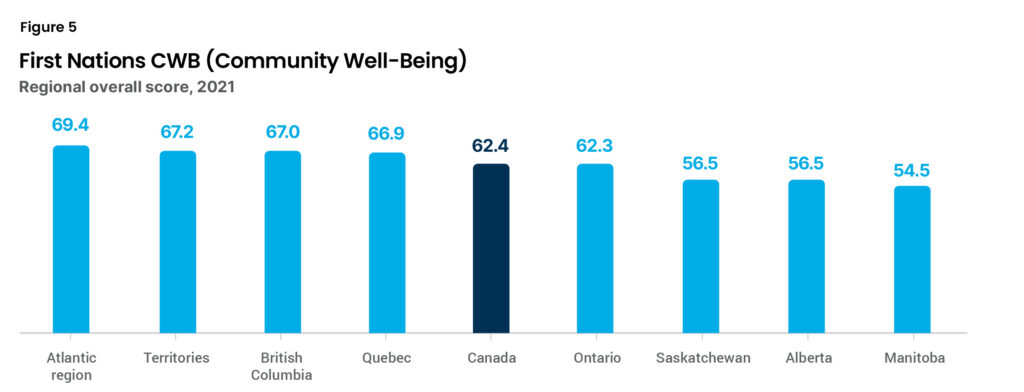
Source: Indigenous Services Canada (n.d.), “Appendix C: Regional Overall Community Well-Being (CWB) Changes and Gaps, 1981–2021 and 2016–2021,” Government of Canada <https://sac-isc.gc.ca/eng/1704400297800/1704400348268#ax-b>.
The good news for BC First Nations is that their average CWB has been steadily increasing over the last three decades. The BC First Nations’ score increased from 48.6 in 1981 to 67 points, an increase of 18.4 points. The less positive news is that the gap between BC First Nations and other Canadian communities is 13 points. In terms of the regional overall CWB changes, BC’s First Nations narrowed the gap by only 8.3 points within a 40-year period between 1981 and 2021 (Figure 6).
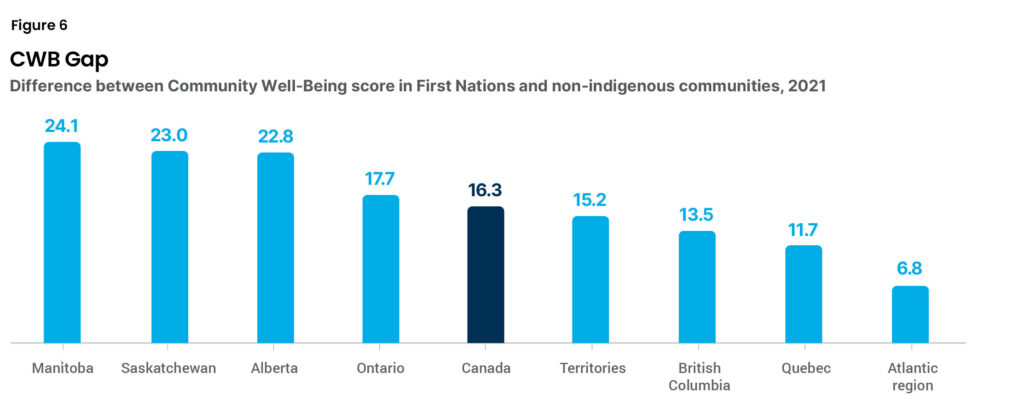
Source: Indigenous Services Canada (n.d.), “Appendix C: Regional Overall Community Well‑Being (CWB) Changes and Gaps, 1981–2021 and 2016–2021,” Government of Canada <https://sac-isc.gc.ca/eng/1704400297800/1704400348268#ax-b>.
If the purpose of federal support is to close the well-being gap, then the fact it persists despite fiscal transfers totalling $27 billion over the last 23 years certainly raises questions about the effectiveness of these transfers. Taxpayers who sincerely desire to see improvement in the well-being of indigenous Canadians would be right to wonder why greater progress has not been made.
On the other hand, if the justification for federal transfers is that BC First Nations are owed land or money as payment for past injustices, then the billions of dollars transferred federally, in addition to the millions flowing from the provincial government, should be counted toward reconciliation efforts. And Canadians who pay the taxes to cover these fiscal transfers may well wonder when that debt will finally be paid, and who ultimately gets to determine that answer.
Over the last 23 years, Canadian taxpayers have supported BC First Nations and indigenous individuals—whether on reserves or off—to the tune of almost $1.2 billion in annual federal transfers, not including federal funds disbursed in the previous century or provincial support in either century. At the very least, this munificence ought to be credited to Canadians as significantly answering to the demands for reconciliation.
David Livingstone, PhD, is a senior fellow with the Aristotle Foundation for Public Policy, retired professor of Liberal Studies and Political Studies, and an Honorary Research Associate at Vancouver Island University (VIU). He has edited two books: Liberal Education and Civic Well-Being in Canada: A Reappraisal of Bankrupt Education (Palgrave Macmillan) and Liberal Education, Civic Education, and the Canadian Regime: Past Principles and Present Challenges (McGill-Queen’s Press).
Ven Venkatachalam, PhD, CPA, is a senior economist at the Aristotle Foundation for Public Policy. With expertise in economic and fiscal policy, international relations, trade, energy, governance, education, immigration, tourism, and NGO matters, Ven has consulted for governments, NGOs, and private sector organizations across Asia, Europe, Canada, and the United States.
Who we are
The Aristotle Foundation for Public Policy is a new education and public policy think tank that aims to renew a civil, common-sense approach to public discourse and public policy in Canada.
Our vision
A Canada where the sacrifices and successes of past generations are cherished and built upon; where citizens value each other for their character and merit; and where open inquiry and free expression are prized as the best path to a flourishing future for all.
Our mission
We champion reason, democracy, and civilization so that all can participate in a free, flourishing Canada.
Our theory of change: Canada’s idea culture is critical
Ideas—what people believe—come first in any change for ill or good. We will challenge ideas and policies where in error and buttress ideas anchored in reality and excellence.
Donations
The Aristotle Foundation for Public Policy is a registered Canadian charity and all donations will receive a tax receipt. To maintain our independence, we do not seek nor will we accept government funding. Donations can be made at www.aristotlefoundation.org.
The Aristotle Foundation for Public Policy has internal policies to ensure research is empirical, scholarly, ethical, rigorous, honest, and contributes to the advancement of knowledge and the creation, application, and refinement of knowledge about public policy. Our staff, research fellows, and scholars develop their research in collaboration with the Aristotle Foundation’s staff and research director. Fact sheets, studies, and indices are all peer-reviewed. Subject to critical peer review, authors are responsible for their work and conclusions. The conclusions and views of scholars do not necessarily reflect those of the Board of Directors, donors, or staff.