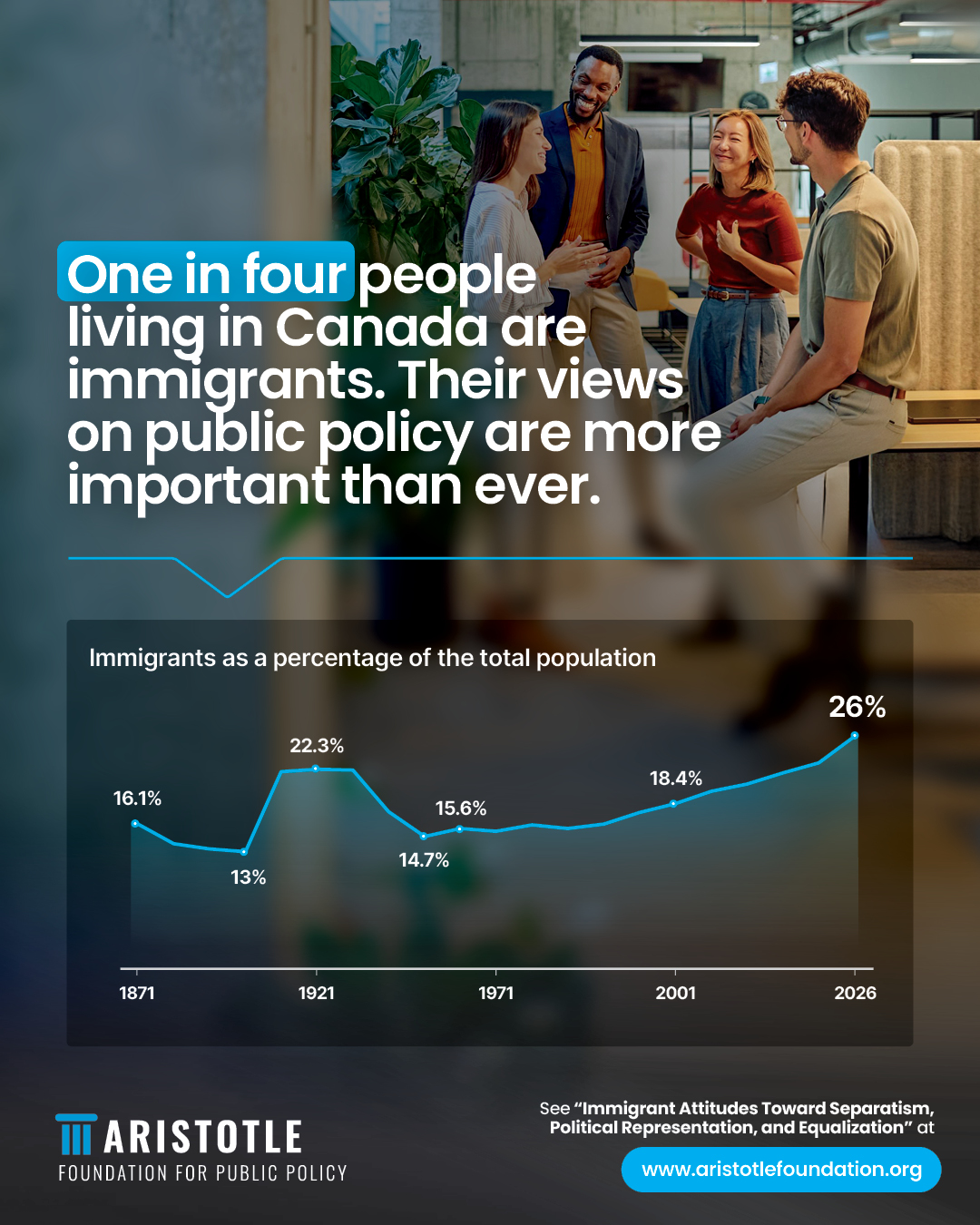


Immigrants play an important role in shaping Canada’s political and public narratives.1 According to Statistics Canada, in 2026, 26 percent of the Canadian population was comprised of immigrants, the largest share in 150 years (Figure 1). That means that, currently, one in four people living in Canada is an immigrant. While contention exists over current immigration policy in Canada, the fact remains that immigrants have always played an important role in Canadian society, and understanding this sizable demographic is crucial for navigating societal dynamics and policy impacts. Gaining insight into immigrants’ perspectives on policy issues is essential for comprehensive policy analysis and informed decision making, as their views influence national debates and policy directions.
Drawing on a subsample of data from the Aristotle Foundation’s recent Léger survey across Canada, this report highlights immigrant Canadians’ attitudes toward political representation, separatism, and fiscal policies,a comparing them with the views of native-born Canadians to provide essential insights for policy discussions.2
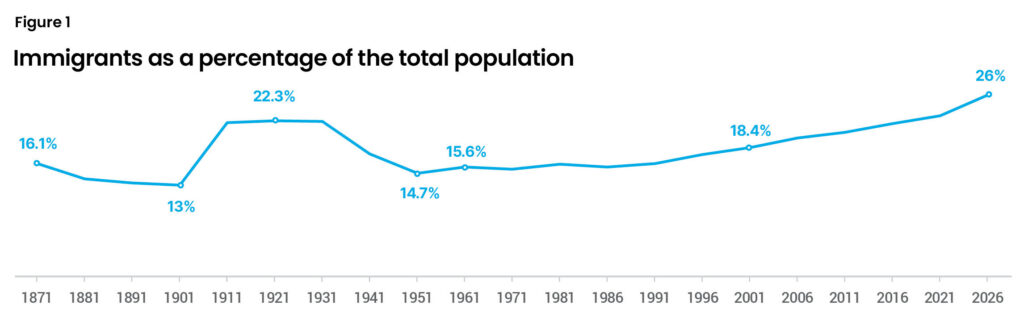
Source: Statistics Canada, “Immigrants Make Up the Largest Share of the Population in Over 150 Years and Continue to Shape Who We Are as Canadians,” The Daily, October 26, 2022, https://www150.statcan.gc.ca/n1/daily-quotidien/221026/dq221026a-eng.htm.
The Léger survey commissioned by the Aristotle Foundation in early 2026 asked immigrants whether, relative to their province’s population, they think their province is under- or overrepresented in the House of Commons and the Senate. Nearly one in four immigrants believe their province is underrepresented in Parliament (Figure 2).
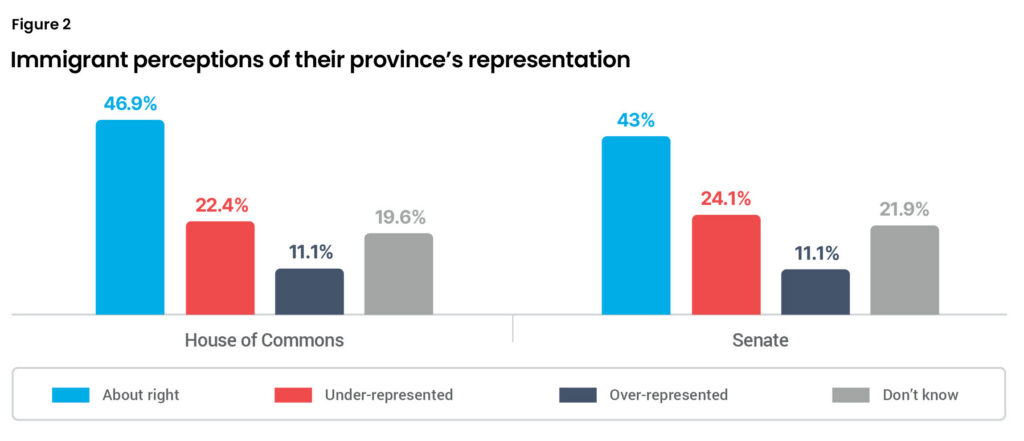
Source: Léger, Multiple Solitudes: What Canadians think about separatism, political representation, democratic reform, and equalization, Aristotle Foundation for Public Policy, March 11, 2026, https://aristotlefoundation.org/study/multiple-solitudes-what-canadians-think-about-separatism-political-representation-democratic-reform-and-equalization/.
By comparison, 30 percent of Canadian-born respondents believe their province is underrepresented in the House of Commons and the Senate. These findings suggest that underrepresentation is a concern both for immigrant and native-born Canadians, though it is somewhat more pronounced among Canadian-born respondents.
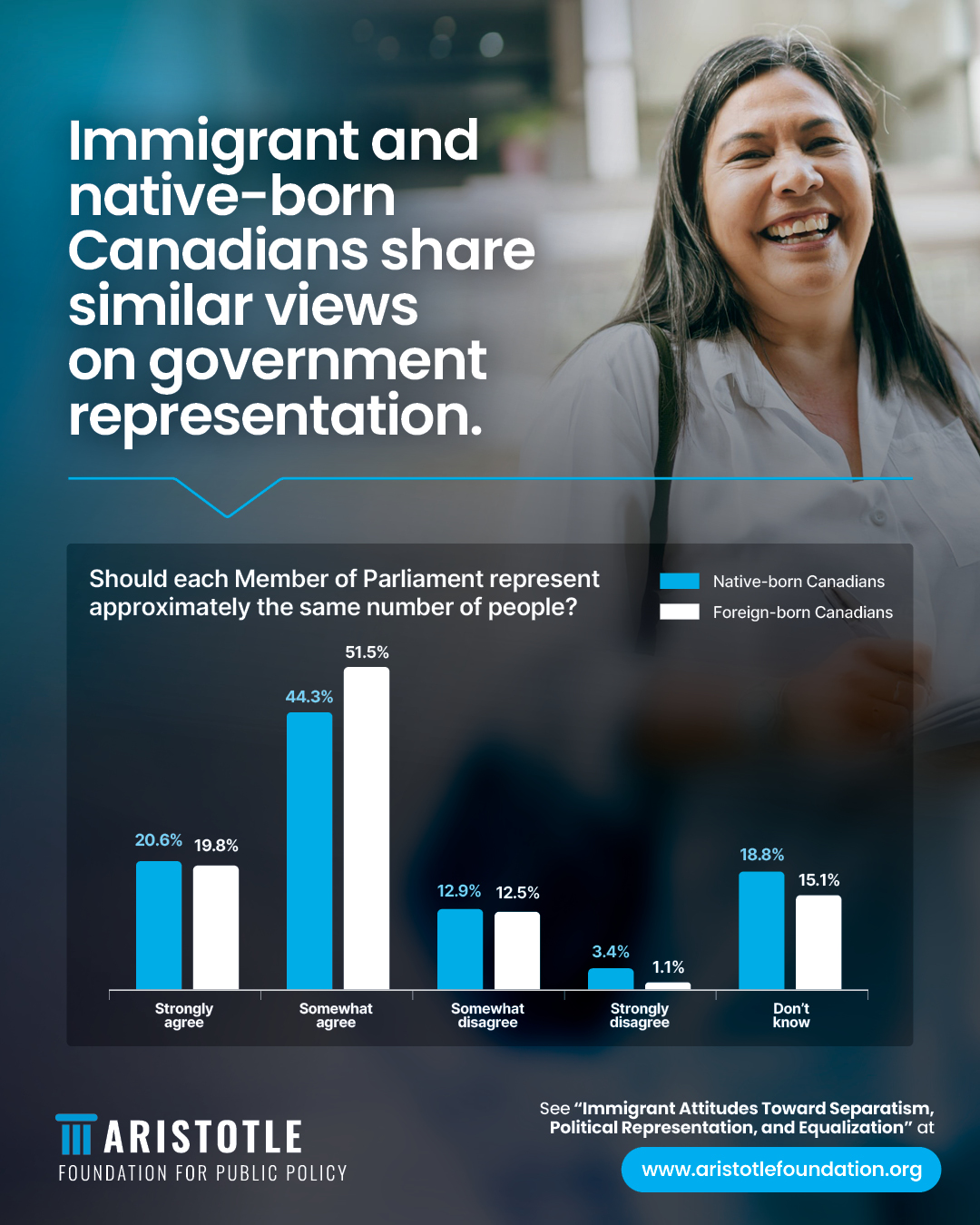
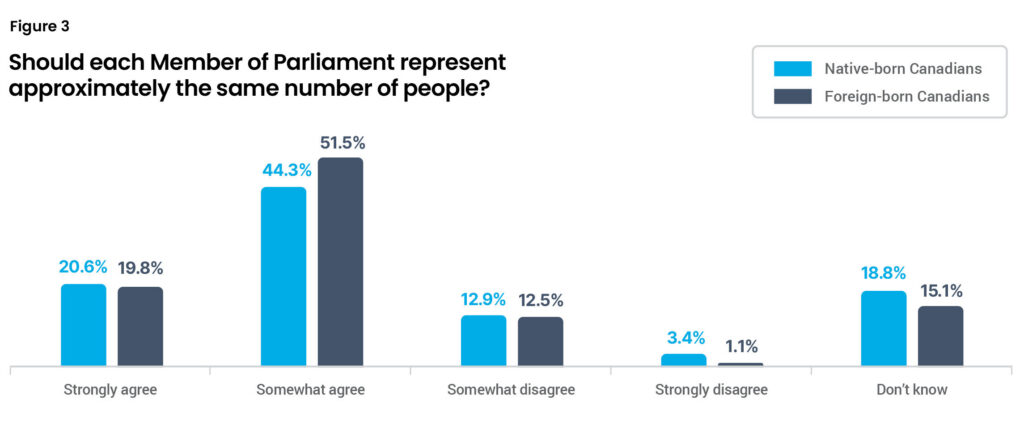
When it comes to the House of Commons, when asked whether they agree or disagree with the principle that all Members of Parliament should represent approximately the same number of people, 72 percent of immigrants expressed agreement (20 percent strongly agreed and 52 percent somewhat agreed), with only 1 percent strongly disagreeing (Figure 3). These findings suggest broad support among immigrant Canadians for representation by population. And, of note, only 65 percent of respondents born in Canada agreed with the same statement (21 percent strongly agreed and 44 percent somewhat agreed); representation by population is an issue of even greater interest to foreign-born than native-born Canadians.
Source: Léger, Multiple Solitudes: What Canadians think about separatism, political representation, democratic reform, and equalization, Aristotle Foundation for Public Policy, March 11, 2026, https://aristotlefoundation.org/study/multiple-solitudes-what-canadians-think-about-separatism-political-representation-democratic-reform-and-equalization/.
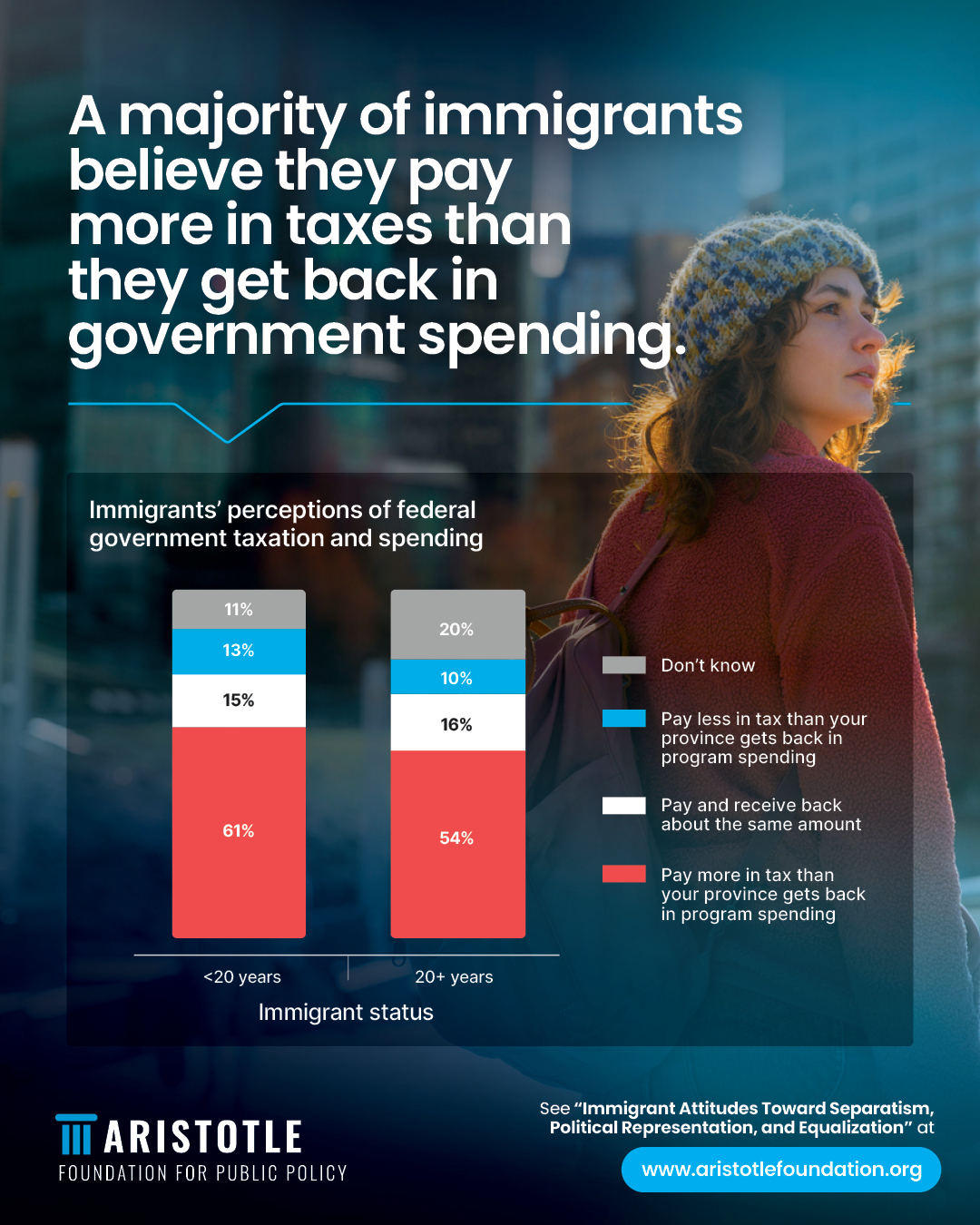
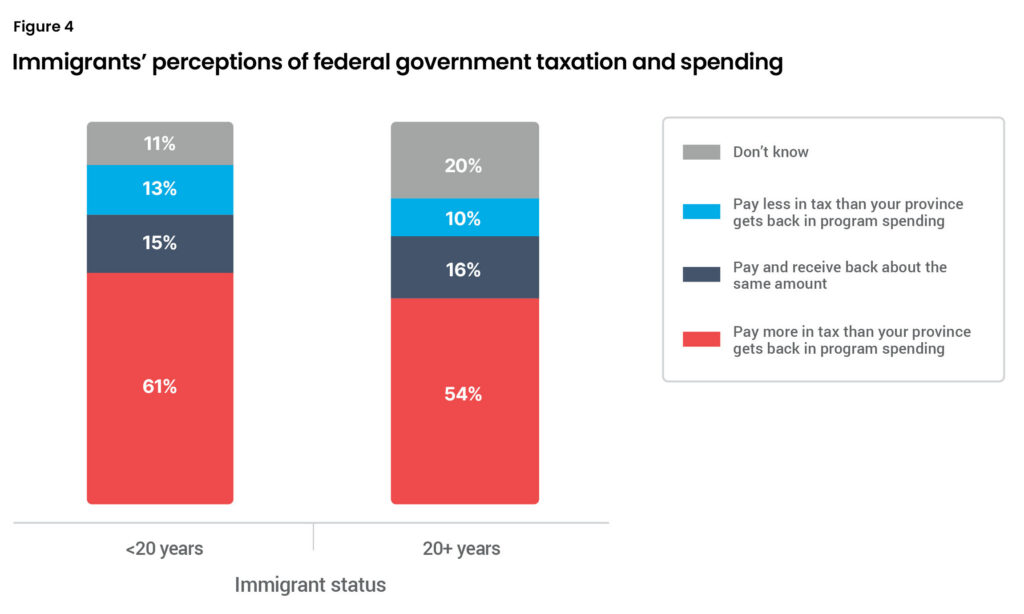
Figure 4 shows slight but important differences in perceptions of taxation and program spending by immigrant tenure. Immigrants who have lived in the country for less than 20 years are more likely to believe they pay more in taxes than their province receives in program spending (61%) compared with those who have been in the country for 20 years or more (54%). Despite the 7 percent gap between newer immigrants and longer-established immigrants, a majority of respondents in both categories feel they pay more in taxes than they receive back in program spending. Taken together, these percentages average out to 57.5 percent. For comparison, 54 percent of respondents born in Canada felt that they paid more in taxes than what they received in program spending.
Source: Léger, Multiple Solitudes: What Canadians think about separatism, political representation, democratic reform, and equalization, Aristotle Foundation for Public Policy, March 11, 2026, https://aristotlefoundation.org/study/multiple-solitudes-what-canadians-think-about-separatism-political-representation-democratic-reform-and-equalization/.
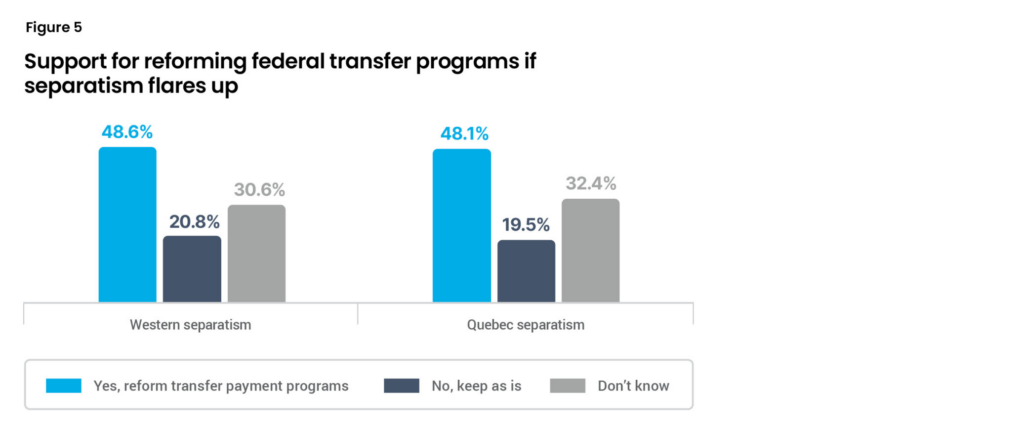
Equalization has long been a core issue as it relates to Alberta alienation and Quebec federalism. If Western or Quebec separatism poses a real threat to national unity, should fiscal transfer payments be reformed? Regardless of region, only one-fifth of immigrants say “no” (Figure 5). Of note, support for reform among immigrants is comparable to but slightly higher than support among Canadian-born respondents (42 percent under both separatist scenarios).
Source: Léger, Multiple Solitudes: What Canadians think about separatism, political representation, democratic reform, and equalization, Aristotle Foundation for Public Policy, March 11, 2026, https://aristotlefoundation.org/study/multiple-solitudes-what-canadians-think-about-separatism-political-representation-democratic-reform-and-equalization/.
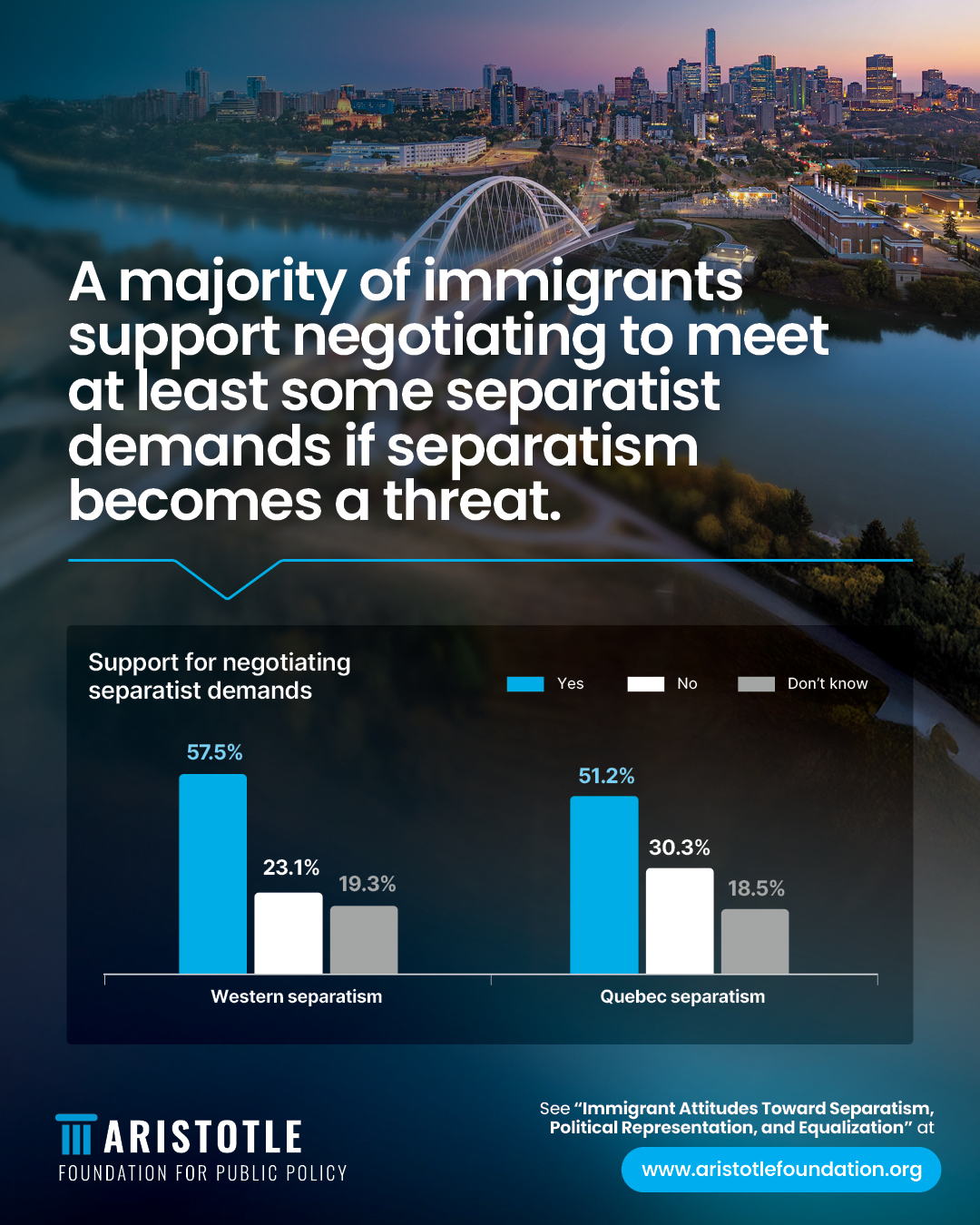
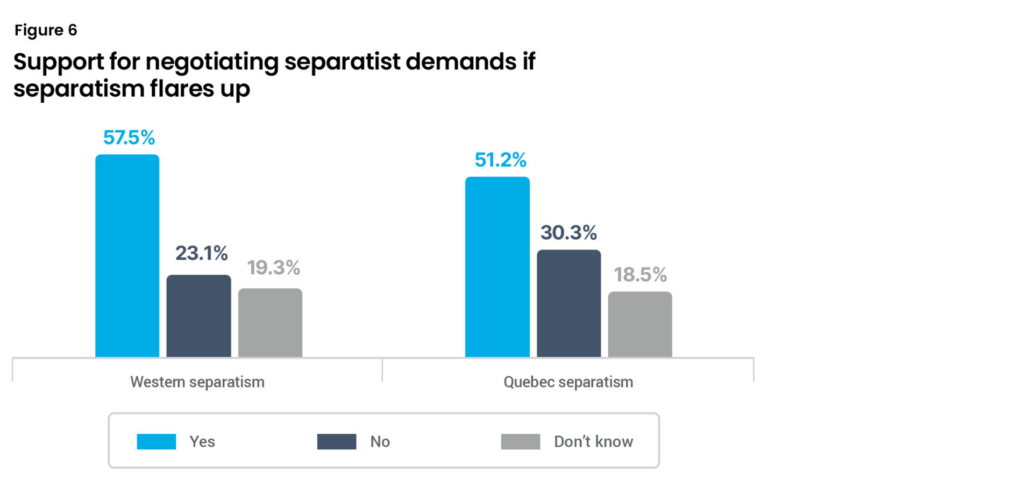
However, if negotiations should occur to meet at least some demands if Quebec or Western separatism becomes a real threat to Canadian unity, immigrant Canadians are more open to negotiating Western than Quebec demands. A clear majority support negotiations if Western separatism becomes a serious threat to national unity (57.5 percent), compared with a slimmer majority in the case of Quebec separatism (51.2 percent). Opposition to Quebec separatism is over 20 percent lower, with 30.3 percent saying negotiations should not occur, compared with 23.1 percent for Western separatism (Figure 6).
Source: Léger, Multiple Solitudes: What Canadians think about separatism, political representation, democratic reform, and equalization, Aristotle Foundation for Public Policy, March 11, 2026, https://aristotlefoundation.org/study/multiple-solitudes-what-canadians-think-about-separatism-political-representation-democratic-reform-and-equalization/.
These results closely mirror those of Canadian-born respondents. Among those born in Canada, 54 percent support negotiating to meet at least some demands in the case of Western independence, compared with 48 percent in the case of Quebec nationalism. Opposition stands at 26 percent and 34 percent, respectively.
An examination of the data on issues of separatism, taxation, and representation reveals two key findings. First, immigrant views on issues of representation, taxation, and separatism are, broadly speaking, similar to those of non-immigrants. On each question, the difference between immigrant and non-immigrant responses was less than 10 percentage points. In some cases, such as views on Canada’s taxation system and negotiating separatist demands, responses differed by as little as zero to 4 percent, highlighting a substantial degree of agreement between immigrants and non-immigrants on several key political issues. Rather than revealing stark differences in political attitudes, the survey results suggest alignment of thought between all Canadian citizens on these foundational issues.
Second, immigrant Canadians share some concern on the issue of representation in the federal government, but this concern is less pronounced than their concern about Canada’s taxation system, which a majority believe does not adequately serve their needs relative to their province’s contributions. National unity is also an important concern for immigrant Canadians, with a majority supporting negotiations to meet at least some separatist demands in both the Western and Quebec contexts.
This report has examined the data on immigrant views toward issues of national unity, political representation, and tax fairness, finding that immigrants share the same concerns as all Canadians.
Debate and discourse in the public sphere often emphasize differences between immigrants and non-immigrants in Canada. The findings of this survey indicate that—at least on issues of national unity, taxation, and representation—immigrant attitudes, by and large, are aligned with those of native-born Canadians. In a time of intense polarization, acknowledging the unity that does exist remains just as crucial as pinpointing and combatting the challenges and divisions that threaten Canada’s national cohesion.
Ven Venkatachalam, PhD, CPA, is a senior economist at the Aristotle Foundation for Public Policy. With expertise in economic and fiscal policy, international relations, trade, energy, governance, education, immigration, tourism, and NGO matters, Dr. Venkatachalam has consulted for governments, NGOs, and private sector organizations across Asia, Europe, Canada, and the United States.
Ava Peacock, MA, B.Ed., is the research manager at the Aristotle Foundation for Public Policy. Ms. Peacock holds a Master of Arts in English and Bachelor of Education from the University of Calgary, and a Bachelor of Arts in History from Ambrose University.
It is worth noting that both authors are proud Canadian citizens who came to Canada as immigrants.
Who we are
The Aristotle Foundation for Public Policy is a new education and public policy think tank that aims to renew a civil, common-sense approach to public discourse and public policy in Canada.
Our vision
A Canada where the sacrifices and successes of past generations are cherished and built upon; where citizens value each other for their character and merit; and where open inquiry and free expression are prized as the best path to a flourishing future for all.
Our mission
We champion reason, democracy, and civilization so that all can participate in a free, flourishing Canada.
Our theory of change: Canada’s idea culture is critical
Ideas—what people believe—come first in any change for ill or good. We will challenge ideas and policies where in error and buttress ideas anchored in reality and excellence.
Donations
The Aristotle Foundation for Public Policy is a registered Canadian charity and all donations will receive a tax receipt. To maintain our independence, we do not seek nor will we accept government funding. Donations can be made at www.aristotlefoundation.org.
The Aristotle Foundation for Public Policy has internal policies to ensure research is empirical, scholarly, ethical, rigorous, honest, and contributes to the advancement of knowledge and the creation, application, and refinement of knowledge about public policy. Our staff, research fellows, and scholars develop their research in collaboration with the Aristotle Foundation’s staff and research director. Fact sheets, studies, and indices are all peer-reviewed. Subject to critical peer review, authors are responsible for their work and conclusions. The conclusions and views of scholars do not necessarily reflect those of the Board of Directors, donors, or staff.