
In the spring of 2026, Lethbridge police issued Frances Widdowson a ticket for trespassing.1 The former Mount Royal University professor is known for challenging prevailing narratives on Indian Residential Schools, and previously clashed with University of Lethbridge officials and activists over her campus appearances. The University of Lethbridge said it had sufficient evidence that her presence “would create substantial disruption beyond the university’s capacity to control.”2
Other Canadian universities have also sought to remove her. At the University of Victoria, in December 2025, authorities arrested and charged Widdowson under British Columbia’s Trespass Act after a gathering organized by a provincial political party.3 Police arrested her again in January at another political party event at the University of British Columbia where nearly 1,000 protesters demonstrated, though she was released without charges.4
This is the latest example of many, prompting an important debate that Canadians ought to engage with: Should publicly funded universities invoke “trespass,” a concept usually associated with private property, or not?
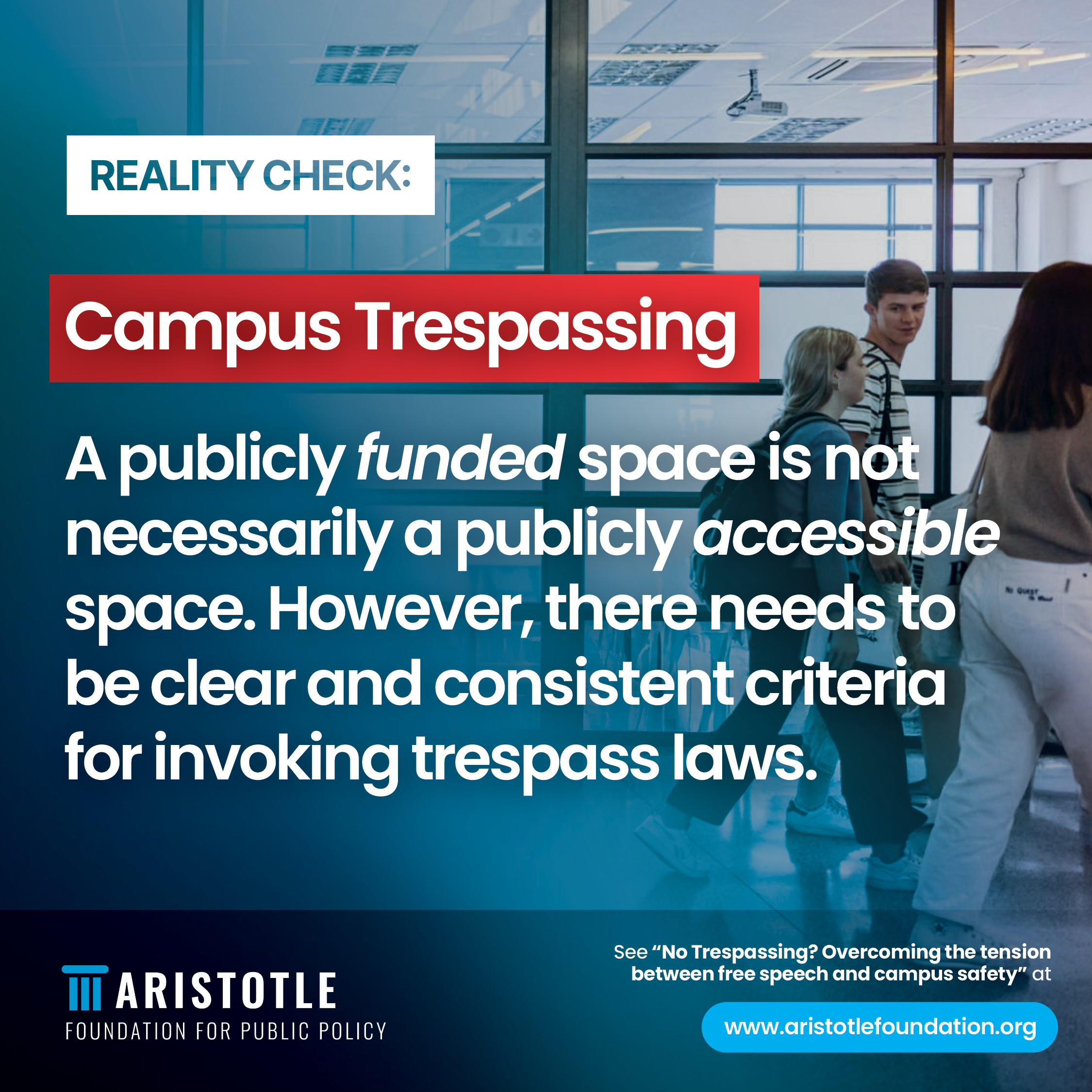
Court rulings provide important context. Canadian courts consistently recognize universities’ authority to bar individuals from campus through trespass powers. They treat universities as property owners with control over access, despite public funding.5 In other words, a publicly funded space is not necessarily a publicly accessible space.
Courts have generally held that trespass law overrides free expression claims. For example, in University of Toronto (Governing Council) v. Doe (2024), the Ontario Superior Court stated, “exercising freedom of expression is not a defence to trespass,” even for peaceful protests.6
Courts uphold bans when universities show a person’s presence creates safety risks, operational disruption, or institutional harm. Students have access rights for educational purposes but cannot occupy or exclude others from university property. The BC Court of Appeal in BC Civil Liberties Association v. University of Victoria (2016) upheld trespass authority over nonstudents and confirmed the Charter does not guarantee campus access.7
The result is a dual status: universities are public institutions but enjoy private-property-like control over their grounds, giving administrators broad discretion over who may enter and on what terms.
But there is a structural problem in how universities apply the rules. Canadian universities do not reflect a broad ideological mix—studies show a pronounced ideological tilt in the academy.
Students notice. More than two-thirds of students who identify as politically moderate are concerned that someone would file a formal complaint against them and that professors would lower their grades, if their moderate views were expressed on campus. Of students who identify as “very conservative,” 85 percent fear a lower grade for expressing their political views.8
It is unrealistic to assume this bias does not shape institutional behaviour. This perceived imbalance is one reason more policy analysts now examine, and some endorse, formal neutrality policies for universities.
Consider 2023. After the October 7th terror attacks in Israel, Hamas protesters established round-the-clock encampments on campuses.9 With the support of media and politicians on one side of the ideological spectrum, university administrators were remarkably slow—and reluctant—to enforce clear violations of trespassing, despite trespassers’ aggressive antisemitism towards Jewish students.10
This brings us back to Widdowson and the claim that she poses a security risk.
University leaders operate within campus culture marked by ideological pressures. In such settings, officials may wield trespass powers more aggressively against speakers who challenge the dominant viewpoint.
The prevailing tilt in one ideological direction is relevant. Across North America, radical activists increasingly shape campus norms. Scholars Jonathan Haidt and Greg Lukianoff document how this has encouraged a tendency to equate offence and emotional distress with harm, violence, and trauma. They note how universities, on both sides of the border, now increasingly adopt this trend.11
In Widdowson’s case, critics frequently argue for excluding her on the basis that she creates a “psychologically unsafe environment.”12 This suggests some administrators now treat “security risk” as elastic, extending it to speech that offends or unsettles, rather than to conduct that poses a physical threat of tangible danger. Yet courts have repeatedly said where university decisions touch on expression, public institutions must remain neutral toward content.13
The contrast with anti‑Israel encampments is telling.
In the early stages, many administrators hesitated to act decisively, citing a desire to safeguard student expression. Some officials justified delay by pointing to the charged emotions surrounding the war in Gaza. Despite the tangible disruption caused by the encampments, many universities often postponed enforcement.14
This raises an obvious question: How did ideology shape decisions during that period?
While not identical, the comparison with Widdowson is instructive. She attempted to hold time‑limited events aimed at discussion. Those who objected need not attend. Yet faculty letters opposing her presence and large protests that followed her around campus likely created strong pressure on administrators to frame her presence as a security problem.15
On any reasonable assessment, Widdowson does not appear as an inherent security threat. She is a middle‑aged academic who explicitly disavows violence, especially in response to contentious views. Her events were of short duration. Assigning trained security staff to her talk might have been prudent, but that is true of many polarizing events. It is difficult to justify the assumption that her speaking would inevitably trigger violence beyond institutional control.
Three principles collide in these disputes: freedom of expression and debate, institutional neutrality, and the university’s authority to manage its property and ensure safety. Even if courts treated universities as fully public in a constitutional sense, it would still be reasonable to grant them authority to exclude individuals who pose genuine threats to people or property. Any institution must retain that basic power.
The concern lies in the scope for abuse. At minimum, the public should require universities to apply transparent criteria when excluding individuals. Universities should adopt objective definitions of safety and apply them through processes insulated, as much as possible, from prevailing ideological pressures.
If institutions fail to do so, the responsibility shifts to lawmakers. Some jurisdictions have already tried to recalibrate this balance. Several US states have addressed campus trespass overreach by embedding protections within broader campus free speech and due process statutes, rather than through narrow anti‑trespass bills.16
These laws limit the discretion of administrators to ban individuals or close off traditionally public campus spaces. Universities must now meet higher thresholds before excluding students or visitors and must justify restrictions in ways that can withstand external scrutiny.
These laws also constrain how public universities designate and manage “public forums,” weakening the conventional model where administrators could marginalize unwelcome speakers under the banner of “order.”
So far, however, there is little empirical evidence that such statutes reliably prevent questionable uses of trespass powers. Canadian provinces have followed elements of this approach. Because Widdowson’s case arises in Alberta, that province’s framework is particularly relevant.
Alberta now requires all of its 26 public postsecondary institutions to adopt free expression policies grounded in the University of Chicago’s “Chicago Principles.” Institutions must commit to “viewpoint neutrality” and to hosting controversial speakers rather than screening them out. The province reinforces this by mandating annual free speech reports, requiring institutions to explain how they uphold open inquiry.17
This regime looks strong on paper, but it remains a ministerial directive, not a fully codified law with built‑in sanctions. It leverages funding pressure and ministerial oversight and leaves substantial discretion with administrators. There is no automatic independent enforcement mechanism.
In Canada, courts remain central. All provincial laws, including Alberta’s framework, must conform to the Charter of Rights and Freedoms. Courts strike down conflicting statutes, interpret vague provisions, and enforce remedies for Charter breaches.
McGill University’s experience during encampment disputes in Montreal illustrates the limits of formal powers when courts set a high bar. Quebec’s general civil procedure rules, not protest-specific statutes, constrained McGill’s attempts to obtain injunctions against pro-Hamas encampments. The Superior Court of Quebec twice denied injunctive relief because McGill officials failed to show sufficient urgency or clear safety risks. Judges demanded evidence of concrete harm rather than hypothetical future dangers.18
Although McGill officials argued that protesters occupied private property to the detriment of others, judges weighed this against Charter protections for expression and assembly. Quebec’s demanding evidentiary standard for imminent harm effectively shielded the encampment.19
Some may see this as judicial bias, but the rulings largely reflect the governing legal framework. Quebec’s Code of Civil Procedure governs injunctions. Article 511 requires “extreme urgency” for a provisional injunction. Quebec courts tend to apply this threshold strictly, insisting on proof of an immediate threat to safety or operations.20
Quebec’s Code of Civil Procedure, however, is still an ordinary statute. The National Assembly can amend it. Legislators who want stronger tools against misuse or overuse of trespass must enact clear binding laws, which should define when universities may invoke trespass against lawful speakers or guests, set out bright‑line limits, and specify consequences for non‑compliance.
Vague drafting invites judicial deference and broad administrative discretion. Clear terms and timelines, including expedited injunction procedures for genuinely imminent events, would help ensure that remedies operate in real time rather than merely after the fact.
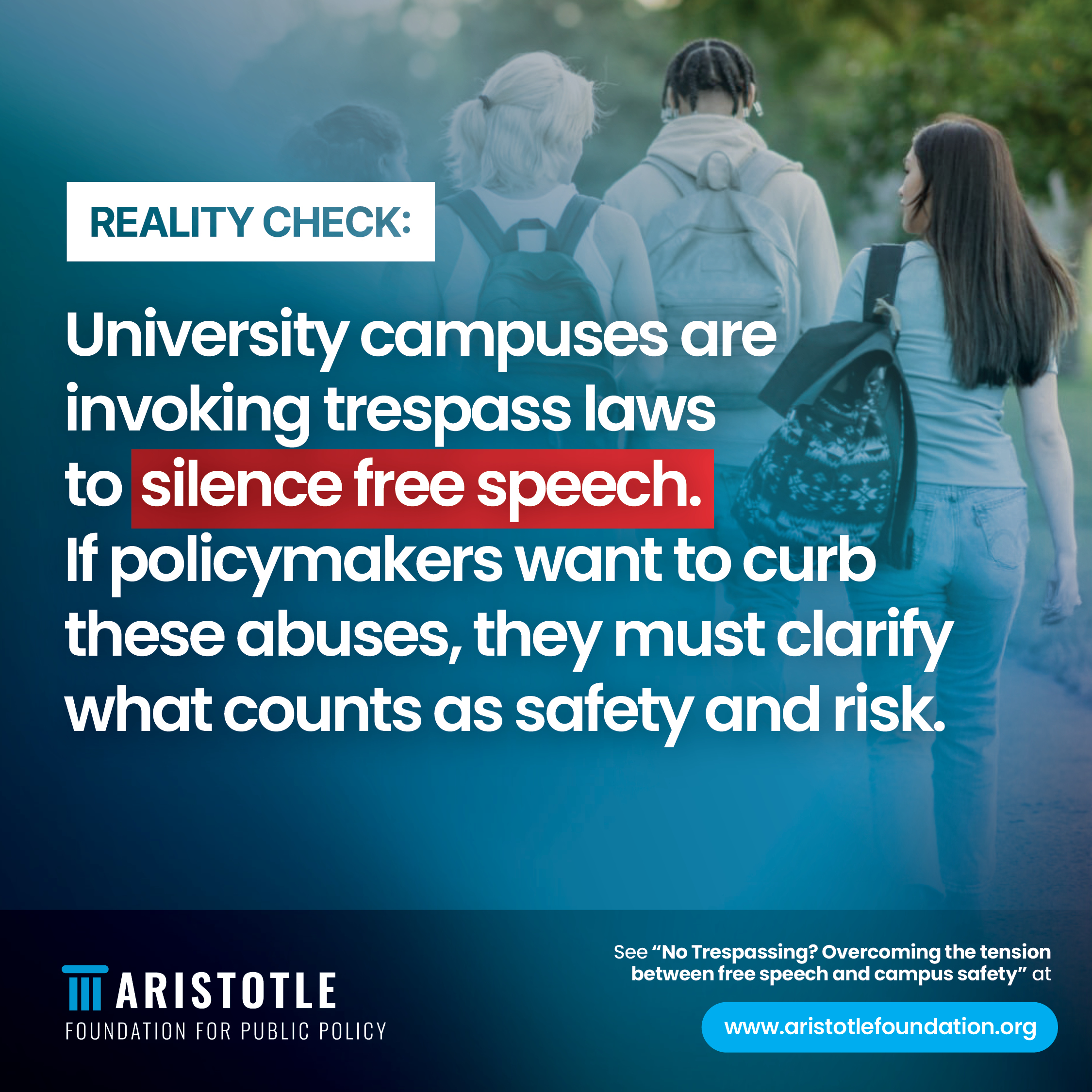
If policymakers want to reduce abuse of trespass powers, they must also clarify what counts as safety and risk. Universities should distinguish objective threats—such as targeted harassment, credible threats of violence, property damage, or blocked access—from subjective ones, like feeling offended or uncomfortable.
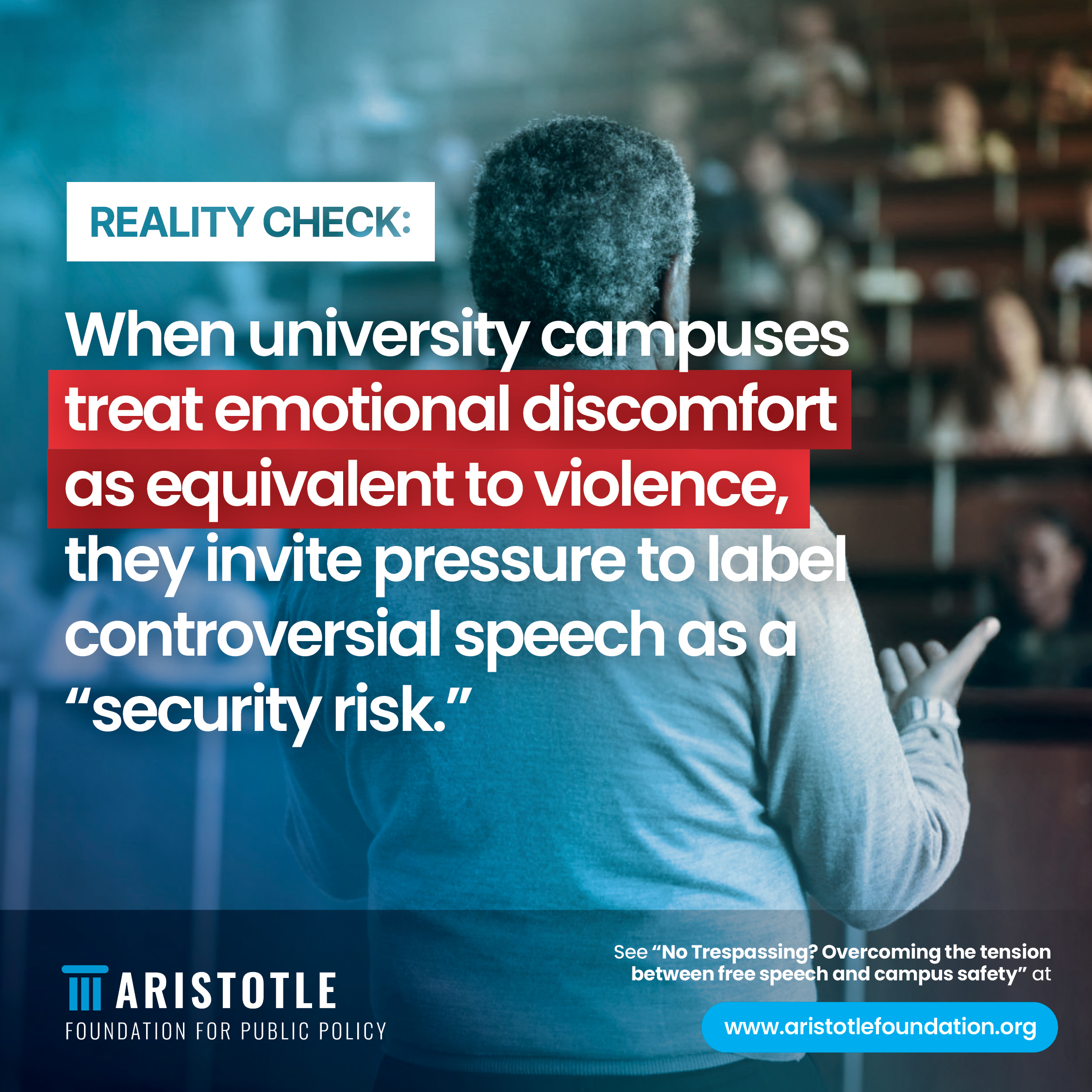
Haidt and Lukianoff show how some campus cultures collapse the difference between emotional discomfort and actual harm. When institutions treat offence as equivalent to violence, they invite pressure to label controversial speech as a “security risk.” That approach must be rejected, as it makes neutrality impossible and turns safety policy into a tool for viewpoint discrimination.
Clear definitions require administrators to show concrete evidence of likely physical harm or serious disruption before invoking trespass. Universities would also need to state explicitly that exposure to controversial, unsettling, or even harsh ideas does not qualify as a safety threat. Separating psychological offence from actual violence moves universities away from a speech-is-harm culture to a standard where safety policies protect people from real danger rather than from disagreement and critical thinking.
Constraining university discretion in these ways does not strip institutions of the ability to protect their communities. It restores a healthier balance. Canada should strive for universities that provide safe campuses, while respecting freedom of expression without ideological favour.
Joseph Quesnel is a senior fellow with the Aristotle Foundation for Public Policy. A veteran public policy analyst, Quesnel’s research has been published by numerous think tanks and research institutes, cited in all major media across Canada, and presented in Parliamentary hearings. Quesnel has also appeared before Senate and House of Commons committees as an expert witness.
Who we are
The Aristotle Foundation for Public Policy is a new education and public policy think tank that aims to renew a civil, common-sense approach to public discourse and public policy in Canada.
Our vision
A Canada where the sacrifices and successes of past generations are cherished and built upon; where citizens value each other for their character and merit; and where open inquiry and free expression are prized as the best path to a flourishing future for all.
Our mission
We champion reason, democracy, and civilization so that all can participate in a free, flourishing Canada.
Our theory of change: Canada’s idea culture is critical
Ideas—what people believe—come first in any change for ill or good. We will challenge ideas and policies where in error and buttress ideas anchored in reality and excellence.
Donations
The Aristotle Foundation for Public Policy is a registered Canadian charity and all donations will receive a tax receipt. To maintain our independence, we do not seek nor will we accept government funding. Donations can be made at www.aristotlefoundation.org.
The Aristotle Foundation for Public Policy has internal policies to ensure research is empirical, scholarly, ethical, rigorous, honest, and contributes to the advancement of knowledge and the creation, application, and refinement of knowledge about public policy. Our staff, research fellows, and scholars develop their research in collaboration with the Aristotle Foundation’s staff and research director. Fact sheets, studies, and indices are all peer-reviewed. Subject to critical peer review, authors are responsible for their work and conclusions. The conclusions and views of scholars do not necessarily reflect those of the Board of Directors, donors, or staff.
SUBSCRIBE TO OUR NEWSLETTER