
The world is more connected than ever, and yet it is surprising that a conflict on the other side of the globe could be one of the prime catalysts for commentary, protests, and even violence within Canada. The Canadian media complex, political figures, and cultural elites have decided that Israel should be a major point of political commentary, public policy, and private activism. Through selective reporting of real events, they have created a narrative that Israel is an illegal, genocidal, settler state that is the perpetrator of serious violence. These narratives, attitudes, and actions have stoked antisemitism in Canada to new levels, but the underlying story that these groups are pushing does not match the facts.
The argument that Israel is a violent settler state that routinely violates agreements and perpetrates unspeakable atrocities upon innocent civilians must be evaluated through hard data. This Reality Check does just that, studying the reality of illegal building and violence against civilians to prove that the great preponderance of violence and illegal activity occurs against Israel. The real data proves that the standard used to evaluate Israeli state activity is biased and inconsistent, and the propagation of false claims based on these standards has contributed to real violent antisemitism in Canada.
The conflict between Israelis and Palestinians is an international issue, but it is directly relevant to Canada for two reasons. First, the narratives Canadian institutions, media, politicians, and civil-society organizations adopt can influence Canada’s foreign policy choices. For example, just recently, Canada joined six European countries in condemning Israel for any settlement expansions in the first disputed territories.1 The federal government also recently recommended Canadian companies not engage in any business or investment with the settlements.2
Second, those narratives shape how Jewish Canadians are perceived and treated at home. When public discussion repeatedly depicts Israel as uniquely aggressive, illegitimate, and responsible for the conflict, criticism of a foreign government can spill over into hostility toward Israelis, Jewish institutions, and Canadian Jews.
Israel, like every other state, should be held accountable for unlawful conduct and unjust policies. The problem arises when Israel is subjected to standards not applied to other countries, when Jewish national self-determination is uniquely denied, or when Jews are expected to answer collectively for the actions of the Israeli government. The rhetoric of “aggressive Israeli settlers,” particularly when used broadly in elite Canadian circles, can contribute to this process by collapsing distinctions between the Israeli government, Israeli civilians, unauthorized outposts, authorized communities, and individual perpetrators.
The issue is therefore not remote from Canadian policy. A one-sided narrative can encourage Canada to adopt diplomatic positions that disregard the security concerns of Israeli civilians, overlook Palestinian violations, or treat Israel as uniquely responsible for instability. At the same time, that narrative can legitimize domestic campaigns that target Jewish institutions as supposed proxies for Israel. Foreign policy analysis and the fight against antisemitism are consequently connected: inaccurate or selectively applied narratives abroad can produce discriminatory consequences at home.
The Canadian debate over Israeli communities and Palestinian construction in Area C (the area of the West Bank administered by Israel) is shaped by a recurring double standard. Israeli activity is routinely presented as evidence of uniquely aggressive or illegitimate conduct, while comparable or more extensive Palestinian violations are described as humanitarian necessity, development, or resistance.
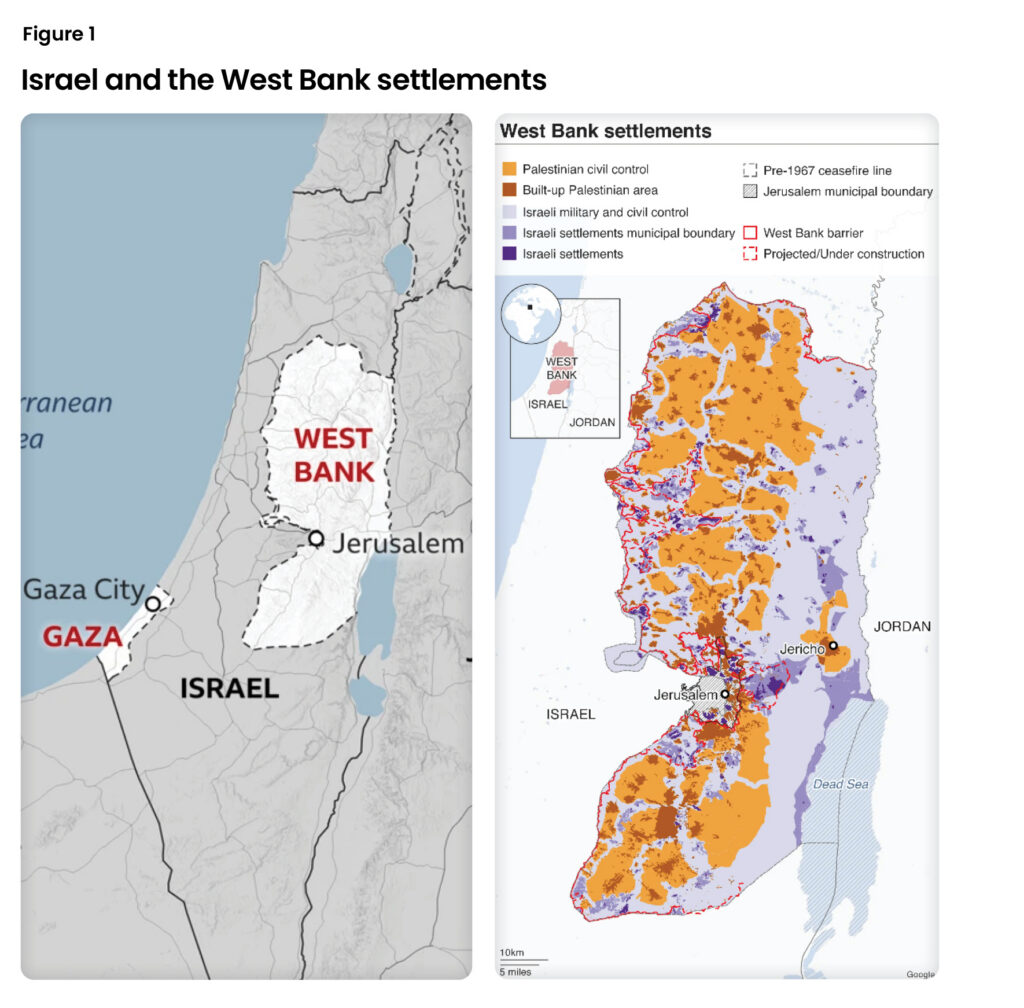
Source: “Explainer: Israel, annexation and the West Bank,” BBC, June 25, 2020, https://www.bbc.com/news/world-middle-east-52756427.
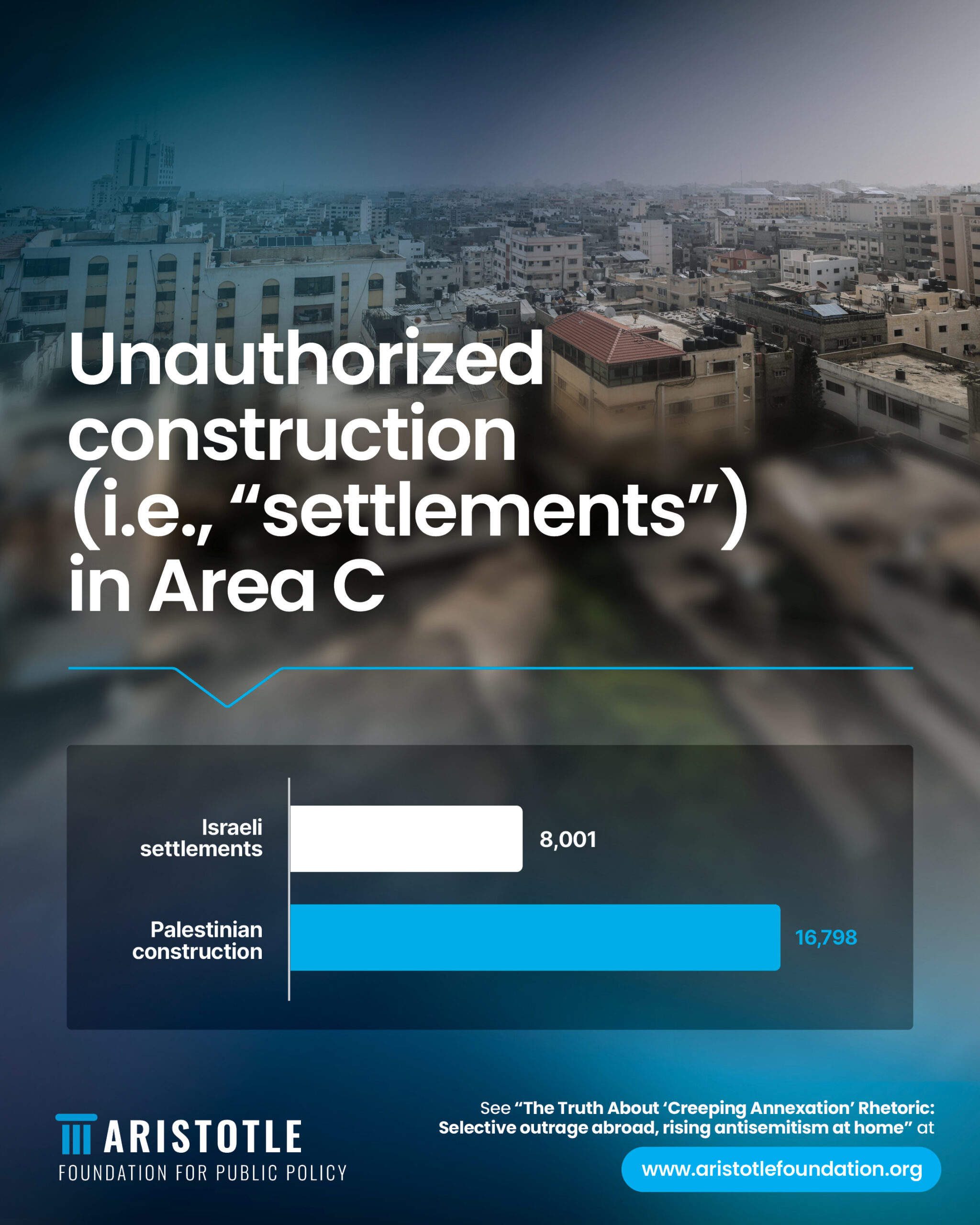
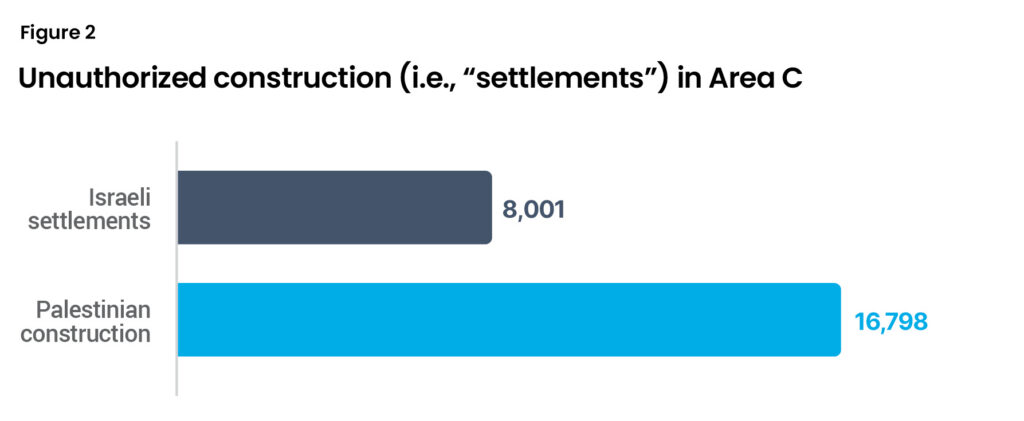
Under the Oslo II agreement on the interim administration of the West Bank and Gaza Strip, Area C remained under Israeli security and civil administration, pending a negotiated agreement. Construction by either side requires authorization from the Israeli Civil Administration. In 2017, the Israeli Civil Administration’s Supervision Unit reportedly opened 8,001 enforcement files concerning alleged unauthorized construction in Israeli settlements and 16,798 concerning instances of alleged unauthorized Palestinian construction in Area C (Figure 2).3 One caveat is these figures represent administrative enforcement files, not a census of structures or a count of completed demolitions.
Source: Publisher’s rendering based on “The South Hebron Hills: A Community under Threat,” Breaking the Silence, 2019, https://www.breakingthesilence.org.il/inside/wp-content/uploads/2019/08/BTS_SouthHillHebron_Booklet_ENG-2019.pdf.
It nevertheless demonstrates that unauthorized Palestinian construction was extensive rather than exceptional. The UN, the NGO ecosystem, and the mainstream media, however, only focus on unauthorized Israeli settlement and ignore unauthorized Palestinian construction. This creates a very distorted narrative.
The problem is that the criticism is rarely applied consistently. Israeli construction is commonly described as “illegal settlement expansion,” whereas Palestinian construction in Area C is often characterized as development, resilience, or humanitarian assistance, even when it lacks the required authorization. In some cases, foreign governments and nongovernmental organizations have supported Palestinian projects despite the absence of Israeli approval.4 Israeli and pro-Israel analysts argue that at least some of this activity forms part of a broader effort to establish facts on the ground and expand Palestinian control outside final-status negotiations.5
This possibility must be considered in relation to the state-building strategy developed under Salam Fayyad. His 2009 program, Palestine: Ending the Occupation, Establishing the State, placed institutional development, infrastructure, and the consolidation of Palestinian presence at the centre of the Palestinian national project. Although Fayyad left office in 2013, the underlying approach has continued through Palestinian Authority planning and foreign-funded roads, schools, agricultural projects, and community-development initiatives in Area C.
This does not mean that every Palestinian home, school, road, or agricultural project is centrally directed as a territorial operation. Palestinian officials argue that the permit system is restrictive, and that lawful development is often impractical. Many projects clearly address genuine social and economic needs. Nevertheless, a serious analysis must examine more than humanitarian justification. It should also consider each project’s legal status, funding sources, location, and relationship to Palestinian state-building objectives.
The same double standard appears in coverage of violence. “Settler violence” has become a dominant category in Canadian commentary, sometimes presented as though it represents the principal threat in the West Bank. Israeli attacks against Palestinians are real and should be investigated and prosecuted.
But Palestinian attacks against Israelis must be treated with equal seriousness. However, UN, NGO, and mainstream media accounts only discuss Israeli settler violence and present that as the sole issue occurring in the territories. These sources all largely ignore pre-existing and ongoing violence from Palestinians against Israeli settlers and against citizens in Israel proper. Data from Shin Bet, Israel’s security agency, recorded 6,828 terror attacks carried out in 2024, including stone throwing and Molotov cocktails, double the number of attacks from 2023.6 Moreover, within Israel, Israeli Arabs carried out 14 significant terror attacks.7
Also, in 2024, the Shin Bet recorded it had thwarted or disrupted 1,040 significant terror attacks against Israelis by Palestinians.8
However, UN and media reports focused exclusively on attacks by Israelis, even though Israeli deaths still dwarf Palestinian deaths by a significant margin. These sources also used scare tactics and emotive language, with terms such as “all-time high” and others.9
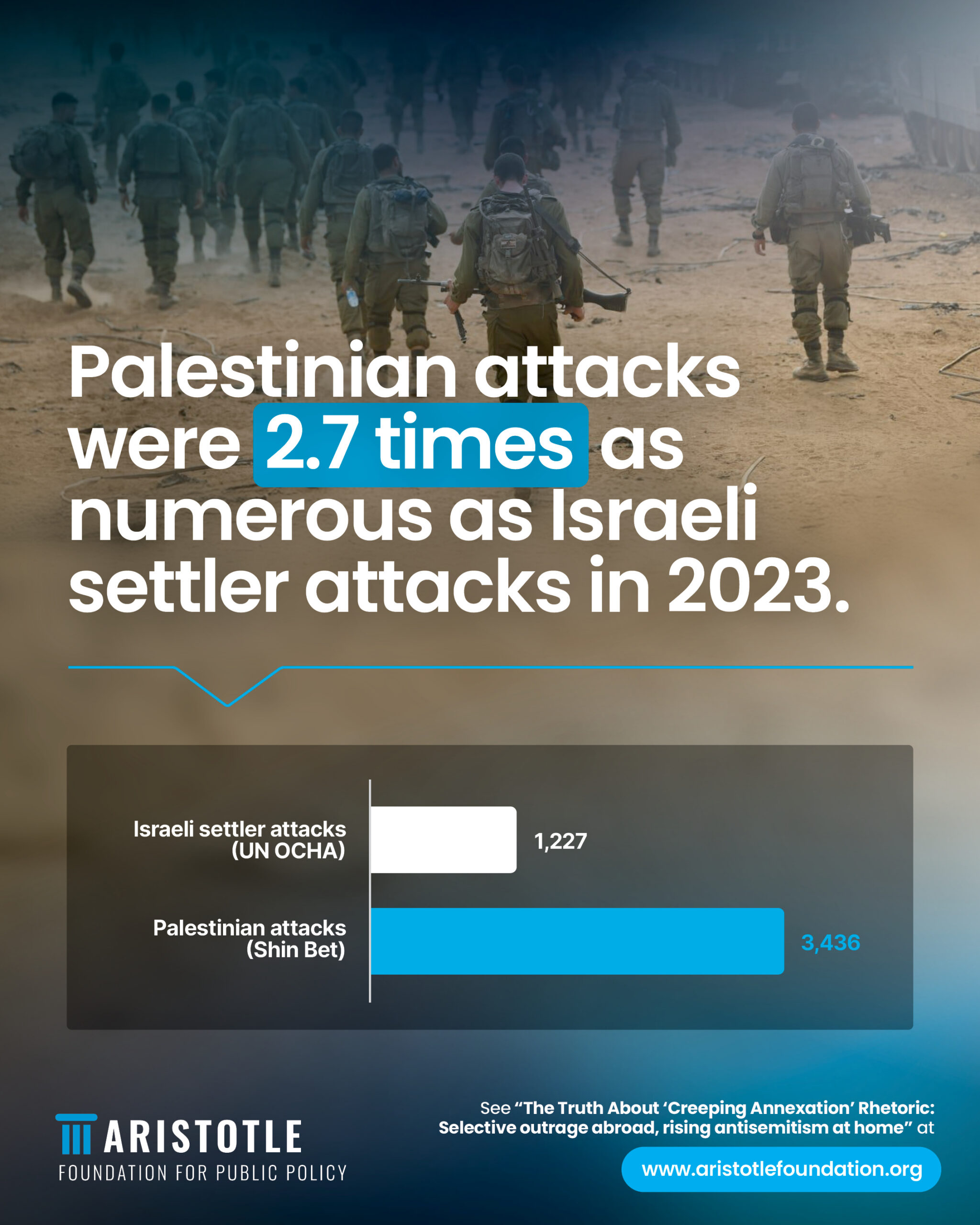
These categories are not perfectly symmetrical and should not be treated as identical measures. Shin Bet reported 3,436 Palestinian attacks in 2023, while the United Nations Office for the Coordination of Humanitarian Affairs documented 1,227 Israeli settler attacks (Figure 3).10 They nevertheless show that Palestinian attacks were approximately 2.7 times as numerous in the available 2023 data.
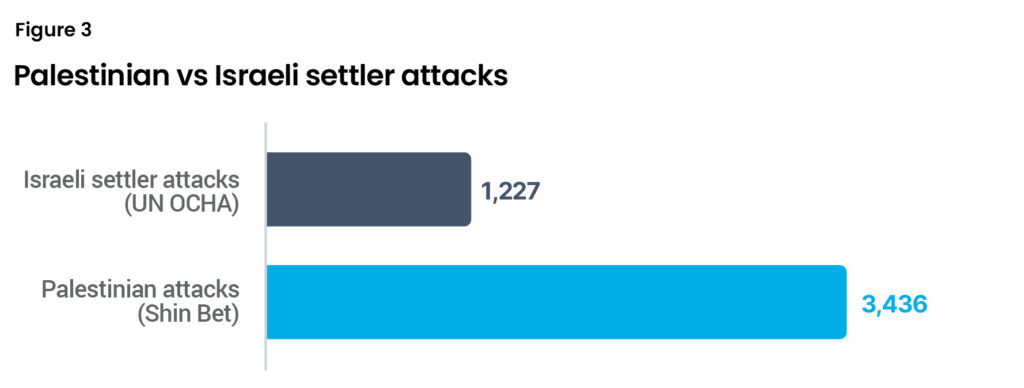
Source: Publisher’s rendering based on United Nations Office for the Coordination of Humanitarian Affairs in the Occupied Palestinian Territory, “Data on Casualties,” United Nations, https://www.ochaopt.org/data/casualties and Mora Deitch, “Summary of Terror Attacks in Israel and the West Bank, 2023–2024,” Institute for National Security Studies (INSS), February 4, 2025, https://www.inss.org.il/publication/terror-2023-2024/.
Those attacks included shootings, stabbings, vehicle attacks, firebombings, stone-throwing, and other assaults against Israeli civilians and security personnel. Many occurred on roads used by Israeli communities in Judea and Samaria. Such violence is part of the security environment in which Israeli residents live. It helps explain the checkpoints, barriers, patrols, and other security measures that can impose serious hardship on Palestinians. Those measures should be scrutinized, but they cannot be assessed honestly if the violence that prompted them is excluded from the account.
The two forms of violence also differ in political and institutional context. Palestinian attacks are frequently connected to militant organizations, the glorification of attackers, and a broader ideological rejection of Jewish sovereignty. Settler violence, by contrast, is not the policy of the Israeli state and is routinely condemned by Israeli authorities, Israeli civil-society organizations, and much of the Israeli public. This distinction does not excuse settler violence. It does mean that the two phenomena should not automatically be portrayed as morally or institutionally equivalent.
Canadian elite rhetoric often removes these distinctions. Describing Israel generally as an “aggressive settler” state may begin as criticism of communities or policies, but the phrase is frequently used as a sweeping moral characterization of Israel itself. It collapses the differences between government policy, civilian residence, unauthorized outposts, authorized communities, and individual criminal conduct. It also suggests that Jewish presence in the region is inherently illegitimate.
That rhetoric can contribute directly to antisemitism. Jewish Canadians may be pressured to answer for the policies of a foreign government simply because they are Jewish. Jewish institutions may be treated as proxies for Israel and targeted accordingly. Jewish students and community members may be expected to demonstrate opposition to Israel before being accepted as legitimate participants in public life. Ordinary Jewish attachment to Israel—or even a refusal to endorse one-sided accusations—can be treated as evidence of complicity.
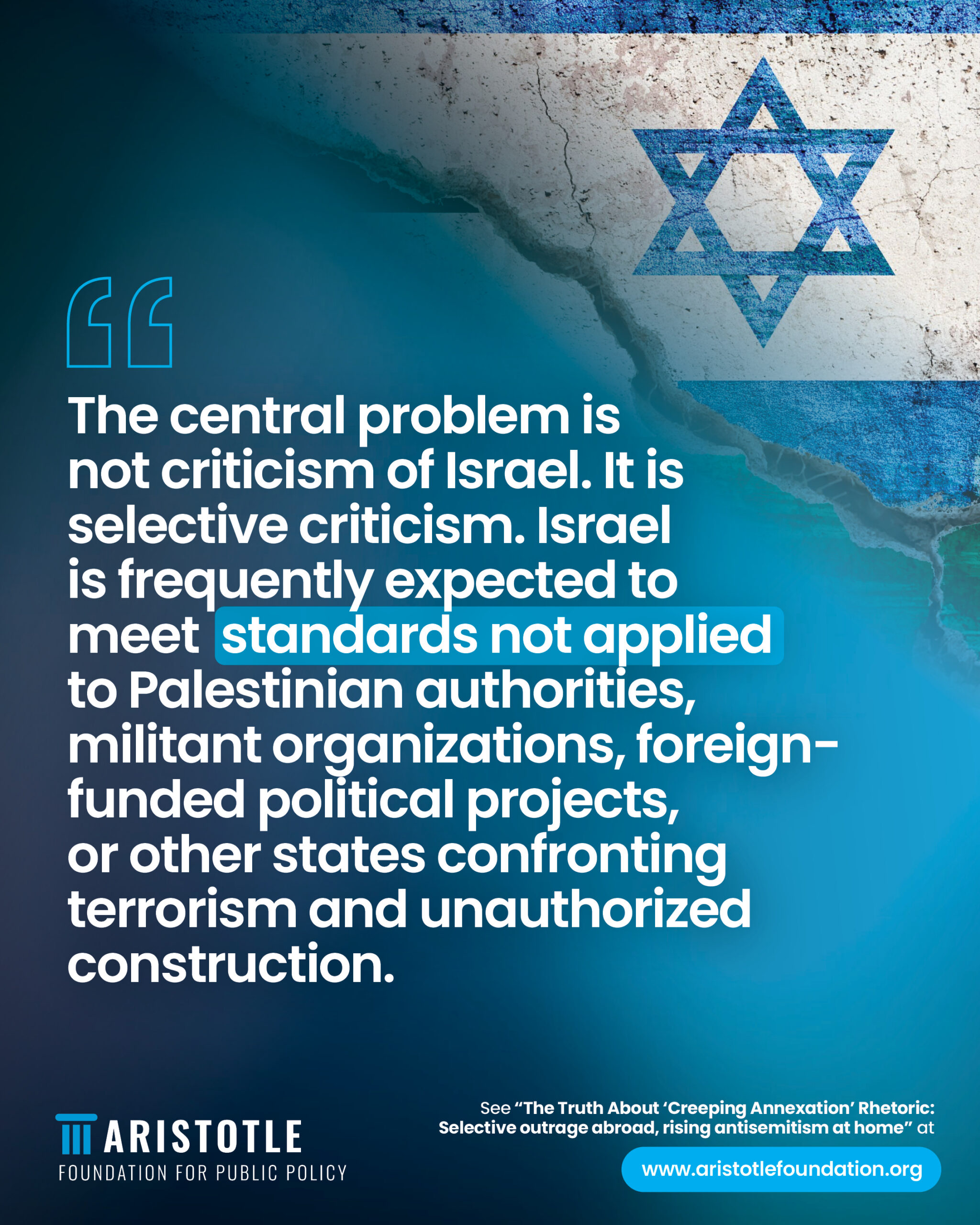
The central problem is not criticism of Israel. It is selective criticism. Israel is frequently expected to meet standards not applied to Palestinian authorities, militant organizations, foreign-funded political projects, or other states confronting terrorism and unauthorized construction. Israeli victims are treated as evidence of an unfortunate context, while Palestinian victims are treated as evidence of Israel’s inherent criminality.
A balanced Canadian discussion should recognize several facts at once: Palestinian construction in Area C has often lacked the approvals required under Oslo II, and the Fayyad-era state-building approach continues to influence Palestinian and foreign-funded activity in Area C. So, while Israeli outposts have also operated unlawfully and have sometimes benefited from more favourable enforcement, Palestinian attacks against Israelis were substantially more frequent than the settler-violence incidents emphasized in much Canadian commentary.
Canadian reporting and policymaking should therefore distinguish structures from communities, enforcement cases from completed demolitions, and settler violence from Palestinian terrorism and other attacks. They should disclose foreign funding, explain the Oslo II framework, acknowledge the continuing influence of the Fayyad state-building model, and recognize that Israeli civilians are not merely participants in the conflict but frequent targets of it.
Above all, Canadian public discussion should reject language that transforms policy criticism into collective demonization. When Israel is portrayed as uniquely aggressive and illegitimate, hostility can extend from the state to Israelis, Jewish institutions, and Jewish Canadians who identify with Israel. Such narratives can distort Canada’s foreign policy while weakening the country’s ability to confront antisemitism consistently. A more responsible approach requires criticism based on evidence, standards applied to all parties, and a clear distinction between legitimate policy disagreement and rhetoric that places Jews collectively under suspicion.
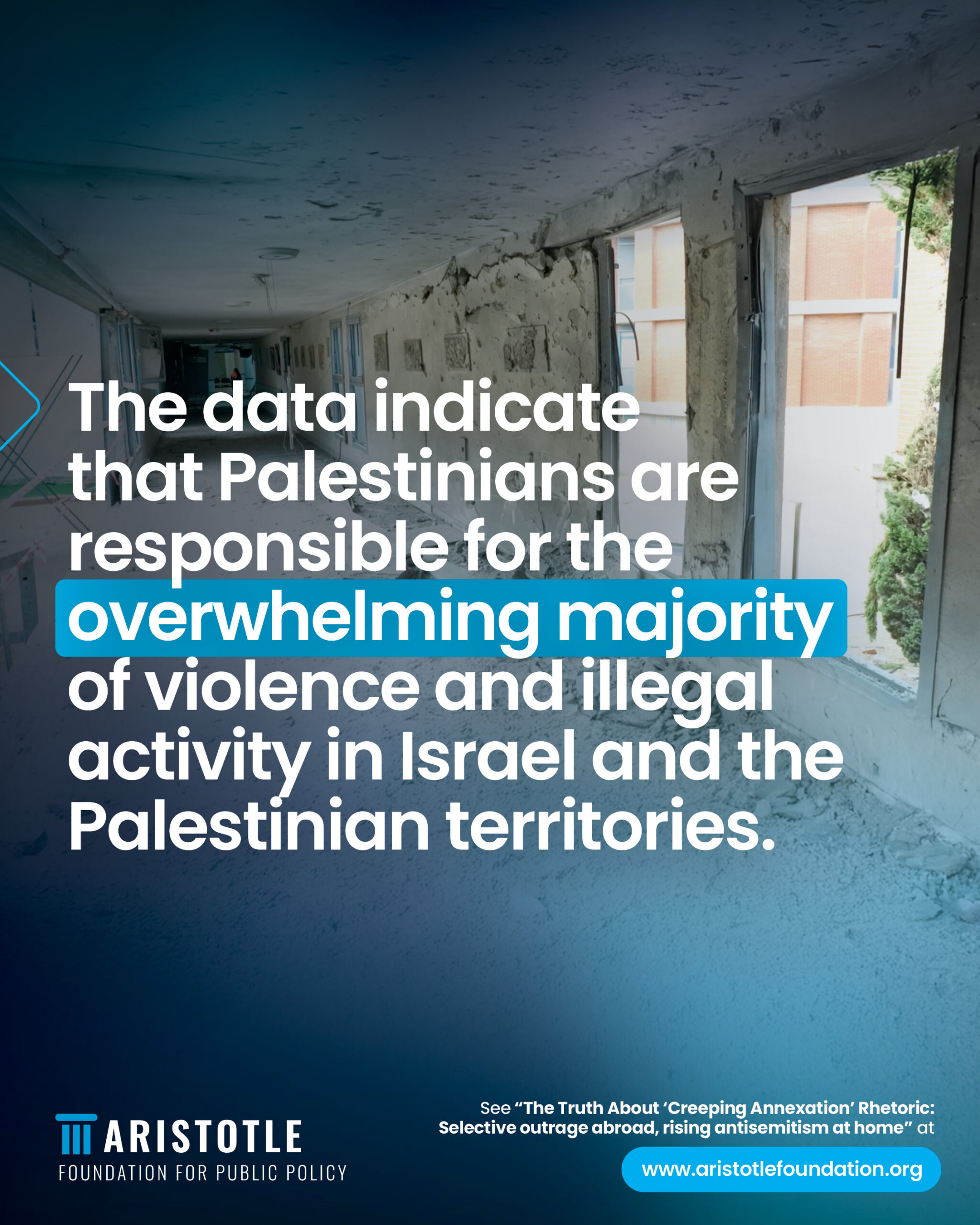
The consequences of false narratives built on inconsistent standards are not merely poor public opinion toward a foreign government. They are felt in real antisemitism and violence toward Jewish people in Canada, as well as in the damaging public and civil assaults upon a people who are under constant attack in their own home country. The data show that the overwhelming source of violence and illegality in Israel and the Palestinian territories is Palestinians. False claims and deliberate misinformation cannot alter the facts of violence and illegality, and it behooves Canadian commentators, politicians, and cultural elites to apply their standards consistently to all who are involved in the conflict. It is perfectly right to criticize the policies of the state of Israel. But to collectively demonize all who live within that state, and to allow that demonization to extend to Jewish people worldwide must be called what it is: dangerous and destructive antisemitism.
Joseph Quesnel is a senior fellow with the Aristotle Foundation for Public Policy. A veteran public policy analyst, Quesnel’s research has been published by numerous think tanks and research institutes, cited in all major media across Canada, and presented in Parliamentary hearings. Quesnel has also appeared before Senate and House of Commons committees as an expert witness.
Who we are
The Aristotle Foundation for Public Policy is a new education and public policy think tank that aims to renew a civil, common-sense approach to public discourse and public policy in Canada.
Our vision
A Canada where the sacrifices and successes of past generations are cherished and built upon; where citizens value each other for their character and merit; and where open inquiry and free expression are prized as the best path to a flourishing future for all.
Our mission
We champion reason, democracy, and civilization so that all can participate in a free, flourishing Canada.
Our theory of change: Canada’s idea culture is critical
Ideas—what people believe—come first in any change for ill or good. We will challenge ideas and policies where in error and buttress ideas anchored in reality and excellence.
Donations
The Aristotle Foundation for Public Policy is a registered Canadian charity and all donations will receive a tax receipt. To maintain our independence, we do not seek nor will we accept government funding. Donations can be made at www.aristotlefoundation.org.
The Aristotle Foundation for Public Policy has internal policies to ensure research is empirical, scholarly, ethical, rigorous, honest, and contributes to the advancement of knowledge and the creation, application, and refinement of knowledge about public policy. Our staff, research fellows, and scholars develop their research in collaboration with the Aristotle Foundation’s staff and research director. Fact sheets, studies, and indices are all peer-reviewed. Subject to critical peer review, authors are responsible for their work and conclusions. The conclusions and views of scholars do not necessarily reflect those of the Board of Directors, donors, or staff.