


It is often said that indigenous peoples (First Nations, Inuit, and Métis) are particularly disadvantaged by systemic racism in Canada. This is a constant theme in the Government of Canada’s anti-racism strategy. “Systemic anti-Indigenous racism accounts for the fact that compared to non-Indigenous People, First Nations, Inuit, and Métis experience poorer social, economic, and political outcomes than their non-Indigenous counterparts,” according to the government.1
Certainly, indigenous peoples in Canada faced historical wrongs. For example, thousands were enslaved in Canada—primarily by other indigenous peoples—before slavery was abolished in the British Empire in 1834.2 Many indigenous children who attended residential schools suffered abuse, violence, and other significant hardships that caused lasting harm.3 And, until 1960, First Nations could not vote unless they gave up their Indian Status under the law.4
However, despite these historical injustices, this report presents evidence that indigenous peoples today can succeed and prosper in the same way as non-indigenous Canadians. While on average their incomes lag the general population, disparities do not imply discrimination.5 Indeed, the difference in average incomes between the indigenous population and non-indigenous population can be explained by factors such as education and geography. This, then, is positive: the data show that where indigenous Canadians have a trade or university degree, live near major urban centres, and work full time, incomes are broadly similar to those of non-indigenous Canadians. That is encouraging because it shows that whatever personal prejudice indigenous peoples encounter (a serious problem but different than institutional racism), indigenous Canadians are not “hostages” to bias and prejudice but can regardless succeed—and in fact are doing just that.
Understanding these facts and data, which are often in conflict with prevailing narratives—such as the narrative presented by the government and various NGOs that “systemic anti-Indigenous racism” is to blame—is important for creating policies and practices that best support opportunities for indigenous Canadians.
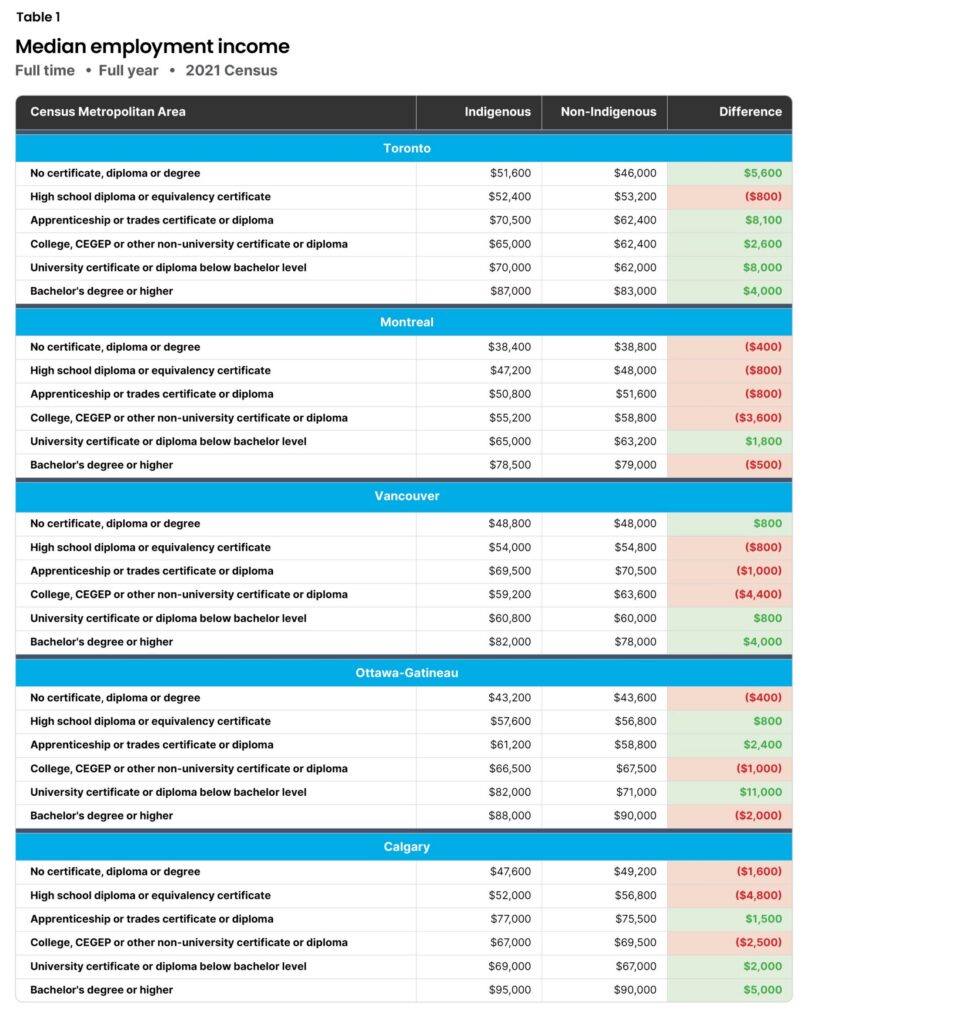
We know that assumed systemic racism is a poor explanation for indigenous incomes because when apples-to-apples comparisons are made—full-time, full-year work for indigenous and non-indigenous workers—half of the comparisons show indigenous workers have median employment incomes above non-indigenous workers, while half show indigenous incomes below non-indigenous workers.
Consider Table 1, which shows, for the five largest Census Metropolitan Areas, the median employment income for indigenous and non-indigenous workers who worked full time for the full year by level of education. Differences are shown in green where the median employment income was higher for indigenous workers, and in red where it was higher for non-indigenous workers. Notably, Table 1 has 15 differences coded green and 15 coded red—exactly what would be expected if indigenous identity did not positively or negatively affect income in a systemic way.
Source:
Author’s calculations based on Statistics Canada (2022, 2023) data.
If, as Table 1 shows, incomes for both indigenous and non-indigenous workers are broadly similar, why then is there a pervasive belief that the data is evidence of racism and great disparities? In large part, it is because those who offer such claims do not make like-to-like comparisons. They instead ignore the “inputs” such as the proportion of workers in each cohort who work full or part time, education levels, and geography. To arrive at accurate comparisons, it is critical to take those differences into account.
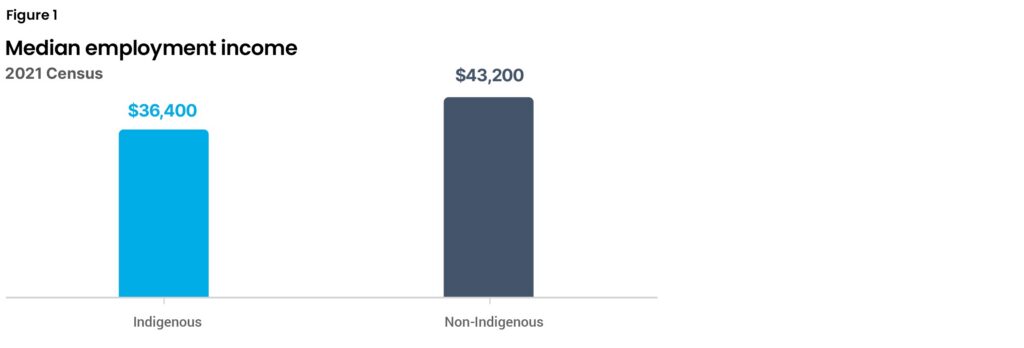
According to the 2021 Census, the median employment income in 2020 for indigenous Canadians was $36,400, compared to $43,200 for non-indigenous Canadians (Figure 1).6 This suggests a disparity of 15.7 percent for indigenous workers.
Source:
Author’s calculations based on Statistics Canada (2022, 2023) data.
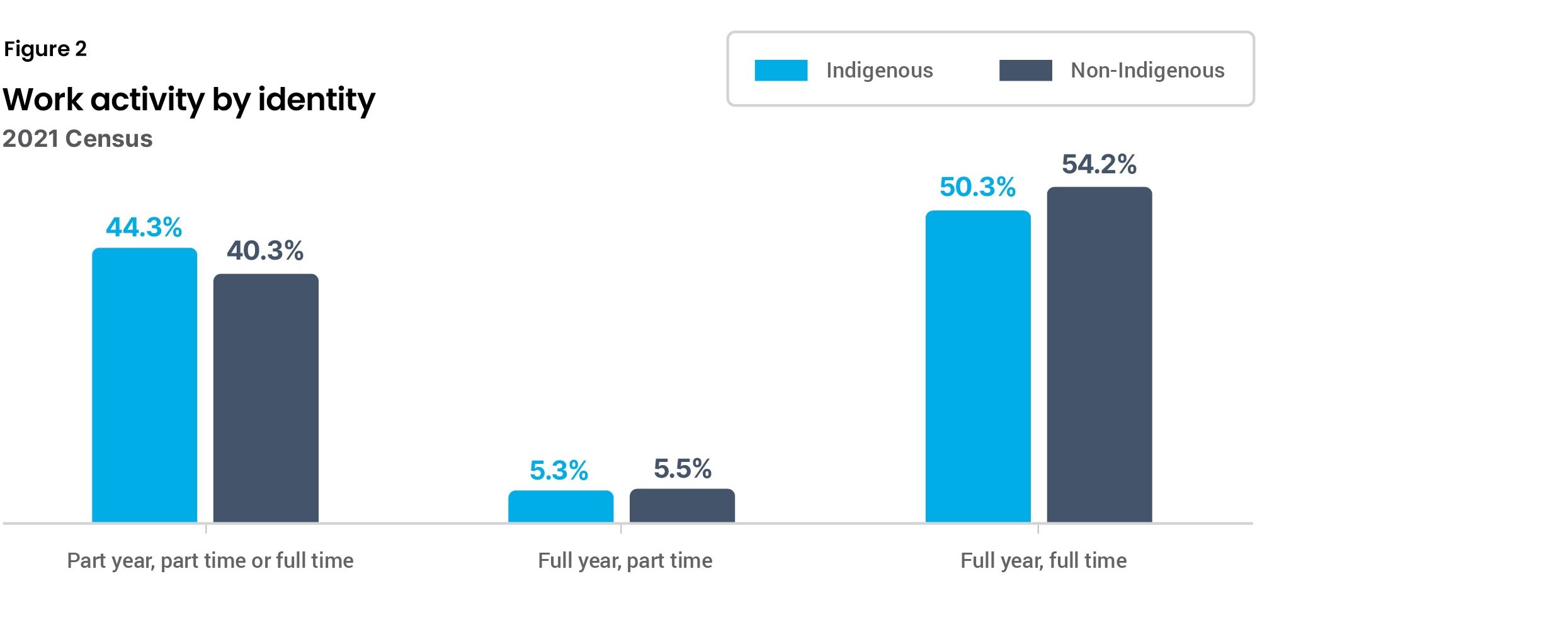
However, these numbers are not directly comparable. A major reason why the median employment income was lower for indigenous Canadians is that only 50 percent of them worked full time for the full year, as compared to 54 percent of non-indigenous Canadians, as shown in Figure 2. Conversely, indigenous Canadians were more likely to be employed for only part of the year.
Source:
Author’s calculations based on Statistics Canada (2022, 2023) data.
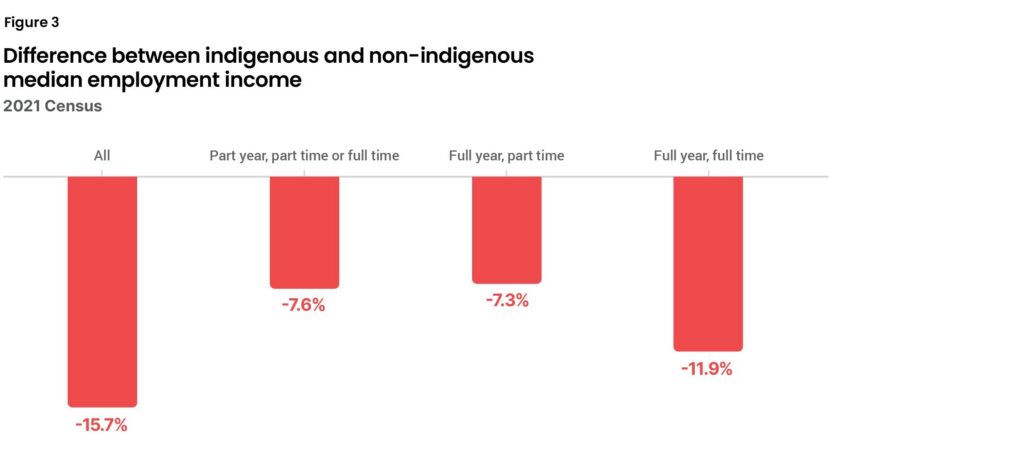
As shown in Figure 3, controlling for this one factor reduces the median employment income deficit to 7.6 percent among indigenous peoples who were employed for part of the year, 7.3 percent among those who worked for the full year but only part time, and 11.9 percent among those who worked full time for the full year.
Source:
Author’s calculations based on Statistics Canada (2022, 2023) data.
Overall, after controlling for this one factor, the employment income deficit for indigenous workers is not 15.7 percent, but only 9.7 percent. Put another way, much of the gap in median employment incomes between indigenous Canadians and non-indigenous Canadians is explained by whether they worked for part of the year or the full year, and, if for the full year, whether they were employed part time or full time.
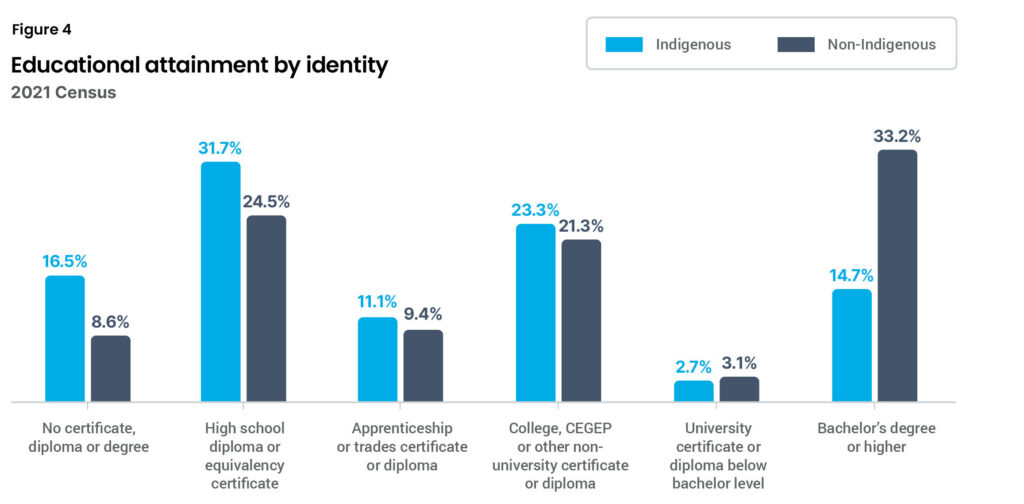
Differences in education levels also provide a powerful explanation for the differences in employment income between the indigenous and non-indigenous population. Figure 4 illustrates that only 15 percent of indigenous workers had a bachelor’s degree or higher, compared to 33 percent for non-indigenous workers. Meanwhile, 17 percent of indigenous workers have no certificate, diploma, or degree, compared to only 9 percent of non-indigenous workers.
Source:
Author’s calculations based on Statistics Canada (2022, 2023) data.
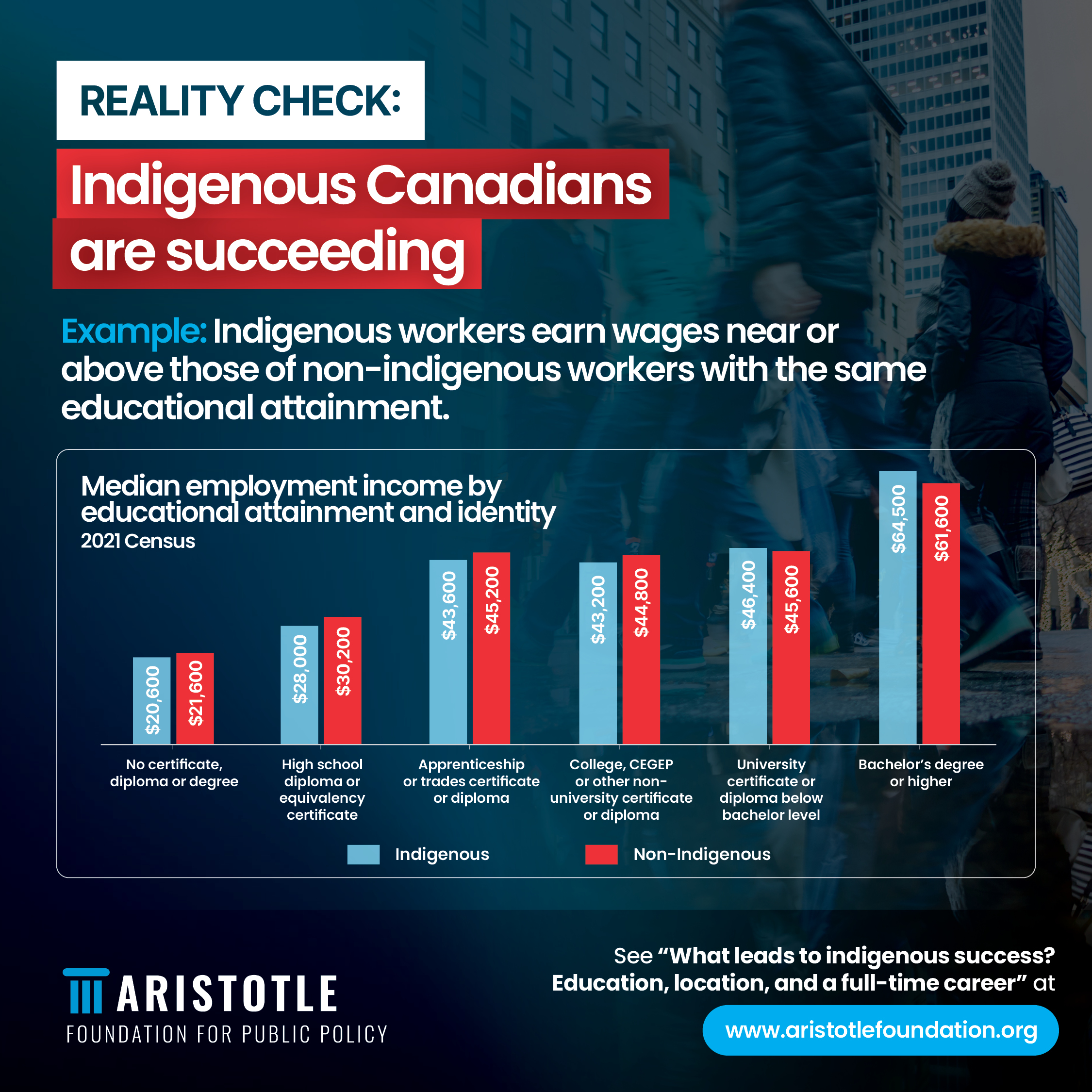
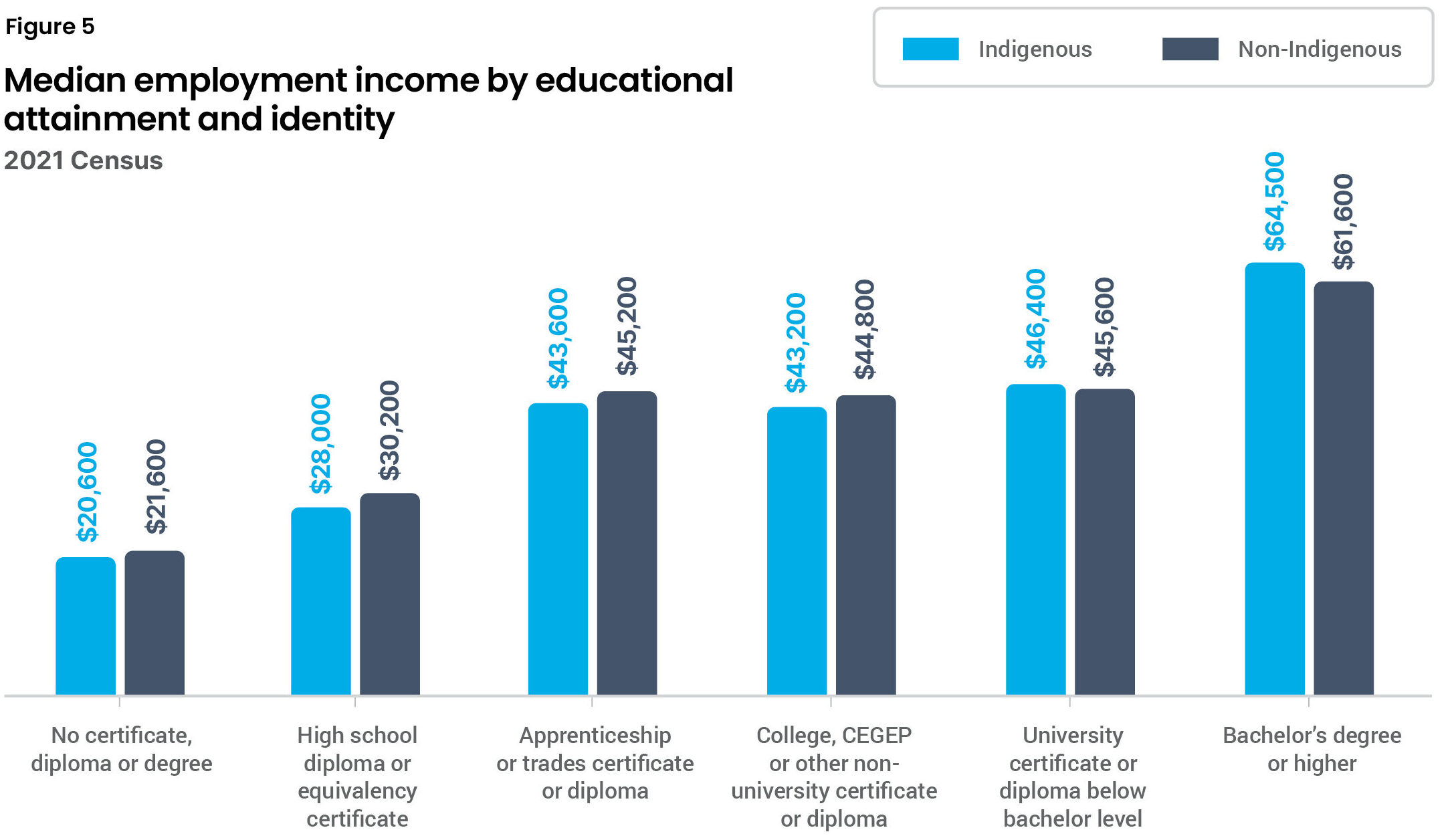
Figure 5 shows that at each level of educational attainment, the median employment income is comparable for indigenous versus non-indigenous workers. Specifically, while at lower levels of educational attainment the median income is slightly lower for the indigenous population, among Canadians with a university certificate or diploma or better, the median income is actually slightly higher for the indigenous population—underscoring the fact that indigenous Canadians who further their education have as much opportunity to succeed and prosper as their non-indigenous counterparts.
Source:
Author’s calculations based on Statistics Canada (2022, 2023) data.
Where people live, which—like education—is a factor they can control, plays a significant part in determining incomes. In general, incomes tend to be higher in large cities where there is more economic opportunity and where the cost of living is higher as compared to rural areas. Living and working in a federal or provincial capital provides more access to public sector jobs, where pensions and job security tend to be much stronger. Proximity to natural resources is also a factor.
The data clearly show there is a significant difference in economic prosperity for indigenous Canadians on and off reserves. Specifically, according to the 2021 Census, the median after-tax income for indigenous Canadians is 29 percent higher for those who live off a reserve as compared to those who live on a reserve.7 The remoteness of many reserves is a barrier to their residents’ educational attainment and economic opportunity.8
Overall, when examining where in each province indigenous versus non-indigenous workers tend to be located, it is clear the indigenous population is less likely to be in larger urban centres where incomes are higher.
For example, in Saskatchewan, median incomes are higher in Regina and Saskatoon than the province as a whole. But while 56 percent of the province’s non-indigenous workers are located in these two cities, among indigenous workers it is only 38 percent.
Similarly, in Nova Scotia, median incomes are higher in Halifax than in the province as a whole, but the proportion of the province’s workers who are located in Halifax is much higher among non-indigenous workers than among indigenous workers.
In every province, the story is similar: in general, the median employment income is higher in larger cities, but the proportion of the province’s workers located in those cities is lower for the indigenous population.
Combining the effects of full-year versus part-year work, education, and geography produces a more complete comparison of indigenous versus non-indigenous incomes.
Two cautions are warranted. First, it is important to note that many more factors than these affect employment income. Industry, years of experience, propensity to work overtime, public sector versus private sector employment, non-wage benefits, and many other factors besides are relevant. However, examining all of these factors is beyond the scope of this paper. Second, any residual differences cannot simply be attributed to racism or systemic discrimination. Disparities do not imply discrimination.
Contrary to the federal government’s claim that “systemic anti-Indigenous racism” is to blame for worse outcomes for the indigenous population, the income statistics show that three factors—employment for part of the year versus the full year, education, and geography—can help to explain the income difference between indigenous and non-indigenous Canadians.
Notably, these are factors that, unlike systemic racism, indigenous individuals have control over and can change. Indeed, many do, and they prosper: indigenous Canadians with a university certificate or diploma, or with a bachelor’s degree or higher, enjoy a higher median employment income than non-indigenous Canadians with comparable educational attainment. Those who leave reserves and move to larger urban centres tend to enjoy greater economic opportunity.
Understanding these facts is important for creating policies and practices that best support standards of living for indigenous Canadians.
Matthew Lau is a senior fellow with the Aristotle Foundation for Public Policy. A financial analyst by trade, his writing covers a wide range of subjects including fiscal policy, economic theory, government regulation, and Canadian politics. He holds a Bachelor of Commerce degree with a specialization in finance and economics from the University of Toronto and is a CFA charterholder.
Who we are
The Aristotle Foundation for Public Policy is a new education and public policy think tank that aims to renew a civil, common-sense approach to public discourse and public policy in Canada.
Our vision
A Canada where the sacrifices and successes of past generations are cherished and built upon; where citizens value each other for their character and merit; and where open inquiry and free expression are prized as the best path to a flourishing future for all.
Our mission
We champion reason, democracy, and civilization so that all can participate in a free, flourishing Canada.
Our theory of change: Canada’s idea culture is critical
Ideas—what people believe—come first in any change for ill or good. We will challenge ideas and policies where in error and buttress ideas anchored in reality and excellence.
Donations
The Aristotle Foundation for Public Policy is a registered Canadian charity, and all donations will receive a tax receipt. To maintain our independence, we do not seek nor will we accept government funding. Donations can be made at www.aristotlefoundation.org.
The Aristotle Foundation for Public Policy has internal policies to ensure research is empirical, scholarly, ethical, rigorous, honest, and contributes to the advancement of knowledge and the creation, application, and refinement of knowledge about public policy. Our staff, research fellows, and scholars develop their research in collaboration with the Aristotle Foundation’s staff and research director. Fact sheets, studies, and indices are all peer-reviewed. Subject to critical peer review, authors are responsible for their work and conclusions. The conclusions and views of scholars do not necessarily reflect those of the Board of Directors, donors, or staff.
Image credits: iStock