
In Canadian education, the path to the classroom is paved with credentials. Most provinces mandate that teachers undergo extensive post-secondary training. This process is often framed as a neutral acquisition of best practices and evidence-based techniques. Yet, faculties of education are far from neutral. In many classes in many Canadian education faculties, future teachers are taught to be revolutionary and to use the classroom as a theatre for social and political transformation, rather than a place to learn objective truth.
This Reality Check analyzes the ideas that permeate Canadian teacher education. It shows that the reigning ideology is largely influenced by the Marxist notion that traditional society is oppressive—and, thus, a political and cultural revolution is necessary to overthrow it. This is taught and embedded in the curriculum through the perspective of what is often called “critical pedagogy.” This ideology dominates Canada’s leading education faculties.
The goal is to highlight the limited available data in Canada’s leading education programs.1a In the United States, course syllabi are regularly posted publicly to Open Syllabus.b That is not the case in Canada. In Canadian universities, course outlines are often hidden from public view, especially for education programs.2 These classes may be mandatory or optional. But even non-required classes reveal the ethos and priorities of the faculties of education.
a. According to Maclean’s, Canada’s top teacher training programs are ranked as follows (2024): the Ontario Institute for Studies in Education (OISE) at the University of Toronto and University of British Columbia (UBC) (tied #1), University of Alberta (3), McGill (4), Queen’s (5), and Western (6). Of all top universities, globally, Times Higher Education ranks Canada’s education degrees as follows (2026): OISE at Toronto (11), UBC (23), McGill (37), Alberta (82), and tied for fifth in Canada: Simon Fraser University (101-125), Université de Montréal (101-125), and Western (101-125).
b. Nearly 33 million college syllabi are available on Open Syllabus’ website.
The reigning paradigm in Canada’s faculties of education is that “liberation” is the purpose of education.3 Students are guided to see and “read the world” as oppressive structures being reproduced in social hierarchies. While the language opposes racism and colonialism, it rejects objective truth in any subject—even mathematics—since this imposes a “white racial frame” on students. Liberation thus involves “decolonizing” the curriculum, where all learning is judged by its social justice utility. For example, a guide to “Equitable Math” criticizes practices that “reinforce objectivity” as being a display of “white supremacy.”4
The public should be aware of this classroom indoctrination of Canadian children. This requires looking at what is being taught in Canada’s education faculties. (Of note: Canada leads the English-speaking world in cross-curricular decolonization “research.” For example, Canada has about ten times the per-capita decolonization output compared to the United States.5)
In order of program rankings, eight teacher training colleges are examined below. Specifically, publicly available course material is presented, to see how and where critical pedagogy and its adjacent concepts of “decolonialism” and “anti-racism” (understood not in a benign sense but as part of a revolutionary political project) appear in what is taught.c
The Ontario Institute for Studies in Education (OISE) represents the vanguard of radical pedagogy. OISE leads Canada and Canada leads the world, in the field of education. Their Graduate Department of Social Justice Education, with courses such as SJE3417H (Critical, Feminist, and Radical Pedagogies), centres the work of critical pedagogy scholars like Paulo Freire and bell hooks to promote “liberatory educational theory and praxis.”6 Praxis is a concept deeply embedded in Marxist thought and refers to political practice that acts out revolutionary theory; Freire, for example, defined praxis as “reflection and action upon the world in order to transform it” and cited the communist revolutions of Mao and Castro as positive examples of this.7
SJE3914H: Anti-Colonial Thought and Pedagogical Challenges utilizes the writings of “revolutionary/radical thinkers” like Che Guevara, Mao Tse-Tung, and Kwame Nkrumah (who was awarded a Lenin Peace Prize by the Soviet Union) to “subvert colonial hierarchies embedded in conventional schooling.”8 Thus, there is an unabashed promotion of thinkers who taught their youth to take up murderous arms against authorities such as parents and small business owners. It is worth noting that Che Guevara, one of the “radical thinkers” studied in this class, described youth as “the malleable clay from which the new person can be built with none of the old defects,” if only they could be “educated for communism. Our work constantly strives toward this education.”9
Through courses like CTL7009H: Anti-Discriminatory Education, OISE explicitly sets out “to develop [teacher candidates’] understandings of theories and practices of pedagogies of liberation within daily life in schools.”10 Here we see the theoretical roots that empower student protestors who have physically attacked campus speakers, trashed the offices of university presidents, and generally practiced (praxis) “liberation” in daily life.
c. Some of these materials are from previous years, with more recent or current syllabus material not publicly available; however, these give a sense of the sort of curriculum found at these institutions.
At the University of British Columbia, the curriculum extends the political mission into the realm of student activism and identity politics. LLED 366 frames “Literature as a catalyst for social action” in the context of “Social and Ecological Justice.”11 EDST 403: Education, Knowledge, and Curriculum, not only challenges the concept of objective truth (“Can teachers teach anything that is absolutely true[?]…How do Aboriginal conceptions of knowledge and truth differ from European conceptions?”), but also requires students to write papers exploring how “identity (e.g. gender, aboriginality, race, sexual orientation)” can be leveraged for “better social/global justice results.”12 Teacher candidates are expected to use “anti-racist” and “social justice” frameworks to achieve academic success. The hidden premise of such relativism is that action without reason or truth has become arbitrary power backed by the force of the state.
McGill’s Faculty of Education emphasizes critical reflection, anti-oppression, and global activism within its teacher training curriculum. In EDEC 248: Equity and Education, candidates examine historical, political, and economic theories of equity, engaging directly with classroom resources designed to foster “anti-racism, anti-oppression and intercultural approaches” in Quebec and Canadian schooling.13 Complementing this, EDEC 249: Global Education and Social Justice utilizes a cross-curricular, interdisciplinary framework intended to nurture active civic participation by infusing classroom teaching with questions centred on “social, economic, and environmental justice.”14 Such goals sound benign until one uncovers the violent revolutionary agenda that has twisted the words to mean their opposites.15 For example, the “critical environmental justice” movement expands the language of “anti-racism” to describe what it sees as human oppression of non-human species. Humans are not seen as special or privileged; this is “human exceptionalism” and is rejected in favour of “multispecies justice.”16
The University of Alberta’s EDU 100: Contexts of Education, presented through the “Aboriginal Teacher Education Program,” defines teacher identity as a “dynamic, reformative process” requiring an “awareness of the positionality of educators.” The stated goal is to help students develop “professional knowledge for critical reconstructive practice.”17 “Reconstruction” evokes critical theory’s project of deconstructing (both analytically and in praxis) and rebuilding social institutions.18 It also evokes critical pedagogy’s predecessor, “social reconstructionism,” which held that the teacher’s role is to politically reorder society; social reconstructionism’s founder, Theodore Brameld, made the case for teachers subtly influencing their students to agree with Karl Marx.19 Either way, this language signals the concept that the teacher’s primary function is as a social engineer.
The University of Western Ontario offers a Master of Professional Education degree in the Field of Equity, Diversity, and Social Justice,20 and its BEd program features some of the most practical applications of critical pedagogy. In EDUC 5019: Safe Schools, students are required to create lesson plans specifically designed to “disrupt and dismantle anti-Black racism” and “disrupt and dismantle hate against individuals or communities who identify as 2SLGBTQIA+.” The assignment mandates that students focus on an identity they “do not claim,” pushing them to act as political “allies.”21 This is supported by Social Foundations (EDUC 5007), which focuses on “colonial, political, [and] socio-cultural” dimensions of education and “historical and contemporary inequities.”22 Ending bigotry such as hatred and racism are noble goals. Unfortunately, even well-intentioned faculty are caught up in a revolutionary agenda that is dangerously “disrupting” community adhesion.
Queen’s curriculum is similarly preoccupied with social justice themes. EDST 296: Understanding Social Justice Issues in Schools focuses on developing a “critical perspective” toward “racism, sexism, homophobia, [and] able-ism” which “will enable them to help students prepare to be ‘global citizens’”23—that is to say, internationalist non-citizens. EDST 201: Theory of Indigenous Education analyzes “Western approaches to education through the lens of critical race theory (CRT),” a framework that views society as a series of power struggles between racial groups.24
At Simon Fraser University (SFU), the Bachelor of Education is framed as a “highly flexible program,” yet its core requirements are inflexibly anchored in critical social theory. A primary example is EDUC 240: Social Issues in Education, a foundational course that introduces students to education through the lens of “Authority, Recognition, Reproduction, and Resistance.” Rather than focusing on pedagogical techniques or cognitive development, the course explicitly aims for a “personal re-valuing” of how students engage with educational institutions.25 By prioritizing “resistance” as a primary educational mechanism, SFU encourages future teachers to see their role as disruptors of the status quo. This theme is further institutionalized in EDUC 341: Literacy, Education, and Culture. This course asks how literacy is “implicated in projects of social ordering, colonialism, [and] oppression.”26 This aligns directly with the Freirean concept of “reading the world” as a precursor to “reading the word,” treating literacy as a political weapon.
The Université de Montréal integrates critical social frameworks into its teacher preparation programs, focusing on social stratifications and systemic inequities within the Quebec school system. For example, the secondary history education program, Didactique de l’histoire 2 au secondaire (Teaching History in Secondary School II) frames citizenship and civic education around issues of “identity” and “social reproduction” (key phrases from Marxist critical theory) encouraging student teachers to evaluate how historical instruction impacts diverse populations and fosters “critical” thinking.27 At the graduate level, ETA 6160: École et société (School and Society) examines the “influence of social inequalities (income, gender, ethnicity) on education,” prompting future educators and school actors to explore targeted “interventions” to address these disparities within school settings. In other words, teachers are trained to overthrow what they regard as “inequalities”28—to interrupt their “reproduction” by revolutionary action and indoctrinate to free from indoctrination.
This report only speaks to what is publicly available on university websites. However, some inferences can be made from what is openly available.
The “social responsibility” to “promote social justice, equity and inclusion…[and] to challenge all forms of social oppression” is one of the three pillars that guide the Canadian Deans of Education.29 Critical pedagogy is not present in every syllabus description, but nonetheless permeates pre-service teacher training overall. Notably, even where critical pedagogy was not overtly present, philosophical perspectives (such as essentialism) that advocate for a more traditional or culturally literate education were completely absent.30 Even where critical pedagogy is not being explicitly pushed, no alternatives to it appear to be offered.
The contemporary faculty of education is rarely a marketplace of ideas; it more often comes across as a cathedral of one, uniform, specific orthodoxy. To use the language of critical theory with irony, this is what Antonio Gramsci called a “hegemony” of dominant assumptions and ideologies31 The nation’s leading education programs regard the classroom primarily as a site for social revolution against what are regarded as oppressive and racist structures (including the concept of objective truth). These ruling ideas are not neutral. Our education programs aim to “deconstruct” the very traditions, convictions, and moral precepts that many parents are attempting to build within their children and which are necessary for a functionally ordered, free society.
This problem may be compounded by accrediting bodies and government actors who fail to grant accreditations to postsecondary teacher training programs that are not on side with revolutionary re-engineering of society. For example, the Ontario College of Teachers denied accreditation to Covenant Canadian Reformed Teachers College on the grounds that its faith-based approach to pedagogical training was not broad and inclusive enough to be in the public interest.32
Choices of accreditation reinforce critical pedagogy’s hegemony among BEd programs. Consider that the Supreme Court of Canada once ordered the BC College of Teachers to grant accreditation to Trinity Western University’s (TWU) BEd program in 2001, despite their objections to TWU’s Christian moral framework.33 However, its more recent decision to uphold the Law Society of Upper Canada’s refusal to acknowledge TWU’s proposed law school for similar reasons suggests that it would likely rule differently today.34
When the intention of the teacher is to produce a social activist, and the object of the curriculum is the dismantling of traditional structures, school is in conflict with home. This violates the principle of subsidiarity embedded in Canada’s constitution, which posits that the state should support rather than supplant the family.d Furthermore, a free society does not limit freedom of beliefs to individuals; it also allows parents to pass on those beliefs to their children, in community. This freedom is impaired if teachers are trained to explicitly challenge what children are taught at home or in the community, when they enter the “liberating” classroom.
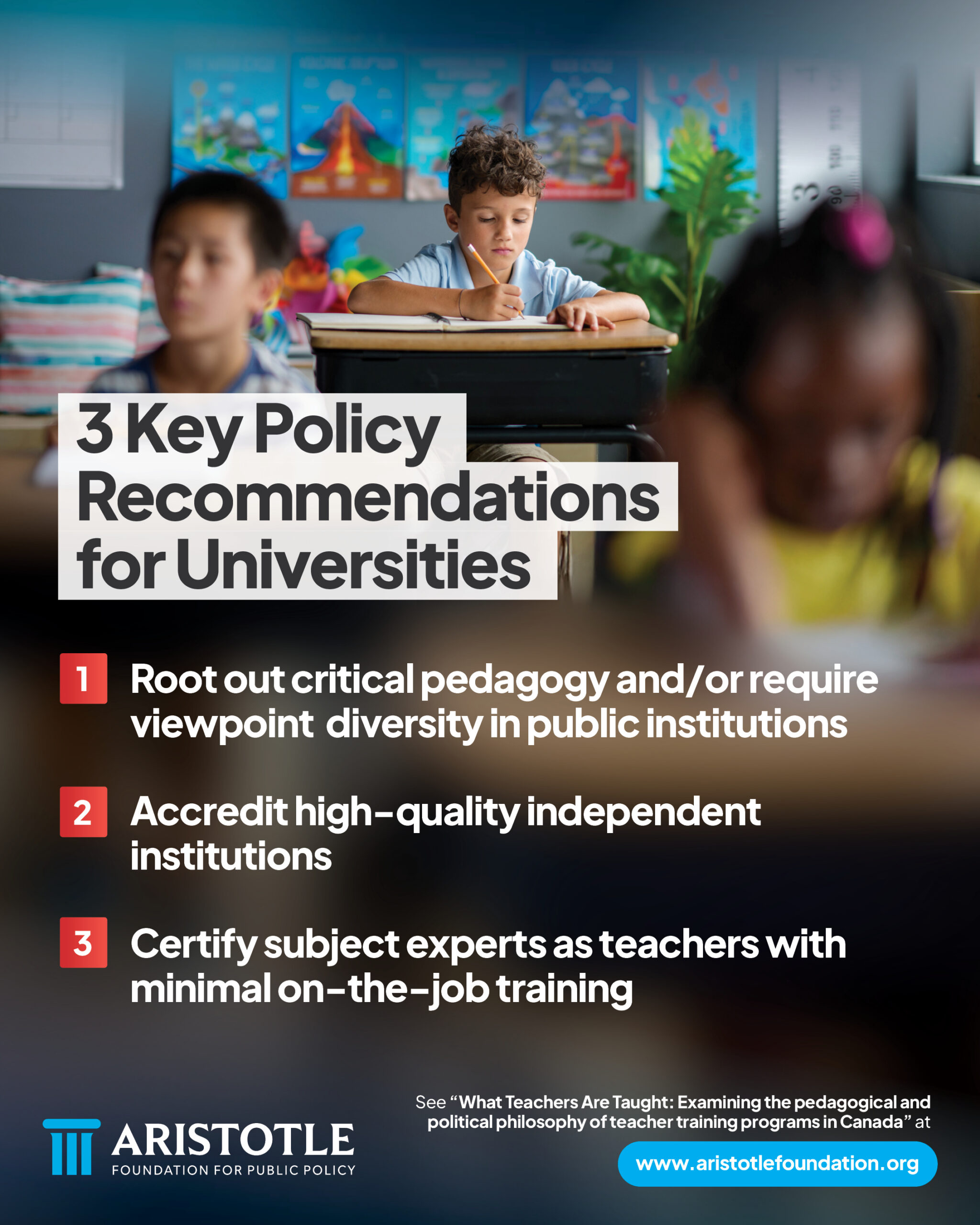
Parents want quality education for their children and educational choices that support their values—or at least do not systematically and unfairly undermine their diverse viewpoints. The following three public policy options are different ways to address or work around the ideological capture in institutions of higher education. Rooting out critical pedagogy is the direct approach, and it is an admittedly challenging policy option, given how deeply engrained it is in teacher training programs. At a minimum, provinces should ensure that genuinely alternative pathways to teacher certification are recognized, to break up the monopoly of the current certification process. This should happen at the institutional level (i.e., accredit independent teacher colleges) and on an individual level (i.e., certify subject-matter experts). All three policy options are recommended.
Recommendation 1: Root out critical pedagogy and/or require viewpoint diversity in public institutions
Rooting critical pedagogy out of the academy is a natural recommendation. All eight of these universities are public institutions—as are the overwhelming majority of Canadian colleges with teacher training programs. Public institutions are answerable to the public, and provincial governments should hold to account public programs that espouse radical ideologies and call for undermining or overthrowing society. At the very least, in a pluralistic society, public institutions should honour viewpoint diversity—and this should be reflected in the curricula and syllabi of public teacher training programs.
d. Subsidiarity is the principle reflected in Section 93 of the Constitution Act (1867) and Section 29 of the Charter of Rights and Freedoms (1982). It is also evident in Article 26(3) of the Universal Declaration of Human Rights. The latter clarifies the role of the state in relation to the home, when it comes to education.
Recommendation 2: Accredit high-quality independent institutions
Provincial governments and accrediting bodies should recognize teachers who have been trained in alternative, high quality teacher training programs (e.g., TWU) to meet these diverse needs. This requires recognizing and accrediting teacher training programs from any postsecondary institution that demonstrates professional and academic competence, including religious and faith-based institutions. Independent teacher training programs should be evaluated and accredited on educational standards alone.
Recommendation 3: Certify subject-experts as teachers with minimal on-the-job training
Another viable alternative—and strongly recommended—is the subject-expertise pathway towards teacher certification.35 For example, a PhD in physics or a professional historian may be excellent teachers in their discipline. To attract such excellent talent into Canadian schools, preliminary training in pedagogy should be kept to a reasonable minimum. Necessary preliminary classes on topics like the code of conduct for teachers, lesson planning, and other foundational professional skills can be offered in an initial semester or two of classes or seminars. After this, the training should yield to a model of on-the-job apprenticeship with a master teacher.e
Regulations should be changed to accept an apprenticeship model for subject expert teachers. Such a policy would work around the monopoly of forced conformity to critical pedagogy—or whatever ideological capture comes next. This would allow into Canadian schools the permeation of deeply knowledgeable and passionate teachers. This would begin to slowly interrupt the subversive political projects of deconstruction and revolution.
Based on publicly available course descriptions, the classes taught in the leading education faculties in Canada are permeated with the language and concepts of critical pedagogy—a Marxist political project of social deconstruction that contests and reinterprets everything from basic literacy to the concept of truth itself. And classes which do not overtly espouse this perspective do not offer an alternative vision. In summary, a monopoly of revolutionary ideology presently dominates the leading education programs in Canada.
Three public policy recommendations flow from the findings. First, provincial governments should hold public institutions accountable and root out critical pedagogy—or, at the very least, require viewpoint diversity. Second, all teacher training programs must be held to a high level of educational standards. Where high standards are met or exceeded, independent teacher training programs (e.g., TWU) should be evaluated and accredited on educational standards alone. And third, barriers should be removed to allow subject-matter experts to teach in the classroom.
e. An unviable approach—that should be removed in provinces, like Alberta, where it exists—is an intense night-class program run by existing faculties of education for new, full-time teachers (who are already burdened with class preparation, marking, and a full teaching load—all, as novices, with a steep learning curve).
Brett Fawcett, EdD, MTS, LLB, is a senior fellow with the Aristotle Foundation for Public Policy and high school humanities teacher in Alberta. Dr. Fawcett did his doctorate at the University of Calgary on the topic of teacher preparation and has written extensively about curriculum, education policy, teacher certification, and related topics.
David Hunt, MPP, BBA, is the research director at the Aristotle Foundation for Public Policy. Hunt has authored and/or directed dozens of peer-reviewed research papers. His work has been presented at numerous conferences and to various levels of government, cited in major media, and used as evidence in court.
Who we are
The Aristotle Foundation for Public Policy is a new education and public policy think tank that aims to renew a civil, common-sense approach to public discourse and public policy in Canada.
Our vision
A Canada where the sacrifices and successes of past generations are cherished and built upon; where citizens value each other for their character and merit; and where open inquiry and free expression are prized as the best path to a flourishing future for all.
Our mission
We champion reason, democracy, and civilization so that all can participate in a free, flourishing Canada.
Our theory of change: Canada’s idea culture is critical
Ideas—what people believe—come first in any change for ill or good. We will challenge ideas and policies where in error and buttress ideas anchored in reality and excellence.
Donations
The Aristotle Foundation for Public Policy is a registered Canadian charity and all donations will receive a tax receipt. To maintain our independence, we do not seek nor will we accept government funding. Donations can be made at www.aristotlefoundation.org.
The Aristotle Foundation for Public Policy has internal policies to ensure research is empirical, scholarly, ethical, rigorous, honest, and contributes to the advancement of knowledge and the creation, application, and refinement of knowledge about public policy. Our staff, research fellows, and scholars develop their research in collaboration with the Aristotle Foundation’s staff and research director. Fact sheets, studies, and indices are all peer-reviewed. Subject to critical peer review, authors are responsible for their work and conclusions. The conclusions and views of scholars do not necessarily reflect those of the Board of Directors, donors, or staff.


SUBSCRIBE TO OUR NEWSLETTER