

Executive summary
This paper examines whether the principle of merit is being consistently applied in federal public service hiring. It finds that while merit remains formally embedded in federal legislation, its application continues to be diluted by Diversity, Equity, and Inclusion (DEI) policies that introduce identity-based considerations into staffing decisions.
The analysis distinguishes among four categories of DEI practices: barrier-removing measures, encouragement-based initiatives, target-driven policies, and preferential or restrictive selection criteria. Barrier-removing and encouragement-based measures are broadly consistent with merit-based hiring, as they expand the candidate pool without altering evaluative standards. In contrast, target-driven and preferential practices incorporate group identity into candidate assessment, raising concerns about equal treatment and fair consideration.
To assess how these practices manifest in federal hiring, the study reviewed 301 federal job postings across 59 departments and agencies between February and July 2026. DEI language was found to be nearly universal, appearing in 95 percent of postings. More significantly, 42 percent of postings indicated that candidates may be prioritized based on identity characteristics, and 4 percent restricted eligibility to specific groups.
As these figures reflect only publicly disclosed information, they likely understate the true scope of identity-based hiring practices within the federal public service. Legislatively, this paper traces how Canada’s Employment Equity Act and the Public Service Employment Act create room for identity-based considerations to be folded into purportedly merit-based assessments. The gap between what is publicly declared and what the law permits means the documented figures represent a lower bound, not a full accounting, of how group identity factors into public service hiring decisions.
Empirical evidence further challenges the rationale for preferential DEI measures. Treasury Board data show that most designated groups already meet or exceed workforce availability benchmarks, including at the executive level. A 2018 Public Service Commission pilot found no significant impact of name-blind recruitment on visible minority shortlisting rates, providing no evidence for the existence of systemic bias in screening processes. Public opinion data also indicate that a majority of Canadians oppose the use of identity-based criteria in hiring, while continuing to support equal opportunity and barrier removal.
Taken together, the evidence challenges the assumption that disparities necessarily reflect discrimination requiring corrective intervention. Evidence also suggests that DEI practices may have limited or even counterproductive effects, particularly where they rely on coercive or preferential mechanisms rather than expanding access for candidates to engage in fair competition.
Accordingly, this paper finds that, while efforts to improve fairness and accessibility in hiring remain welcome, the expansion of identity-based selection practices risks undermining both the integrity and perceived legitimacy of the federal staffing system.
The paper concludes that target-driven and preferential DEI practices are widespread, ostensibly poorly disclosed, and inconsistent with both the principle of merit and Canadians’ expressed preferences. It recommends clearly separating barrier-removal measures from preferential treatment, narrowing the PSEA’s “organizational needs” provision to exclude representation objectives, and reforming the reporting framework to emphasize procedural fairness rather than representational outcomes.
This paper’s findings emphasize that a genuinely merit-based system—one that evaluates candidates on demonstrated qualifications, relevant experience, and assessed competence—is best positioned to ensure fair access to public employment while effectively supporting federal institutions and the Canadian public alike.
The federal public service employs nearly 350,000 Canadians.1 At that scale, how the federal government decides who to hire is not an insignificant matter. Its staffing decisions affect the quality of public services Canadians receive and the efficiency with which the public’s scarce resources are deployed.
This paper examines whether the principle of merit, formally enshrined in the Public Service Employment Act (PSEA), is being observed in practice. A genuinely merit-based selection process—grounded in demonstrated qualifications, relevant experience, and assessed competence relative to the demands of the role—creates the conditions under which qualified candidates from any background can succeed. Every community, without exception, contains individuals of outstanding competence. A staffing system designed to identify and appoint those individuals serves Canadians better than one that seeks to predetermine staffing outcomes based on group membership.
This paper distinguishes among four categories of Diversity, Equity, and Inclusion (DEI) practices in federal hiring: barrier-removing measures, encouragement-based language, target-driven programming, and preferential or restrictive selection criteria. While the first two categories are broadly compatible with a merit-based system, the latter two raise serious concerns about equal treatment and conflict with the legitimate expectation of all Canadians that they be fairly considered when competing for publicly funded employment.
To assess how these practices operate in the federal context, this study reviewed 301 publicly available job postings from 59 federal departments and agencies. DEI-oriented language was found to be nearly universal across examined job postings. More significantly, in a meaningful subset of competitions, postings referenced explicit preferences or restrictions based on an applicant’s group identity. Yet even postings that make no such disclosure operate within a legislative framework that affords departments broad latitude to apply DEI considerations at any stage of the process. This gap—between what postings disclose and what the legislative framework permits—raises a fundamental question: to what extent are identity-based hiring practices in place transparently, and to what extent are they being applied without public knowledge?
Diversity, Equity, and Inclusion (DEI) refers to a suite of policies designed to increase the representation and advancement of designated groups within institutions. In practice, these policies include aspirational statements, procedural interventions, and, in many cases, preferential or exclusionary selection criteria that explicitly take group identity into account.
The foundational premise of these policies is that observed group-level outcome disparities are primarily explained by discrimination, and that the appropriate remedy is to artificially adjust group-level representation toward prescribed proportions in cases where those proportions are not arrived at spontaneously.
That premise warrants scrutiny. Differential employment outcomes across groups are not, in themselves, evidence of discrimination in the selection process. They may instead reflect the many factors that impact who applies for and is qualified for any given role. Representation differences between populations arise from multiple interacting factors and, when controlled for, group-level disparities often diminish substantially or disappear entirely, as was found in a 2026 analysis by Matthew Lau, published by the Aristotle Foundation.2
The research examined income disparities between indigenous and non-indigenous Canadians and found that when education level, urban residency, and full-time employment status are held constant, differences in median income are small and, in some cities, disappear or reverse. DEI policy proponents that bypass this complexity and directly attribute observed disparate outcomes to systemic bias substitute their preferred narrative explanation for a more complex, empirical one.
A merit-based hiring process, on the other hand, is built on the principle that outcomes should be tied as closely as possible to qualifications, competence, and demonstrated ability. A merit-based system does not presuppose that all groups will be represented equally, nor in any particular proportion. It does, however, expect selection decisions to be made without regard to group membership.
Critics of merit-based hiring contend that the instruments used to assess merit, such as credential requirements, standardized assessments, and fixed interview formats, themselves can embed structural bias against certain groups. Of course, merit-based assessment tools can be badly designed. A poorly chosen credential requirement, an unnecessarily rigid qualification, or an interview rubric that rewards things other than job-relevant competencies can lead to suitable candidates being overlooked.
The appropriate solution, in that case, would be to improve the merit-based instrument, whether by ensuring that competitions are accessible to a wide pool of applicants, that tests and interviews are structured relevantly to the position, or that accommodations are made so that all candidates can demonstrate their ability. A hiring process in which candidates are assessed on sound, job-related criteria, using tools designed and periodically audited to minimize barriers, is more consistent with both fairness and effectiveness than one that allocates advantage on the basis of identity.
Not every DEI-related provision is equally problematic. What matters is the extent to which a given measure removes barriers to fair competition, as opposed to imposing preferences based on innate characteristics. Four categories are useful for distinguishing among them.
Barrier-removing measures
At one end of the spectrum are barrier-removing measures: accessible application processes, reasonable accommodations, and structured assessments. These practices reduce obstacles to participation and are properly understood as extensions of a merit-based system, since they help ensure that the pool of potential candidates is as broad as possible. Removing a barrier is not the same as precipitating a result.
Encouragement-based measures
A second category consists of encouragement-based measures, such as outreach to diverse communities, affirmations that all qualified applicants will receive equal consideration on their merits, or general declarations of commitment to an inclusive workplace. Provided these statements do not influence how candidates are actually evaluated, their effect is primarily in shaping who chooses to apply, which, again, can have the positive effect of broadening the candidate pool, but they do not pre-determine who gets selected.
Quotas
The third grouping comprises target-driven DEI policies that involve the adoption of explicit arbitrary representation goals and are often accompanied by institutional accountability mechanisms to meet prescribed targets. Even where these goals are framed as aspirational, they create pressure on hiring managers to favour candidates from designated groups. The distinction between an objective and a quota becomes difficult to draw when representation outcomes are monitored in either case and departments face institutional consequences for failing to meet prescribed staffing outcomes.
Exclusive hiring
Finally, the most concerning set of practices can be grouped under preferential and restrictive DEI. These include explicit practices whereby preference is given to members of designated groups, restrictions are placed on who may apply for certain positions, and, in general, identity-based characteristics are elevated to the status of selection criteria. In such cases, competitive advantage and disadvantage are allocated on the basis of group membership either alongside, or in lieu of, individual qualification. This constitutes differential treatment on the basis of identity, and, regardless of the policy rationale advanced in its defence, is, in a normative sense, discrimination.
Canadians are broadly supportive of inclusion in principle, but polling data show that they oppose candidates receiving preferential or exclusionary treatment in hiring processes based on identity characteristics.
A 2024 Léger survey found that 57 percent of Canadians disagree that employers should consider cultural background or racial identity in hiring decisions, compared to just 28 percent who support it. Even among the communities preferential and exclusionary DEI hiring policies are implemented to benefit, opposition is nearly as strong as it is in the general population. Women oppose it at similar rates to men (57 percent), while among non-white Canadians, 49 percent oppose it, demonstrating that even within the communities that DEI policies are intended to support, it is unpopular.3
These findings, however, should not be read as indifference to barriers to employment. Canadians largely distinguish between removing barriers to fair participation and actively privileging particular groups. That distinction matters. One can simultaneously support inclusion as a value and oppose preferential or exclusionary selection as a means of pursuing it.
Canada’s Employment Equity Act (EEA) was first enacted in 1986 and underwent substantial amendments in 1995.4 It establishes the primary legislative framework for employment equity in federally regulated sectors, applying to federally regulated private-sector employers with 100 or more employees, Crown corporations, and the core public service. The Act designates four groups for targeted representation objectives: women, indigenous peoples, persons with disabilities, and members of visible minorities.
The Act has a conflicting mandate. On the one hand, the Act’s stated purpose, set out in section 2, is to ensure “that no person shall be denied employment opportunities or benefits for reasons unrelated to ability.” On the other hand, section 5 requires federal hiring managers to take proactive measures to ensure that “designated groups achieve a degree of representation in each occupational group in the employer’s workforce,” which would necessarily require them to direct attention toward personal characteristics unrelated to ability. The first clause is individual- and ability-focused; the second is group-focused and outcome-oriented.
Section 33 of the Act does provide a partial limit on this outcome orientation, as neither the Canadian Human Rights Commission nor an Employment Equity Review Tribunal may “require an employer to hire or promote persons who do not meet the essential qualifications” for a role, “require an employer to hire or promote persons without basing the hiring or promotion on merit,” or “impose a quota” system.5 In practice, however, the combination of proactive reporting and representational targets creates pressure to consider group identity when making selection decisions, even if formal quotas are prohibited and merit-based hiring and promotion are emphasized.
The Public Service Employment Act (PSEA) codifies merit as the foundational principle governing appointments to or within the federal public service. Section 30(1) requires that all appointments be “on the basis of merit” and “free from political influence.”
Prior to 2003, the PSEA required the appointment of the best-qualified candidate among those meeting the essential qualifications. The Public Service Modernization Act (2003) altered that structure by eliminating that requirement, establishing instead that any applicant who meets the essential qualifications may be appointed.6 Despite the change being made to increase managerial flexibility and improve staffing efficiency, it had a significant side effect. By expanding the range of candidates who could legitimately be appointed, it created more room for non-position-related considerations, including employment equity factors, to influence selection without violating the Act.7
The PSEA reinforced this opening in section 30(2)(b)(iii), which includes “any current or future needs of the organization” as a permissible element of merit-based assessment.8 Where a department identifies increasing the representation of a designated group as an organizational need, that objective can legitimately function as a selection criterion alongside technical job-specific qualifications. Merit continues to be formally required, but the Act defines it with sufficient flexibility that identity-based considerations can be integrated into the selection process without contravening it.
Treasury Board reporting on employment equity in the core public administration shows that as of March 2025, three of the four groups (women, indigenous peoples, members of visible minorities) meet or exceed workforce availability (WFA) benchmarks, while at the executive level, all four groups exceed their respective WFA benchmarks.9
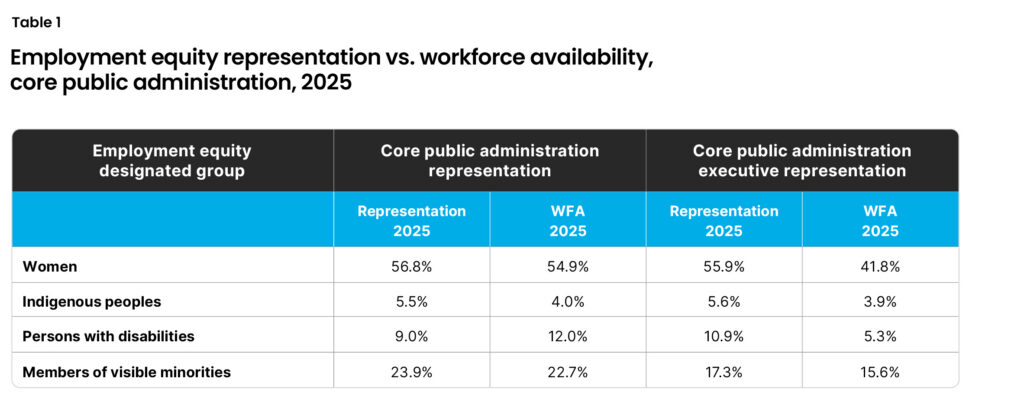
Source: Treasury Board of Canada Secretariat, “Employment Equity Demographic Snapshot 2024–2025,” Government of Canada, https://www.canada.ca/en/treasury-board-secretariat/services/innovation/human-resources-statistics/diversity-inclusion-statistics/employment-equity-demographic-snapshot-2024-2025.html.
Hiring data tell a similar story. The share of new hires who are members of visible minorities has climbed steadily from 17.9 percent in 2016/17 to 27.2 percent in 2024/25. The share of persons with disabilities hired has also increased significantly, from 3.7 percent in 2016/17 to 8.6 percent in 2024/25. To be clear, these outcomes are not inherently problematic, provided the appointments were made on the basis of competence. Unfortunately, that is not something the data can tell us. Whether they reflect expanding qualified candidate pools, barrier-removal measures, or identity-based selection preferences, it is not clear how these outcomes were achieved.
The central point is that the gender, disability, or race of a public servant should be irrelevant to their hiring. What matters is whether they are best suited to perform the responsibilities of the role. And yet the federal government asserts that these characteristics are highly relevant and has built systems to track them in an attempt to meet specified thresholds. Those thresholds, WFA benchmarks, themselves deserve scrutiny, as they are set on the premise that a federal workforce that mirrors the general labour market is necessarily the correct outcome.
Such a framework inevitably triggers questions about whether individuals occupy their positions primarily because of merit or because of identity. Those questions can be unfair to the individuals concerned, particularly if they were in fact appointed on the basis of their competence and qualifications. Yet the wide range and reach of DEI policies as they relate to federal hiring practices makes it hard to unequivocally dismiss such doubts.
Within a merit-based system, it is reasonable to periodically evaluate whether the instruments used to identify qualified candidates are functioning effectively. If screening tools, credential requirements, or interview formats are producing biased outcomes—systematically filtering out capable candidates on grounds irrelevant to the work—those tools should be identified and corrected. The Public Service Commission has undertaken work of this kind.
In 2018, the Public Service Commission piloted name-blind recruitment, anonymizing applications to conceal cues about candidates’ identities. The pilot included 27 external job processes across 17 departments and over 2,200 applicants and found no significant change in visible minority shortlisting rates (46 percent under name-blind screening versus 47 percent under traditional screening). The results indicated that applicant names were not materially disadvantaging candidates at the screening stage of competitions.10
These findings weaken the claim that systemic bias is pervasive within federal hiring processes, and they undercut one of the arguments commonly advanced to justify identity-based preferential criteria.
Despite this evidence of procedurally fair treatment, audits by the Canadian Human Rights Commission document that federal employers and employees continue to report barriers related to selection processes, career development, and workplace culture.11 These findings rest primarily on self-reported perceptions rather than demonstrated links between specific practices and systematically unfair outcomes. Claims of structural barriers warrant investigation. A merit-based system depends on the principle that every candidate be evaluated fairly on their suitability for a role, and any credible evidence of procedural misconduct should be taken seriously and assessed through appropriate review mechanisms. At the same time, self-reported claims of discrimination are not, in and of themselves, evidence that discrimination occurred. They should be evaluated within the context of present procedures and policies.
This section examines the forms that DEI-related hiring practices take in federal government job postings. The analysis draws on a review of job postings from a total of 59 different federal departments, agencies, and Crown corporations. Data collection began in February 2026, with postings closing as early as February 18, 2026, and as late as July 18, 2026, for a total sample size of 301 job postings across federal departments, agencies, and Crown corporations.
While inclusion-oriented language is nearly universal in federal hiring materials, a meaningful subset of job postings goes beyond broad encouragement to impose potentially preferential and restrictive selection criteria based on immutable identity characteristics. Many postings do not specify with any precision the extent to which DEI considerations may factor into the assessment process, leaving prospective applicants without a clear understanding of whether, or to what degree, their application may be advantaged or disadvantaged based on their group identity.
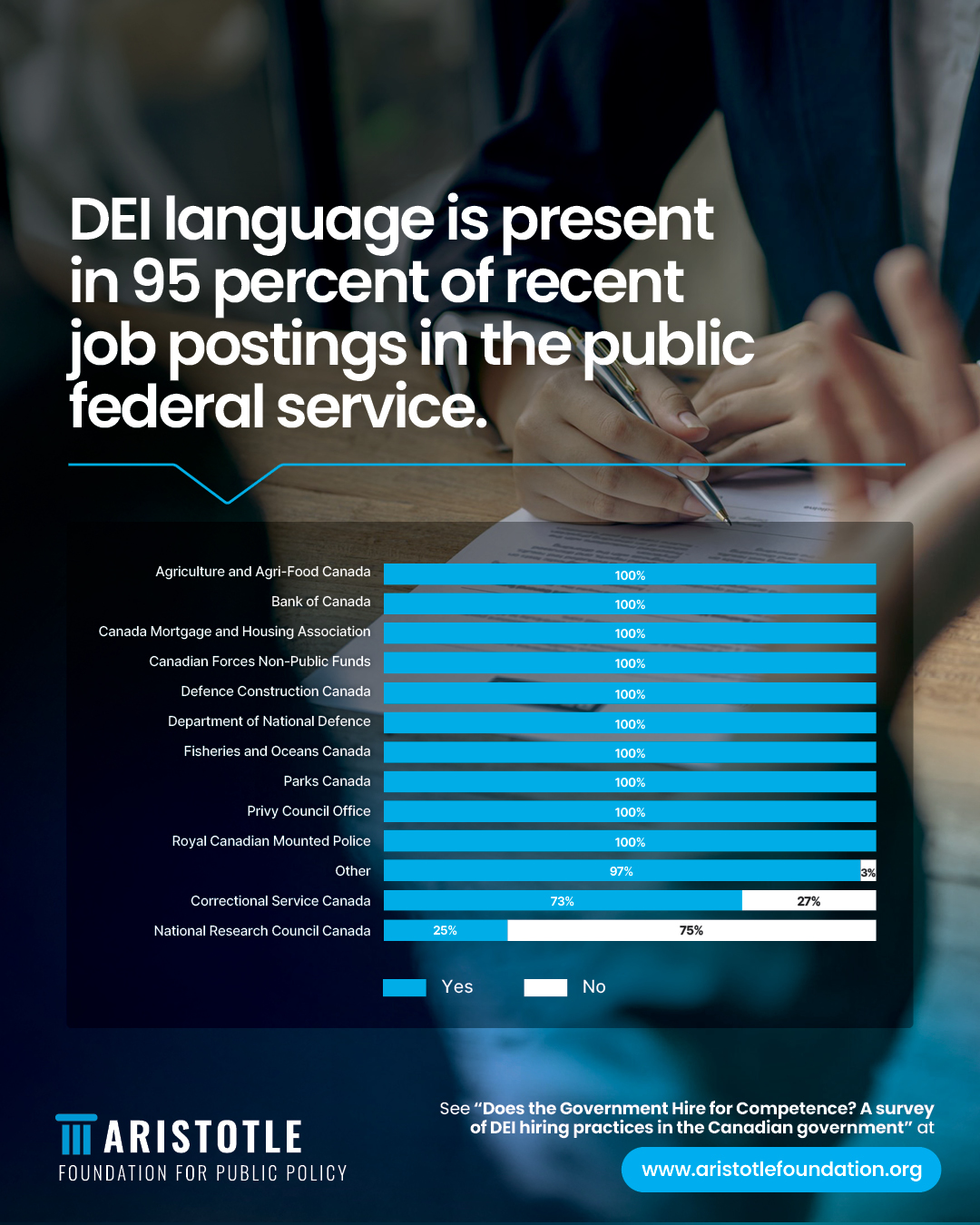
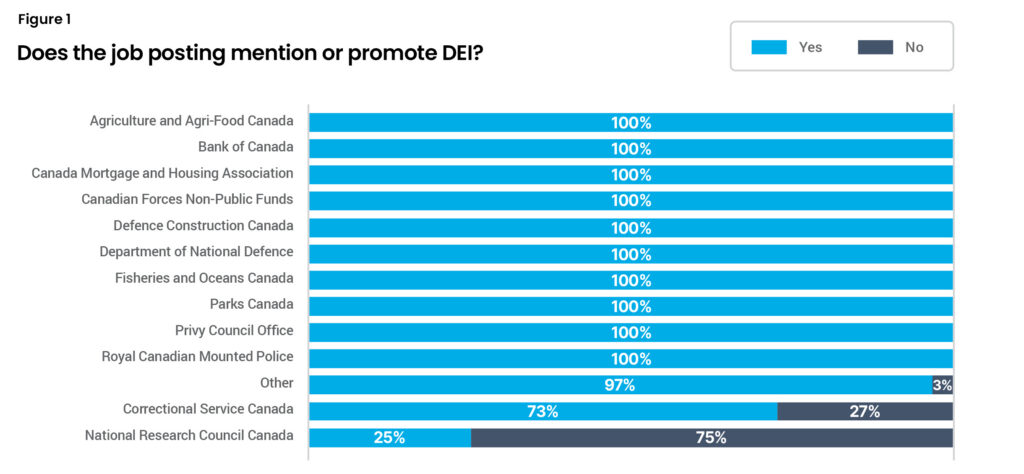
Ninety-five percent of job postings mention or promote DEI in some form. These references range from generic statements affirming the organization’s commitment to inclusion, to more specific acknowledgements of designated groups, to explicit disclosures of the integration of DEI considerations into the assessment framework.
The prevalence of DEI language alone is not necessarily problematic. A generic statement affirming that all qualified candidates will be treated equally is categorically different from a statement disclosing that candidates will be evaluated on the basis of their demographic characteristics. The former is consistent with a merit-based process. The latter introduces an evaluative dimension that is not tied to job-relevant competencies.
It is impossible to determine from the posting alone whether even innocuous statements function primarily as symbolic declarations or whether they steer hiring decisions. At a minimum, this signals that identity-related considerations may be present, which could have self-selection effects that could narrow the candidate pool.
Figure 1 shows the share of federal job postings that mention or promote DEI, highlighting how close to universal DEI-oriented language has become in federal hiring materials.
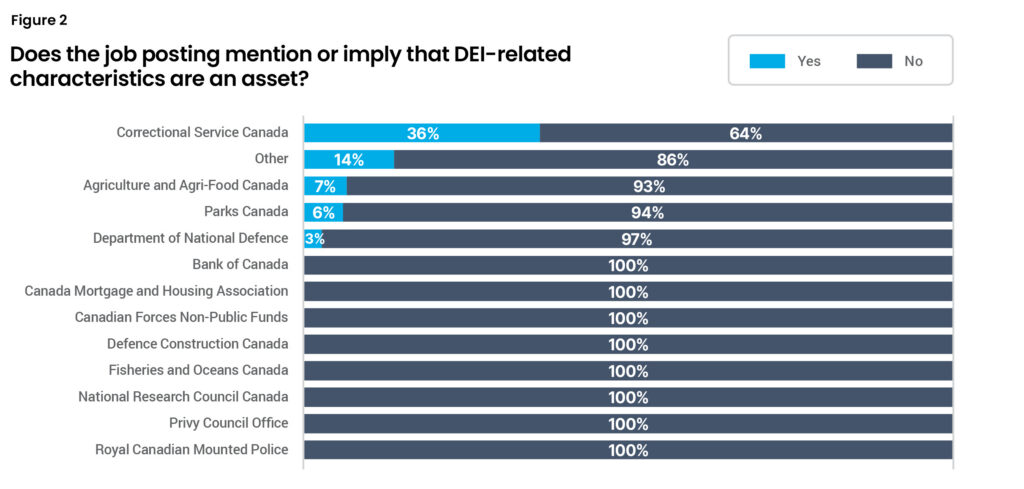
Across federal departments, DEI-related characteristics are infrequently stated outright as an asset to be considered when assessing candidates, as just 7 percent of job postings mention or imply that DEI characteristics will be considered favourably. The prevalence of this practice, however, varies by department. Thirty-six percent of job postings by Correctional Service Canada include such language.
Figure 2 outlines the proportion of job postings that list DEI-related characteristics as an asset, illustrating how often identity-based traits are treated as advantages in candidate assessment.
Asset qualifications are legitimate tools under the PSEA, which expressly permits hiring authorities to consider a range of qualifications. The difficulty is that when DEI-related characteristics are treated as an asset, it introduces an evaluative criterion that is not directly related to the work to be performed. This can systematically advantage candidates whose demographic profile aligns with institutional representation targets while disadvantaging equally or better-qualified candidates whose profiles do not.
Whether or not a posting explicitly lists DEI-related traits as an asset, it is important to reiterate that current federal legislation permits identity characteristics to be elevated to the status of an asset within a merit-based evaluation framework, whether or not that possibility is disclosed in the public-facing posting.
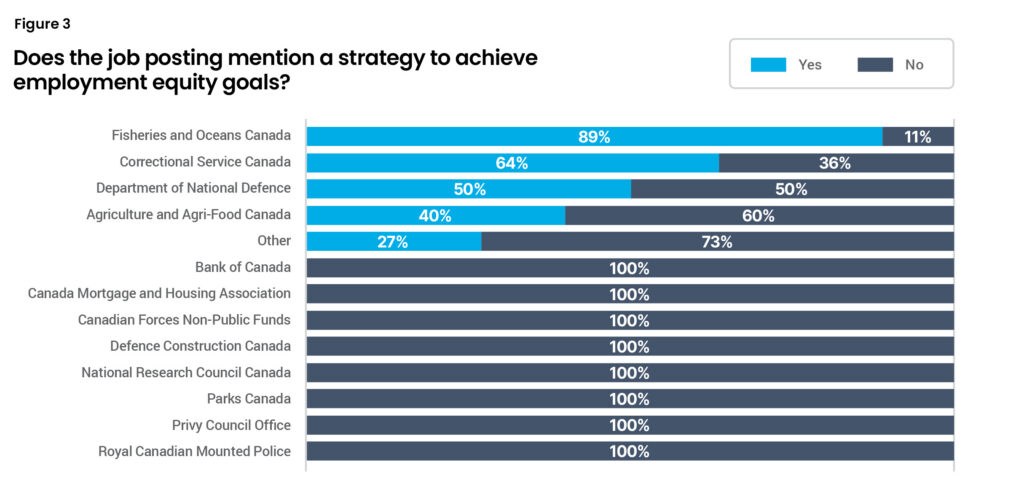
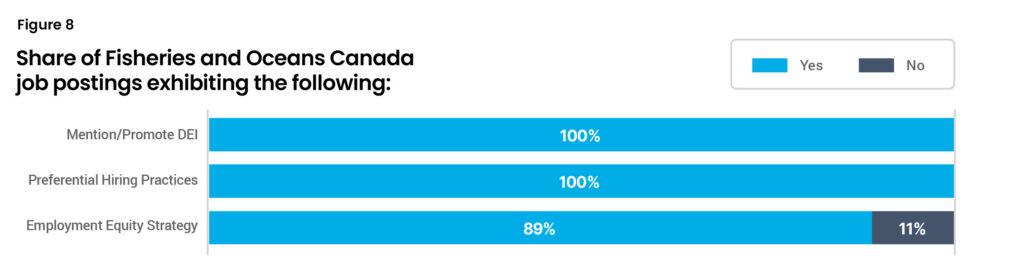
Twenty-one percent of job postings mention a strategy or goal related to achieving employment equity objectives. The distribution again varies significantly by department. Among postings from Fisheries and Oceans Canada, 89 percent include such references.
Figure 3 shows the percentage of job postings that reference strategies or goals related to employment equity, indicating the extent to which departments publicly commit to meeting representation objectives.
Annual reporting requirements have departments track and disclose their representation rates relative to WFA benchmarks.12 Departments that fall below benchmarks face institutional pressure to demonstrate progress toward them, which creates incentives for hiring managers to favour designated-group candidates in the selection process, whether or not an individual posting discloses the presence of such considerations.
Despite the formal prohibition on quotas under the EEA,13 employment equity objectives, accompanied by an internal accountability structure, operate in a similar manner to a quota system. While distinct in theory, in practice both mechanisms tend to produce similar interventions in the selection process, since hiring managers facing institutional accountability for representation outcomes have strong incentives to consider group identity when making appointments, regardless of whether the target is technically binding.
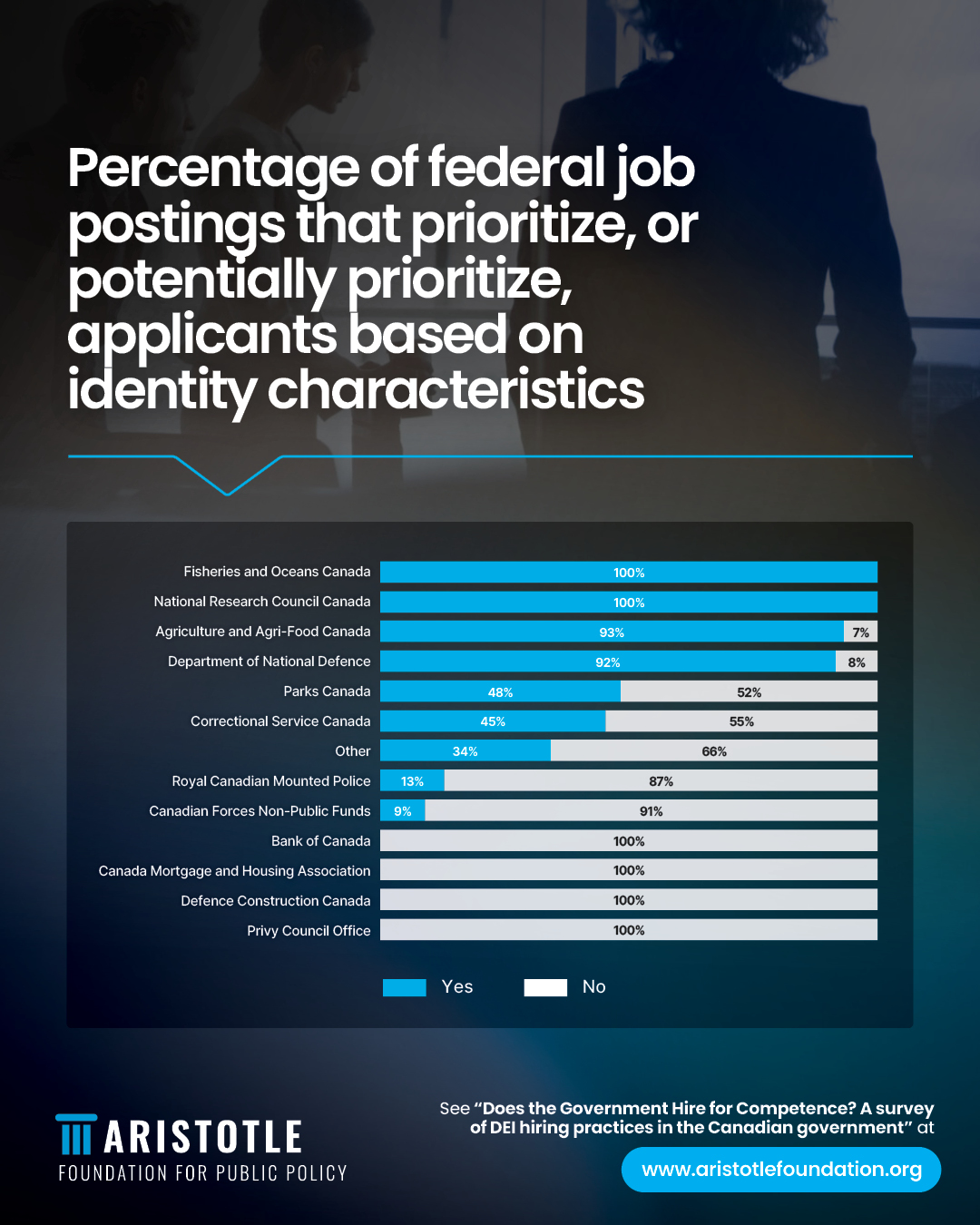
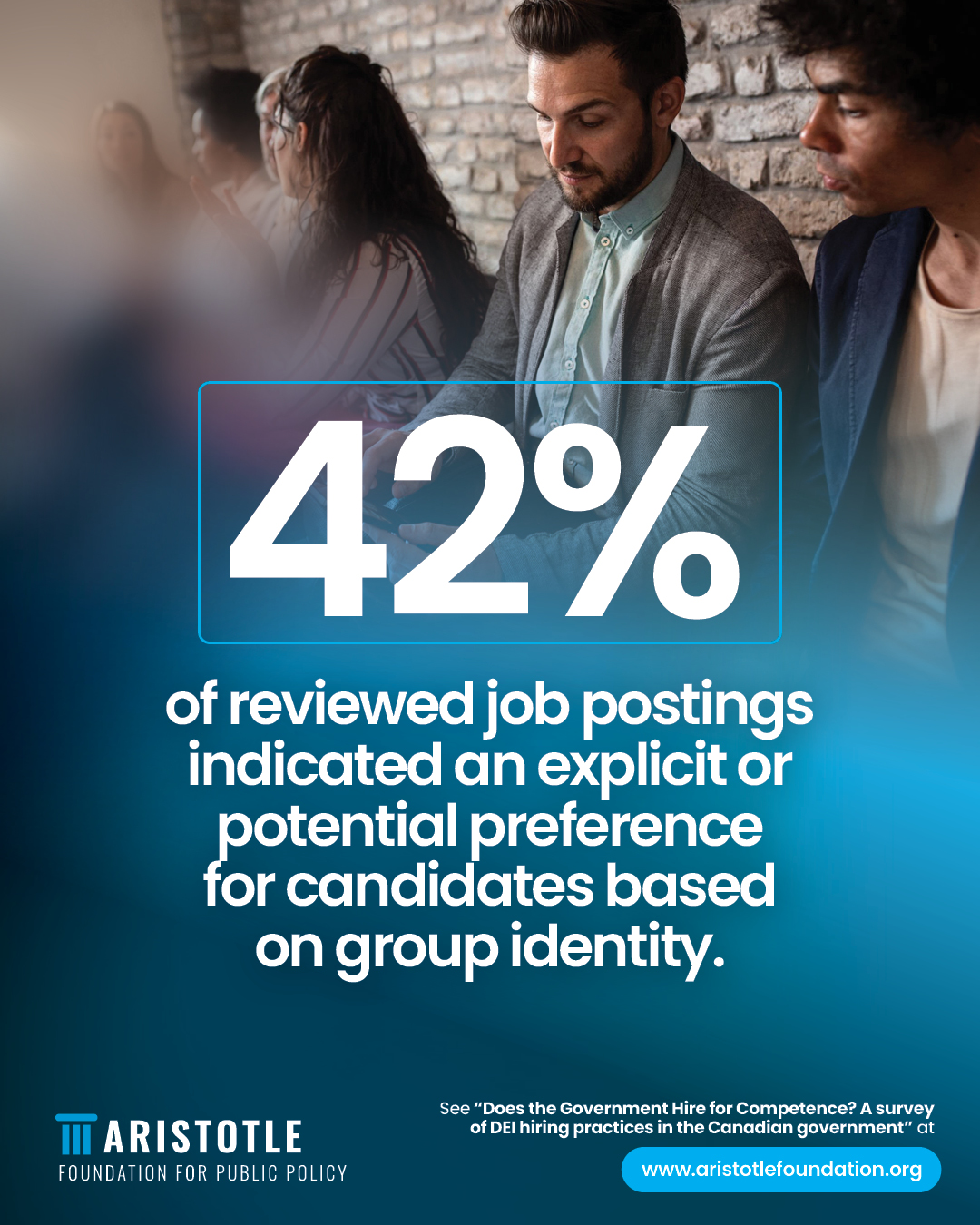
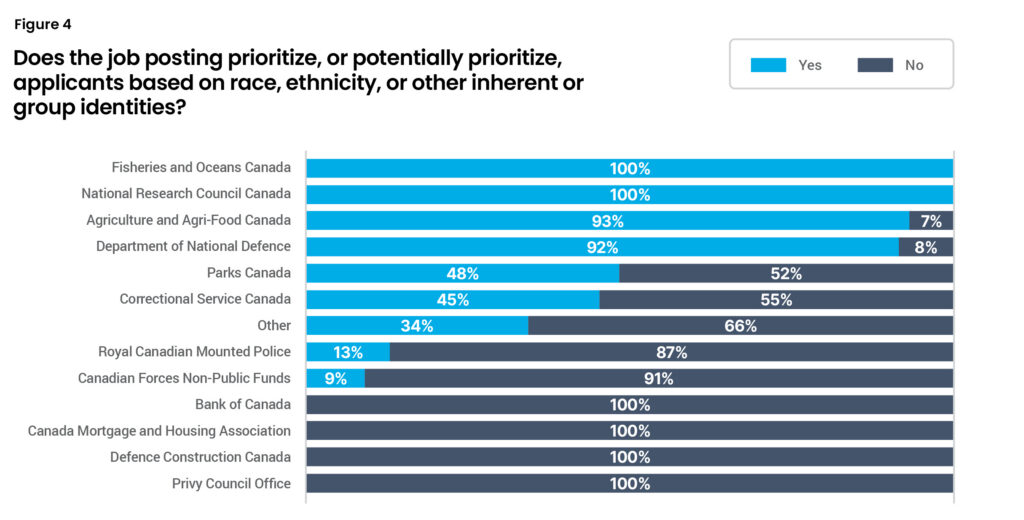
Forty-two percent of postings either explicitly prioritize or signal that they may prioritize applicants based on race, ethnicity, or other group-identity characteristics. Among postings from the National Research Council of Canada, that figure is 100 percent, meaning every position the department sought to fill carried an intention to weigh candidates not only on assessed capacity but on innate characteristics.
These postings go beyond signalling an inclusive workplace culture or encouraging applications from particular communities. They explicitly disclose that certain groups may or will receive priority consideration in the selection process. A candidate who does not belong to a specified group enters the competition at a disadvantage for reasons entirely outside their control.
Figure 4 displays the share of job postings that explicitly prioritize, or signal that they may prioritize, applicants based on race, ethnicity, or other inherent group identities, underscoring the prevalence of preferential hiring language.
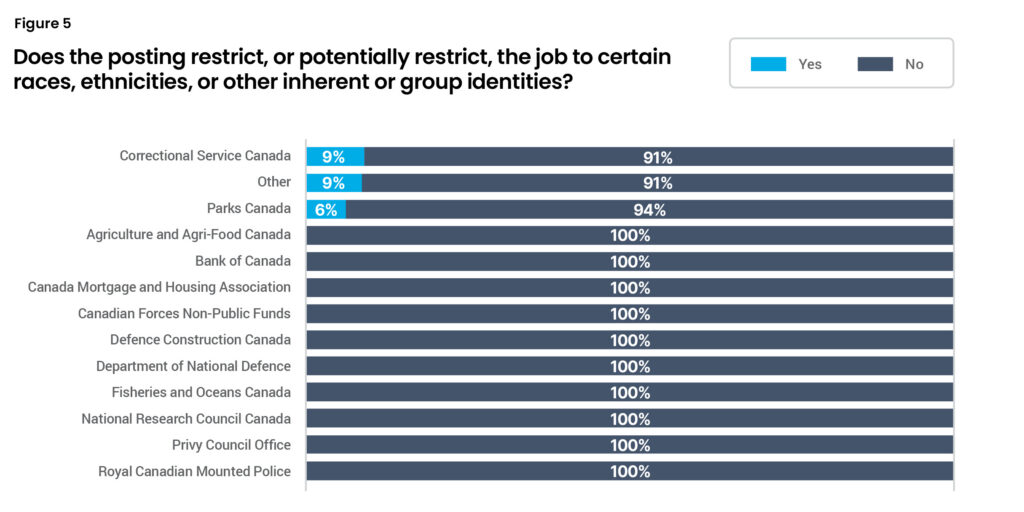
Beyond preference-based language, a subset of federal employment opportunities explicitly restricts eligibility to candidates who self-declare as members of specified groups. Four percent of postings in this review restricted or potentially restricted eligibility on the basis of race, ethnicity, or other group characteristics. Among Parks Canada postings, 6 percent fall into this category.
Restrictive hiring tends to be justified by two distinct arguments. The first links a candidate’s demographic profile explicitly to the nature of the position by claiming that identity is itself a qualification. The second limits the applicant pool with the aim of raising the proportion of individuals from underrepresented groups, with no claim about the relationship between identity and job performance. Both justifications raise concerns. The first claims a link between identity and the capacity to perform a role, yet if such a link genuinely exists, it should already be captured through a merit-based assessment of the candidate’s knowledge, skills, and experience. The second is straightforwardly discriminatory, as it restricts access to publicly funded employment on the basis of characteristics candidates did not choose and cannot alter.
When individual suitability for a role is set aside in favour of group membership, the result is a selection process less likely to identify the candidate best able to carry out the position’s responsibilities. That is not in the interest of individual applicants, who deserve to be assessed on their actual capabilities. It is not in the interest of government departments, which are less well-positioned to fulfil their mandates. And it is not in the interest of Canadians broadly, who rely on federal institutions to deliver services effectively.
Figure 5 shows the proportion of job postings that restrict, or potentially restrict, eligibility to specific races, ethnicities, or other inherent group identities, showing how often access to competition is limited on identity grounds.
No postings in this review outlined a requirement that candidates complete a DEI survey as a condition of progressing through the selection process. The federal government does, however, ask applicants to complete employment equity self-identification forms at the application stage. While self-identification is presented as voluntary, it is a standard element of the application process. There is a distinction between voluntary self-identification and mandatory DEI surveys, but its practical significance depends on how the self-identification data are used, particularly if demographic information collected at the application stage influences which candidates are advanced through the selection process.
No postings included language that indicated a requirement that candidates demonstrate their commitment to DEI through written statements or essays. This practice has been documented more extensively in academic hiring. The Aristotle Foundation’s 2025 University Discrimination Index analyzed 489 academic job postings at Canada’s ten largest public universities and found that a substantial share required DEI statements as a condition of consideration.14
No postings in this review established a formal requirement that candidates pledge a personal commitment to DEI doctrine as a condition of their consideration. The absence of such a requirement in public-facing postings does not mean DEI alignment is irrelevant to career advancement within the public service. But those internal dynamics fall outside the scope of this study.
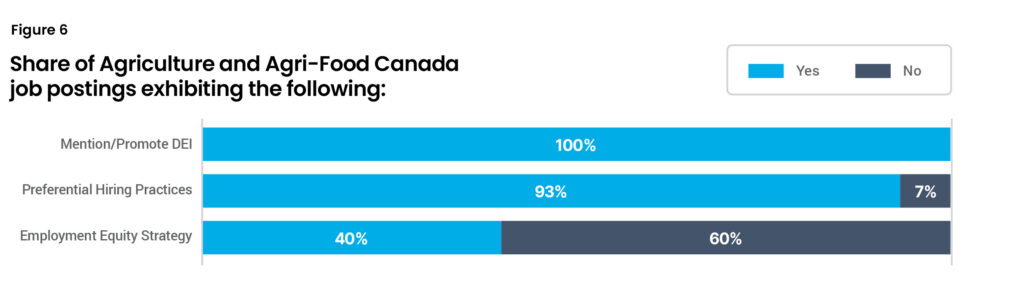
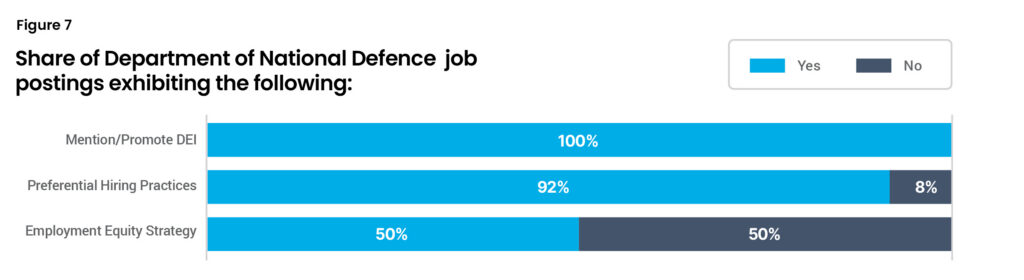
Among the 59 federal departments, agencies, and Crown corporations whose job postings were reviewed, the extent to which DEI initiatives were publicly disclosed to factor into hiring practices varied considerably. Three departments, however, stood out from the rest for the consistency with which their postings combined universal DEI language, preferential hiring practices, and employment-equity target references: Agriculture and Agri-Food Canada, the Department of National Defence, and Fisheries and Oceans Canada. The frequency of these features speaks to the extent to which identity-based considerations factor into hiring competitions within these departments.
Agriculture and Agri-Food Canada
Figure 6 shows that every posting issued by Agriculture and Agri-Food Canada during the study period contained some reference to DEI, with nearly all postings disclosing that applicants would be, or might be, prioritized on the basis of race, ethnicity, or other inherent characteristics. A substantial share of these postings also referenced the department’s employment equity strategy.
Department of National Defence
Figure 7 outlines the finding that all job postings issued by the Department of National Defence within the study period mentioned DEI, while a majority acknowledged the existence, or potential existence, of preferential hiring practices. Half of the department’s postings additionally referenced the intent to achieve employment equity goals.
Fisheries and Oceans Canada
Figure 8 displays the results of the analysis of job postings by Fisheries and Oceans Canada, which found that not only did all postings mention or promote DEI, but all of them also disclosed the intention to prioritize, or potentially prioritize, applicants based on their group identity. In addition, a majority of postings referenced the department’s employment equity goals.
The job-posting data reviewed in this study capture only what federal hiring managers have chosen to disclose in public-facing advertisements. Given the PSEA’s flexible definition of merit and of organizational need, it allows for the application of DEI considerations in any competition, whether or not those criteria are acknowledged in the posting.
Hiring managers who apply identity-based weighting informally and without declaration are not required to disclose that fact, nor would they necessarily be found to have contravened the Act. If such weighting occurs in competitions where postings give no indication of it, the actual scope of identity-based selection may be substantially larger than this study’s findings suggest. The figures documented here should therefore be understood as a lower bound of DEI hiring practices found in federal hiring processes.
The absence of a declared preference in a job posting is not the same as the absence of that preference in the selection process. Canadians who believe they are competing on merit may be competing in a process that, in practice, gives weight to characteristics they cannot control. The question of transparency is distinct from the question of prevalence. Even if identity-based criteria were applied in only a fraction of undeclared competitions, the fact that the legislative framework authorizes their application without disclosure in any competition is a legitimate concern for an institution financed by and accountable to all Canadians. That concern is made more salient by the evidence that a majority of Canadians oppose precisely the kinds of practices this study has documented.
Setting aside for a moment the justifications for DEI interventions, the evidence suggests they are not actually achieving their stated goals.
Frank Dobbin and Alexandra Kalev’s 2016 analysis in the Harvard Business Review, drawing on three decades of data from more than 800 US firms, found that the most common DEI interventions actually decreased the proportion of women and minorities in management over time. As the authors found, coercive compliance mechanisms tend to activate the very biases they are designed to reduce.15
Similarly, a 2024 review by David Millard Haskell examined multiple meta-analyses covering hundreds of studies published in the world’s leading social science journals. It concluded that there is no clear evidence that DEI changes attitudes for the better, while several studies examined demonstrated that it can animate bigotry among colleagues.16
Notwithstanding the growing literature that demonstrates the unintended consequences of DEI policies, these findings do not render all workplace inclusion efforts counterproductive. The same body of research identifies barrier removal, voluntary mentorship programs, and structured, consistently applied hiring processes as having genuinely positive effects. The distinction between expanding the candidate pool and engineering outcomes remains critical.
This study finds that DEI-oriented practices are widely embedded within federal government hiring. Nearly all federal job postings reviewed included some form of DEI language. Forty-two percent of reviewed postings included language disclosing an intention to explicitly or potentially prioritize candidates based on group identity characteristics, while 4 percent disclosed the intention to restrict, or potentially restrict, eligibility criteria for employment consideration. These results represent only what is publicly declared.
The legislative framework creates an opportunity for identity-based considerations to operate far more broadly. It is possible that any and all hiring decisions made within the federal government may be made with immutable characteristics in mind. However, aside from mentioning or promoting DEI broadly, many job postings do not transparently acknowledge the role or extent of such policy interventions.
These practices proceed against the expressed preferences of a majority of Canadians, who in polling reject identity-based hiring even as they affirm their support for inclusion in principle. This opposition likely reflects an intuition about fairness, as most people, regardless of background, prefer to be evaluated on their own merits.
Studies examining diversity training, mandatory hiring targets, and preferential promotion find effects that range from negligible to counterproductive. However, these findings do not imply that all efforts toward workplace inclusion are misguided. Removing barriers to participation can legitimately expand the qualified applicant pool without distorting the selection process. That is what a genuinely merit-based system should aim to do.
Federal policy should clearly distinguish between measures that remove barriers and measures that impose preferences. Accessible application processes, appropriate accommodations, and structured assessment tools are all compatible with a meritocratic system and are likely to improve it. Such practices ought to be maintained and, where feasible, enhanced.
By contrast, preferential and restrictive hiring provisions should be eliminated. Language indicating that preference may or will be given to particular demographic groups, as well as restrictions that limit job competition to members of designated groups, ought to be removed, and such practices ceased. Every candidate should be evaluated on the basis of genuine merit—demonstrated qualifications, relevant experience, and assessed competence in relation to the demands of the role—not on group membership. The best-qualified candidate among those meeting the essential qualifications should be appointed.
The PSEA’s organizational needs provision currently allows representation objectives to be embedded within the merit definition while remaining in compliance with the Act. Clarifications should be made to specify that identity group representation targets may not serve as an organizational need for the purpose of merit assessment.
In practice, this would mean making explicit that a department’s shortfall relative to WFA benchmarks does not constitute an organizational need for selecting one candidate over another. This would help close the gap between the formal prohibition on quotas and the informal system of representation accountability that currently functions as one.
The federal government’s current annual reporting requirements create an accountability structure oriented toward group-level outcomes rather than procedural fairness. Reforms should shift the reporting framework toward the quality and openness of the hiring process rather than toward achieving arbitrary targets.
Measurable indicators of procedural fairness could include whether competitions use structured interviews and standardized assessments, whether reasonable accommodation requests are granted, and the frequency of outreach efforts to attract qualified applicants from a wide range of communities.
Efforts could also include periodic audits of hiring practices, such as those previously undertaken, to determine whether processes are operating fairly. A reformed reporting framework would build on that tradition, shifting accountability away from representation outcomes and toward the procedural standards that a merit-based system requires.
A meritocratic selection process, conducted fairly and accessibly, creates conditions under which members of any group can reasonably expect to be selected for a role. Every community contains qualified individuals who can perform at the highest levels. The task of a sound hiring process is to find them and appoint them. A staffing system organized around demonstrated qualifications, relevant experience, and assessed competence is both the fairest and the most effective means of achieving that goal. With nearly 358,000 employees and over 50,000 external hires in a single fiscal year, even modest distortions in the selection process can have a substantial effect on the quality of public services and the fairness of access to public employment.
The findings documented in this study are notable not only for what they show, but for what they cannot. Nearly all federal job postings reviewed include DEI language, 42 percent mention explicit or potential prioritization based on group identity, and 4 percent restrict or potentially restrict eligibility on the basis of immutable characteristics. These figures represent only what hiring managers have chosen to declare publicly. The proliferation of identity-based hiring practices within the federal public service may be more extensive than the available evidence is able to demonstrate.
DEI practices that remove barriers to fair participation ensure that people of comparable ability have a genuinely comparable opportunity to attain and achieve. This is consistent with a meritocratic vision of the public service. A genuinely open competition is more likely to identify the most capable candidate. DEI practices aimed at producing prescribed outcomes are a different matter entirely. As documented in this study, DEI policies that are target-driven, preferential, or exclusionary compromise that task. In such cases, advantage and disadvantage are allocated on the basis of characteristics candidates did not choose and cannot alter. Such practices serve neither the applicants who compete under such a system, nor the federal institutions that must deliver on their mandates, nor the Canadians who depend on those institutions to function at their best.
Conrad Eder, BA, is a research fellow with the Aristotle Foundation for Public Policy and an independent researcher and public policy analyst. Eder’s research and commentaries have been published by four Canadian think tanks and been cited extensively in the media. He holds a Bachelor of Arts in Economics from Laurentian University and a Graduate Diploma in Economic Policy from Carleton University.
Ven Venkatachalam, PhD, CPA, is a senior economist at the Aristotle Foundation for Public Policy. With expertise in economic and fiscal policy, international relations, trade, energy, governance, education, immigration, tourism, and NGO matters, Dr. Venkatachalam has consulted for governments, NGOs, and private sector organizations across Asia, Europe, Canada, and the United States.
The Aristotle Foundation for Public Policy is a new education and public policy think tank that aims to renew a civil, common-sense approach to public discourse and public policy in Canada.
A Canada where the sacrifices and successes of past generations are cherished and built upon; where citizens value each other for their character and merit; and where open inquiry and free expression are prized as the best path to a flourishing future for all.
We champion reason, democracy, and civilization so that all can participate in a free, flourishing Canada.
Ideas—what people believe—come first in any change for ill or good. We will challenge ideas and policies where in error and buttress ideas anchored in reality and excellence.
The Aristotle Foundation for Public Policy is a registered Canadian charity and all donations will receive a tax receipt. To maintain our independence, we do not seek nor will we accept government funding. Donations can be made at www.aristotlefoundation.org.
The Aristotle Foundation for Public Policy has internal policies to ensure research is empirical, scholarly, ethical, rigorous, honest, and contributes to the advancement of knowledge and the creation, application, and refinement of knowledge about public policy. Our staff, research fellows, and scholars develop their research in collaboration with the Aristotle Foundation’s staff and research director. Fact sheets, studies, and indices are all peer-reviewed. Subject to critical peer review, authors are responsible for their work and conclusions. The conclusions and views of scholars do not necessarily reflect those of the Board of Directors, donors, or staff.