
Executive summary
Canada’s school libraries are in crisis, and many are now threatened with extinction. Once central to school life, they have been transformed into “learning commons” that prioritize technology, collaboration, and digital access over books, sustained reading, and cultural literacy. At the same time, the disappearance of teacher-librarians and the shrinking of physical collections have meant that book curation has lost its venerable meaning of cultivating beauty and human flourishing. Instead, the new curation narrows to political ends that impoverish. The result is a generation increasingly detached from whole books and the shared literary knowledge essential to the vitality of Canadian democratic values and traditions.
Compounding this decline are aggressive equity-based weeding policies and “culture war” conflicts over book selection. While intended to promote inclusion, these processes have often led to the removal of classic works and pre-1970 books, effectively narrowing students’ exposure to foundational texts. Meanwhile, public debates over “book bans”—from both progressive and conservative perspectives—mask a deeper issue: the steady disappearance of book culture itself. The controversy is real, but it is being waged on diminished terrain as book libraries disappear and the proportion of readers shrinks among the younger generation.
Research in cognitive science and education underscores the importance of reading whole books for developing comprehension, background knowledge, and critical thinking. Influenced by E.D. Hirsch’s concept of cultural literacy, this paper argues for a return to knowledge-rich curricula supported by robust library collections. A revitalized model would combine Core Knowledge classics with significant Canadian works, cultivativating both intellectual rigour and culture.
Five key recommendations are presented to change the trajectory. First, restore libraries as sanctuaries for reading, reflection, and discussion. Second, adopt a Core Knowledge approach adapted to Canadian traditions and identity. Third, reassess equity and diversity screening practices that unintentionally exclude literature of profound significance to successive generations. Fourth, replace restrictive approval processes with an openness to knowledge-building curriculum and book collections grounded in professional library standards. Finally, support teacher-librarians and invest in professional development to foster an appreciation for, and broaden expertise in, classic books at the heart of our cultural tradition.
Rebuilding school libraries means restoring good and great books to the centre of Canadian primary and secondary education and reaffirming their role as repositories of knowledge that spark curiosity, deeper understanding, and fresh insights among today’s students. It all starts in the early grades, which is the prime focus of this study.
Canada’s school libraries are unmoored and have lost their bearings. Once central to school life, many have been reduced to “learning commons” focused more on technology, collaboration, and digital access than on books, reading, and cultural literacy. Teacher-librarians are disappearing, collections are shrinking, and classic works of literature are increasingly screened out through equity-based “weeding” policies and sensitivity reviews.1 The result is a growing generation of students with less exposure to whole books, sustained reading, and the shared literary foundations essential to full democratic citizenship and deeper understanding of our cultural traditions.
Recent controversies over school libraries demonstrate that both sides in the “culture war” pursue “book bans” to cleanse collections. Activist parents, professional library associations, and pressure groups on the left and the right demand that school libraries shield children from words and ideas that contain what they deem to be the “wrong” models for living.2 Both assume that by limiting what students read, they can change society to reflect their worldview. This policy paper demonstrates that such highly publicized skirmishes are being waged on a much-diminished terrain. From coast to coast, province to province, we are gradually becoming a nation of non-readers.3 The deeper and more hidden crisis is the one posing an existential threat to book culture itself and affecting an entire generation of children.
Revitalizing school libraries must begin with restoring books—and especially Great Books—to the centre of K–9 education. Today’s Canadian school libraries have evolved from book-centred institutions into multi-purpose digital spaces and reflect the largely unintended consequences of aggressive equity screening and bias review policies. Screening out books with a Eurocentric bias that deal with “controversial topics” and “forbidden words” led to removing books published before 1970, including a fair number of classics.4 Fierce debates over “age-appropriate titles” or “explicit sexual references” or the inclusion of graphic novels and books exploring gender issues mask a deeper malaise.
The survival of libraries as repositories of whole books and timeless classic works is what is at stake. In that respect, the September 2023 Peel District Board of Education directive to remove all books published before 2008 is a far graver concern.5 Rather than removing them, we should be cherishing those books and finding ways to integrate them back into the contemporary curriculum. It can and should be done so children and teens are re-introduced to the full treasury of books, providing the context for students to fully appreciate why they are cornerstones of our shared cultural heritage.
Today’s school libraries have declined in the galaxy of competing priorities and are being pushed from the centre to the periphery in far too many of Canada’s K–12 schools. They are being cast aside as relics of a fading book culture, along with vitally important spaces that provided a quiet oasis for reading, reflection, thinking, and discussion. Once considered a haven for books and readers, they have evolved along with modern technology into so-called “learning commons” in many schools, particularly in more affluent urban and suburban communities.
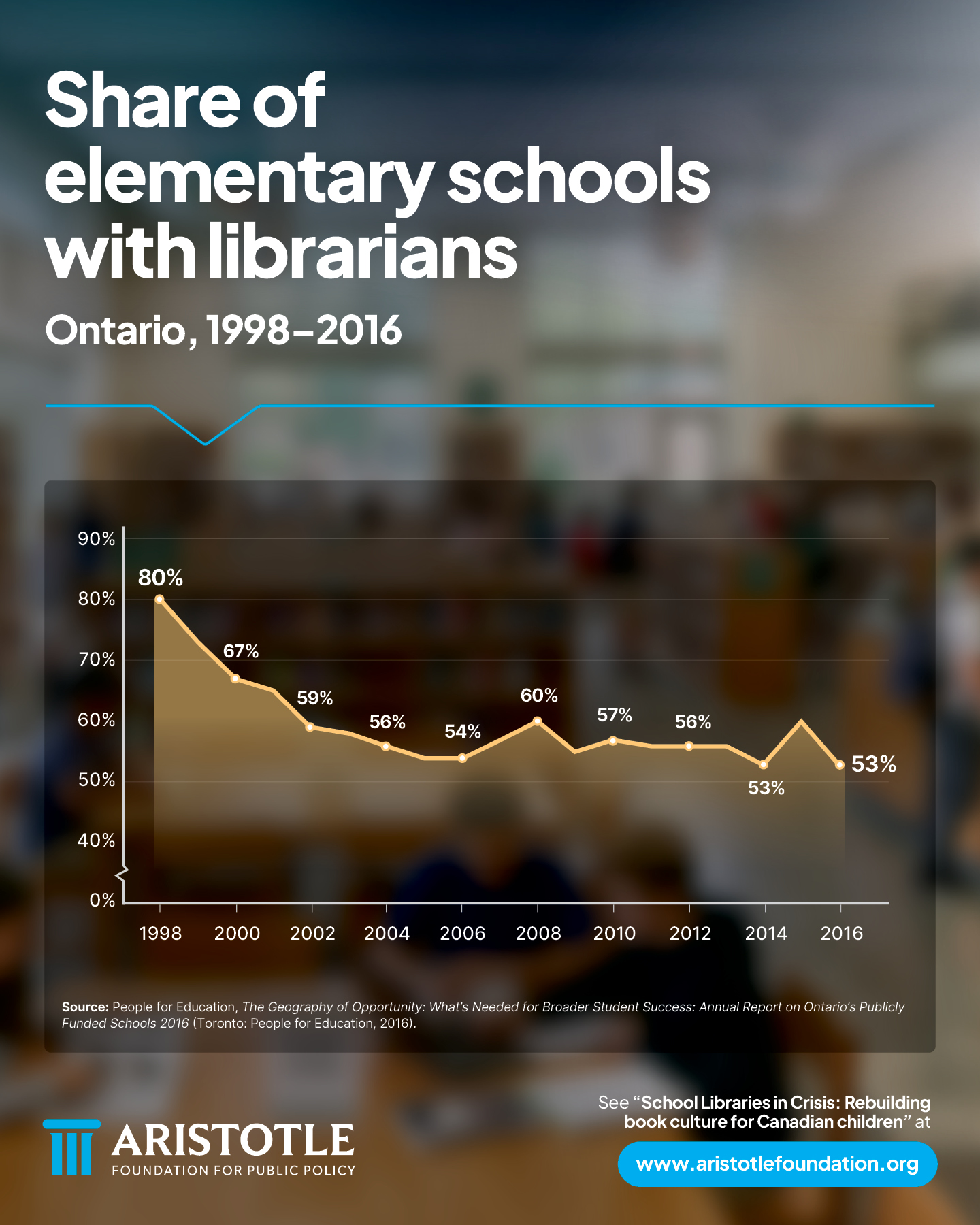
School libraries devoted to displaying books and housing collections on overflowing bookshelves are now at risk. All too often the book collection has shrivelled as school library facilities provide access to resources housed in both physical and virtual space and gathering places where students and teachers congregate over lunch or collaborate on projects. In many Canadian schools today, the library is an endangered species. In Ontario, People for Education (Figure 1) reported that, back in 2016, only about 53 percent of elementary schools had a teacher-librarian on staff (down from about 80 percent in the late 1990s) and, in some regions like Northern Ontario, only around 11 percent of elementary schools were even staffed with librarians.6
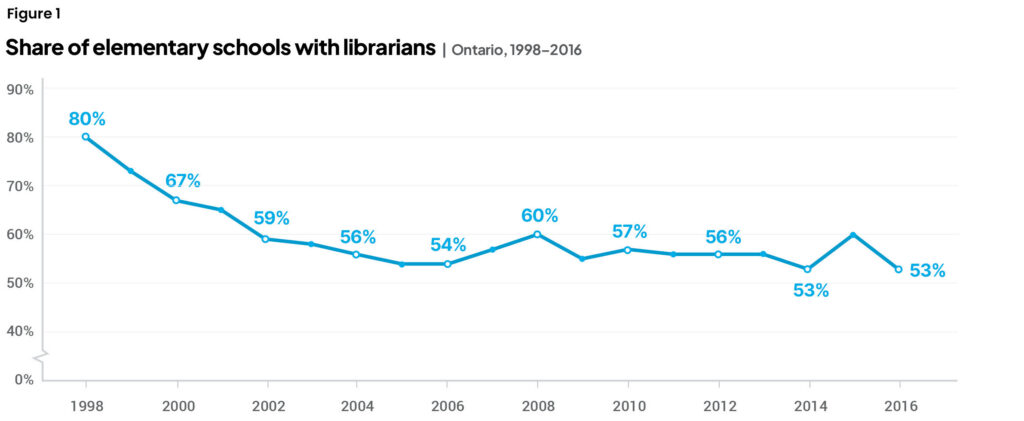
Source: People for Education, The Geography of Opportunity: What’s Needed for Broader Student Success: Annual Report on Ontario’s Publicly Funded Schools 2016 (Toronto: People for Education, 2016), https://peopleforeducation.ca/report/annual-report-2016/.
Teacher-librarians are facing an existential crisis, gradually being displaced by “library technicians” skilled at accessing and utilizing digital content and resources. Without stable, dedicated staffing—whether teacher-librarians, trained library technicians, or learning commons facilitators—students lose access to current books and technology, miss out on guidance on navigating information, and lack a safe, peaceful space beyond the classroom. The real paradox is this: While school libraries are gradually being supplanted in the teaching-learning process, they live on as contested spaces, zones of active and ongoing conflict on the education front in the contemporary “culture war.”
Harry Potter, The Hunger Games, and Roll of Thunder, Hear My Cry: These are all examples of books Grade 10 student Reina Takata could no longer find in the fall of 2023 on the shelves of her public high school library in Mississauga, Ont., which she visited regularly on her lunch hour.7 Back in May 2023, the shelves at Erindale Secondary School were full of books, but, when she returned after the summer, the library’s bookshelves were nearly bare.
Roughly half of the school’s library books went missing and Takata learned from school staff that it was undertaken in response to a directive to “remove all books published prior to 2008.” She was only one of a number of Peel District School Board (PDSB) students, parents, and community members who registered their concerns. It was all justified on the grounds that they were following a new “equity-based” book weeding process authorized in the spring of 2023 by the Ontario Ministry of Education.
The process of weeding books from a library was not new, but policies ruling out books deemed outdated has always sparked controversy. Weeding is standard practice to dispose of damaged, moldy, or factually inaccurate books, and to ensure collections remain a trusted source of current, updated information. The new PDSB policy went much further in an “equitable curation cycle” for weeding, which it says was created to support Directive 18 from the Minister of Education based on a 2020 Ministry review and report on widespread issues of systemic discrimination within the PDSB.8
School libraries in Peel were actually carrying out part of a much wider “diversity audit of schools.” Under Directive 18, “books, media and all other resources” currently in use for teaching and learning in English, history, and social sciences were subjected to an equity review to ensure that they were “inclusive and culturally responsive, relevant and reflective of students, and the Board’s broader school communities.”
Today’s controversies over “book bans” are far more complex than the narratives popularized in the Canadian media. One memorable CBC Fifth Estate episode, “A Shadow War on Libraries,” which aired in February 2025, seized upon a library closure battle in the small prairie town of Valleyview, Alberta, northwest of Edmonton, to make its point.9 That closure, according to the CBC investigative team, was cloaked in secrecy. What was presented as a budgetary decision to relocate to a newer school complex, the Fifth Estate reported, was cover for backlash against library advocates like 17-year-old transgender teenager Theo Robertson, founder of the town’s GSA (gay and straight alliance), holding meetings in the space.
The CBC’s Fifth Estate claimed that the little episode was representative of “a shadow war in Canada on libraries and books.” It was all born of an American movement “trying to roll back 2SLGBTQ+ rights in Canada – one book at a time.” It only became a “controversial issue” when the focus of book challenges shifted from targeting and culling books labelled as “racist” or “perceived as racist” to removing books focusing on gender issues and anti-racist themes. Between January 2015 and December 2021, only 8 percent of Canadian book challenges were over gender issues. Then, beginning in 2022–2023, some 44 of the 118 reported challenges (or 38 percent) were directed at book titles and events, most of which were “drag queen storytime” activities.10
Tracking the trends only began when the nature of the book challenges changed along with its targets. Up until recently, public libraries and school libraries in Canada carried out unreported library system book removals and weeding without any requirement for public disclosure. The rise of Canadian conservative public interest groups such as Action4Canada and Concerned Citizens Canada not only put pressure on such institutions to be more accountable for their decisions but also prompted defenders of “free expression” to surface. Foremost among the new breed of “library police” is James Turk, Director of the Centre for Free Expression, at Toronto Metropolitan University (TMU).11 That is why we now have a publicly accessible Canadian Libraries Challenges Database, managed by Turk at TMU.
Reported book challenges to public libraries peaked in 2024 with 141 challenges: 133 objections to library items, four to library-directed programs, and four to library displays, exhibits, and computer access policy. In 2025, as shown in Table 1, public libraries reported 116 challenges, including 98 directed at library items, 13 related to community-use access, and only two pertaining to exhibits and displays.12 The slight reduction may be the result of determined public advocacy aimed at expunging references to “explicit sexual” content and limiting or eliminating “drag queen storytime” events.
School libraries attracted far more attention in 2025 from Turk and his Free Expression allies. While, in 2024, school boards reported only 13 challenges, all related to collection items, the number skyrocketed in 2025 to 384 cases, of which 382 were related to books and resources (see Table 1). Some 94 percent of the challenges, or 360 out of 384, were actually the direct result of a 2025 Alberta Ministerial Order issued by Education Minister Demetrios Nicolaides. It was partly rescinded when the Edmonton Public School Board was found to be carrying it to extremes, removing graphic novel versions of George Orwell’s 1984 and Margaret Atwood’s Handmaid’s Tale, along with modern classics by Margaret Laurence and Ayn Rand, books of social criticism clearly acceptable for high school-age readers.13
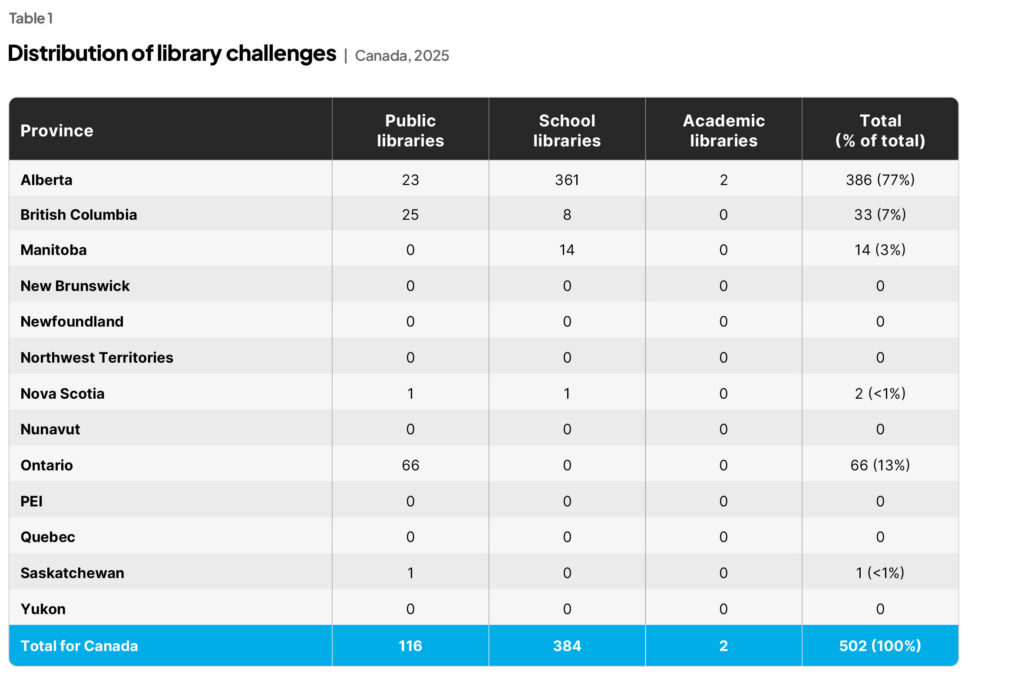
Source: Centre for Free Expression, “Canadian Library Challenges Database,” Toronto Metropolitan University, 2025, https://cfe.torontomu.ca/databases/canadian-library-challenges-database .
Weeding out collections becomes “book banning” when initiated by the public or, in this case, by provincial authorities, attempting to weed collections without going through the official “diversity and equity” screening process. Removing “sexually explicit books” from school libraries, it should be noted, was not a problem when library professionals routinely applied standards with respect to “age-appropriate” materials for young children. When combined with public libraries, Alberta accounted for 77 percent of all recorded book challenges in 2025, hardly surprising given the prevailing public attitudes in that province.14
Screening for bias and prejudice did not emerge out of nowhere. Across Canada, it can be traced back to a highly influential 1971 Ontario report, Teaching Prejudice: A Content Analysis of Social Studies Textbooks Authorized for Use in Ontario, initiated by Queen’s education professor David Pratt and co-authored with Garnet McDiarmid. Commissioned by the Ontario Human Rights Commission, this report analyzed how some 143 social studies textbooks perpetuated bias, racism, and stereotypes, particularly against indigenous peoples.15
Pratt, McDiarmid, and many who followed were quick to identify sources or references presenting “Eurocentric views” that failed to provide “a balanced or accurate representation of Indigenous history and culture,” and, in turn, contributed to “teaching prejudice” to young students. Few reports had exerted so much influence because it acted as a catalyst for action, influencing later discussions about representation in school curricula.16
The methodology for identifying prejudice gained widespread adoption, and it came with a scientific-looking quantitative tool aimed at identifying “value judgments in textbooks” and designed to assess how minorities were treated within written texts. Sixty years later, Pratt’s Teaching Prejudice is still cited by those seeking to expunge racism, inequality, and “colonial perspectives” from libraries and classrooms.
The American movement to redefine bias and introduce a new regime of sensitivity sprang from similar origins. In her 2003 book The Language Police: How Pressure Groups Restrict What Students Learn, Diane Ravitch highlighted the 1998 Riverside Publishing Company’s “Bias and Sensitivity Guidelines” as a prime example of the stringent, and often absurd, rules governing educational publishing.17 These guidelines, utilized in the review of tests and textbooks, were designed to eliminate potentially offensive material but, as Ravitch argues, often result in sanitized, low-quality content. Under the screening rules, according to the publisher, “everything written before 1970 was biased.” The real tragedy was that most classical literature was “unacceptable” and “best to avoid” because it had references which might contravene the guidelines with respect to gender, ethnicity, age, and disability.
The aim of such guidelines was to avoid creating content that could be interpreted as offensive, stereotypical, or harmful to any student based on gender, race, or socio-economic status. What it led to was something real but difficult to detect: “beneficent censorship,” producing “insipid” and “bland” texts that “sanitized” language, ultimately limiting student learning and reducing the quality of literature. While well intended, the Riverside guidelines, in Ravitch’s view, went “terribly wrong” in their implementation, contributing to a “cotton-candy world” in educational materials.
Building library book collections is no longer the priority for school libraries. The new “learning commons” vision articulated in the 2023 Canadian School Libraries policy framework, Foundations for School Library Learning Commons in Canada, put it this way: “earlier standards for school libraries were based on output measures for things such as collection size” but “[now] we have avoided setting arbitrary benchmarks.” Having an excellent collection, the CSL brief states, “does not mean that learning is taking place.”18
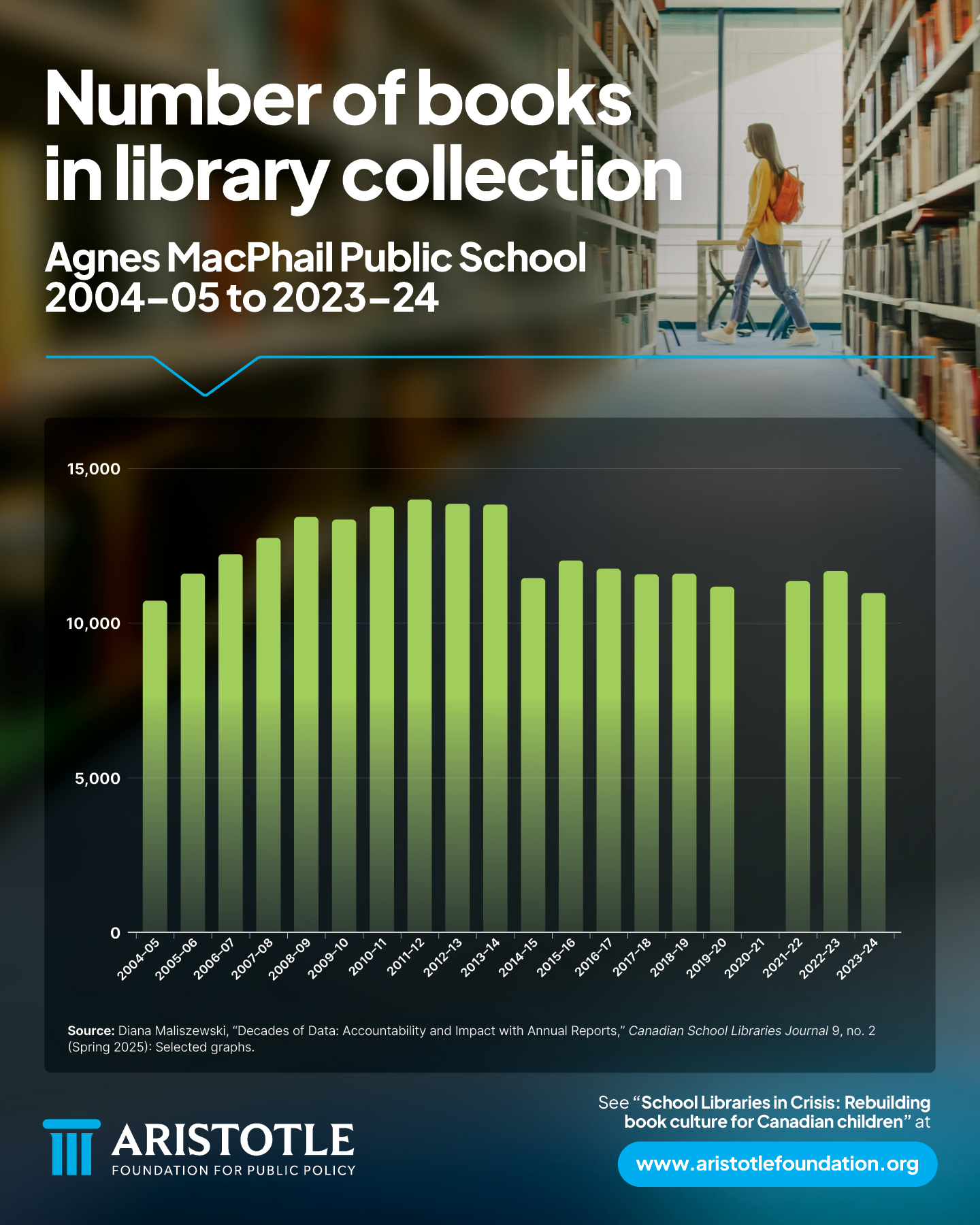
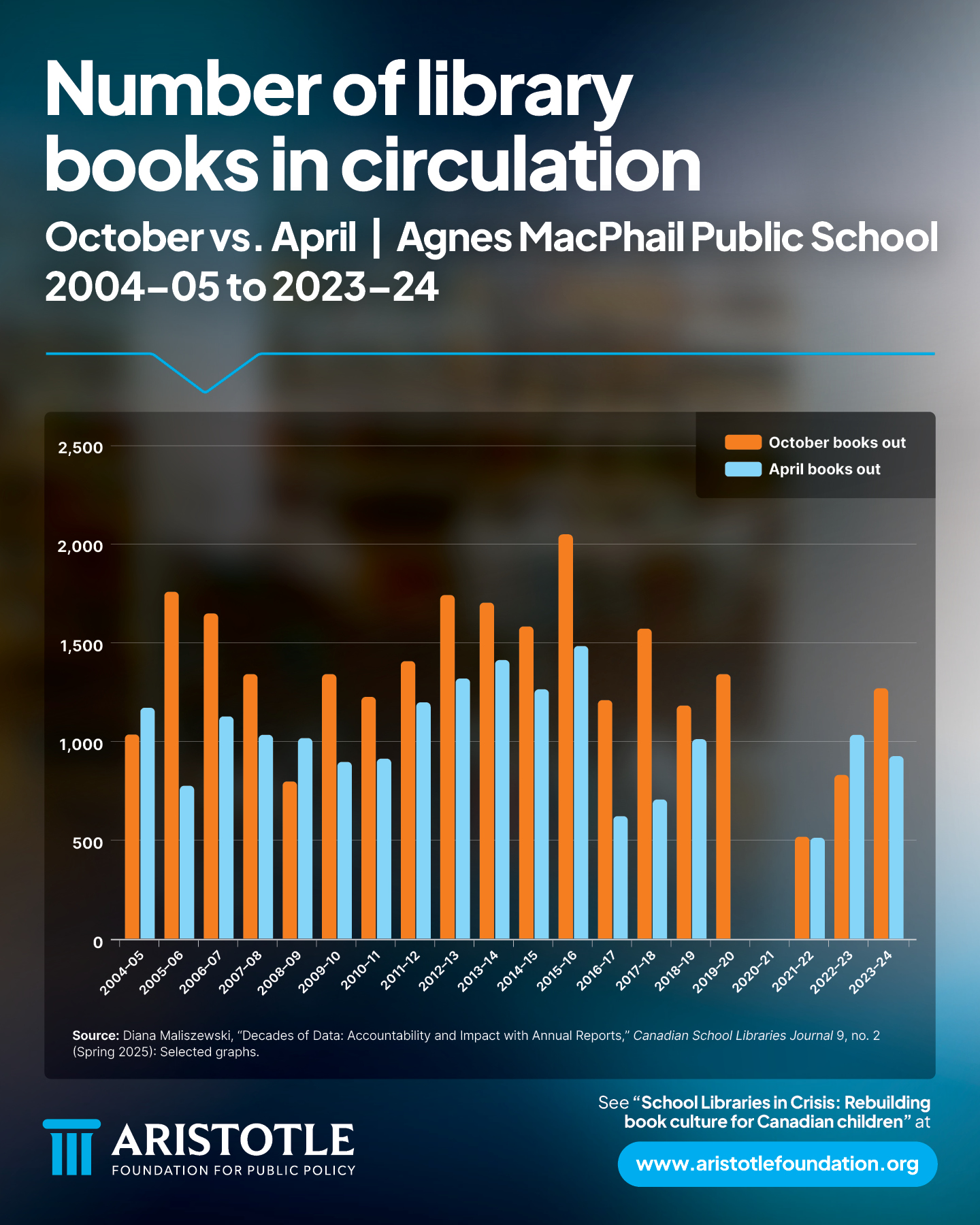
Tracking trends in book collection size and circulation is difficult, but a few experienced librarians have maintained records to capture recent trends. One Toronto school librarian, Diana Maliszewski, reported the trends over a twenty-year period.19 From 2004–05 to 2023–24, her data (Figures 2 and 3) demonstrates how book collections peaked, then declined, and how circulation dipped well before being adversely affected by prolonged pandemic school closures.
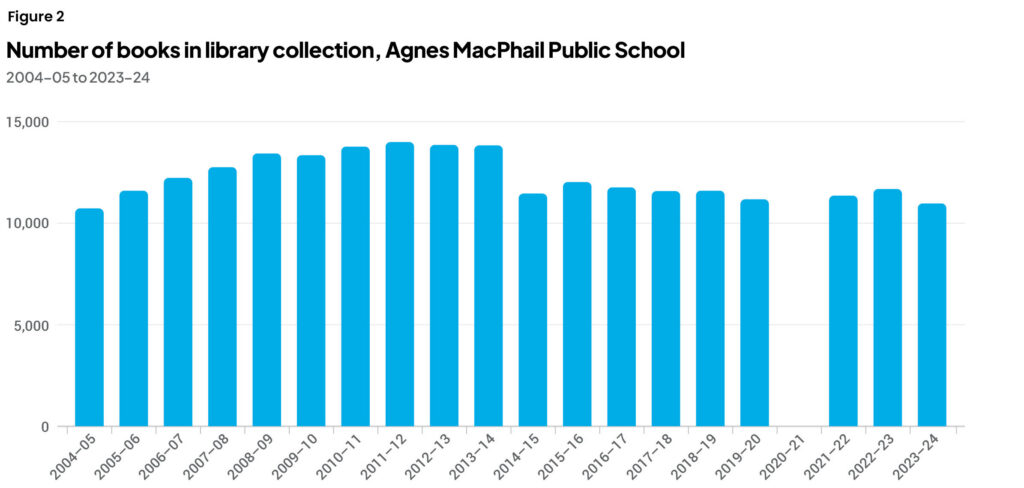
Source: Diana Maliszewski, “Decades of Data: Accountability and Impact with Annual Reports,” Canadian School Libraries Journal 9, no. 2 (Spring 2025): Selected graphs.
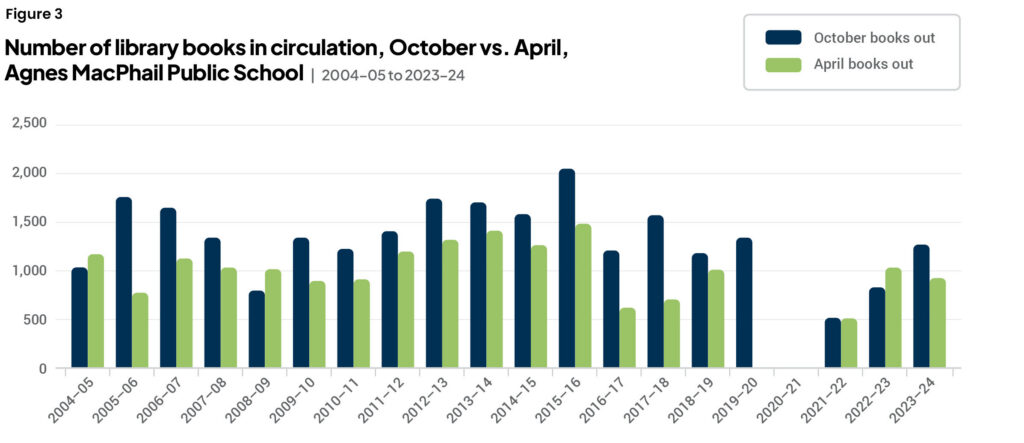
Source: Diana Maliszewski, “Decades of Data: Accountability and Impact with Annual Reports,” Canadian School Libraries Journal 9, no. 2 (Spring 2025): Selected graphs.
Culling school library collections follows prescriptive guidelines. The Canadian School Libraries Association and its supporters are heavily engaged in policing libraries and upholding contemporary versions of the American “bias and sensitivity” guidelines. Compared to the Core Knowledge guide for library collections, the CSL guide cuts in a completely different direction. The latest version is focused on equity-informed selection and provides a CSL Diversity Selection Toolkit. The guideline deserves repeating in its entirety: “The ethical foundations of librarianship are based on advancing principles of democracy and human rights, by making information and learning accessible to all. Diverse collection development is a fundamental value of librarianship. Equity and inclusion are fundamental values in public education.”20 All of the research cited in support of the Toolkit originated in the United States and much of it reflects “anti-racism” bias detection and is aligned with “culturally-responsive instruction” in elementary grades.21
Today the Canadian School Library Association, with the support of the Canadian Association of Psychologists, is also at the forefront of promoting “bias free” initiatives, which keep many of the classics out of public school libraries. Public advocates for libraries, such as Concordia University professor Michael Lecchino, idealize school libraries as “creative maker-spaces” and newcomer reception centres well supplied with graphic novels appealing to teens.22
Library experts like Lecchino are turning libraries into spaces that can function without books. Today’s “learning commons” is “a far cry from the hushed, musty bookrooms of the past,” he recently wrote in Education Canada. It is a place that is “changing lives” by not only educating “better readers,” but producing “safer digital citizens, more inclusive school communities—and even calmer, more curious kids.”
Saving school libraries is all about the books. It begins by confronting what has happened to erode the foundations of a liberal education, beginning in the early grades. One of the clearest signs of the unacknowledged crisis is the virtual disappearance of children’s classics in the Canadian Kindergarten to Grade 9 curriculum and the dominant trend of replacing reading whole books with snippets in and outside of the classroom. All is not lost because leading North American cognitive scientists and research-informed teachers continue to champion building the foundations with a knowledge-rich curriculum for children from ages 4 to 16 years.
The Knowledge Matters podcast lights the way for the reclamation of books and the revivification of school curriculum and library resource centres. In a powerful 2025 episode, American educator Doug Lemov sounded an alarm: “The book is in a death struggle with electronic and social media. And right now, it’s losing.”23 In the episode, Lemov made a spirited case for reading whole books in the classroom—especially since today’s students read almost no books outside of school. The podcast also featured some special guests: Stephen Sawchuk of Education Week, renowned cognitive psychologist Daniel Willingham, and two educators from Amarillo, Texas—using whole books to great effect in their school—Lori Hughes and her principal Genie Baca.
As the founder of Uncommon Schools, based in Albany, New York, Lemov makes no apologies for challenging students in class. “Learning to be able to struggle—to read a challenging text, and to persist with it—is one of the greatest gifts an education can give students,” Lemov claimed. Shifting to reading shorter-form excerpts and articles instead of books, according to Sawchuk, has trade-offs and might make sense, but only to “build stamina” as a bridge to longer reading assignments. For his part, Willingham pointed out that books relay stories, which have added benefits because “our minds more readily understand and remember information contained in stories compared to other kinds of texts.”
Lemov and Willingham are both strong advocates for a knowledge-rich curriculum populated by books. According to Willingham, books call on readers to actively engage and persist. “You kind of need to sit with it and see what you can make of it,” he said. Today’s world still needs books, according to Lemov. “Books also model long-form reflective thinking,” he claimed, which stands in stark contrast to modern social-media posts, where a few words or brief video provide a snapshot of right-now considerations.
The case for reading whole books is compelling. “Books are the medium in which people have been doing their best long form thinking for hundreds of years,” Lemov reminded us, noting that “[t]hey are the storehouses of almost every idea that is important to us. Whether it is the seeds of democracy or the foundations of science, chances are it has been communicated and passed down in the form of a book.” Knowledge still matters, it appears, and mastering whole books is still the best way to ensure fully educated citizens.
School library advocates committed to rebuilding book culture would be well advised to revisit one of the seminal works in American education reform, E. D. Hirsch’s 1987 book, Cultural Literacy: What Every American Needs to Know. In it the University of Virginia literacy scholar dared to advance the notion of “cultural literacy” to explain the great legacy of cultural expression passed down from one generation to another.24 While the book generated an intense furor on both sides of the spectrum, it has exerted a profound influence on policy and practice to this very day. Much of the inspiration for the Core Knowledge Foundation (CKF) and its widely used curriculum sequence came from this book.
Hirsch and his colleagues, mostly affiliated with the CK Foundation, challenged the prevailing wisdom with respect to literacy and how to teach it in the schools. Literacy is more than just the actual mechanics of reading, he claimed. Literacy involves “understanding what you read and to understand what you read you need to have the appropriate background knowledge.”25 Formalistic theories of literacy, he contended, focus far too much on formal reading skills without paying much attention to the background knowledge or schema (plural: schemata) that students need to know before they can comprehend a given text ranging from excerpts to short essays and books.
The most daring aspect of Hirsch’s Cultural Literacy was his invention of the term “cultural literacy” and his bold attempt to provide a prescription for what ailed American education. It was possible, Hirsch demonstrated, to capture and expound upon “the core cultural knowledge” that American students need to attain in order to function productively in society. It was this “core knowledge” that provided a unique “cultural schema” essential to achieving academic excellence and becoming a fully educated American.26
The Core Knowledge Foundation (CKF), founded by Hirsch and based in Charlottesville, Virginia, carries the torch for promoting educational excellence and providing today’s generation of children with something that has gone missing in mainstream public schools—Great Books for kids. For more than four decades, CKF has held the line and breathed new life into true children’s book classics.
Nothing like it exists in Canada and that is what inspires this policy paper. If we are to revitalize schooling, it will involve putting whole books back on the curriculum and demonstrating the enduring value of studying and mastering the classics central to the life and vitality of our civilization and the social cohesion of two North American societies, Canada and the United States. Our challenge is not to reinvent the Core Knowledge curriculum or the CK guidelines for stocking school libraries, but rather to build upon that model while adapting it to our unique Canadian culture and traditions.
Today, the Core Knowledge Foundation provides rich and intellectually stimulating lists of “Great Books” for children.27 The sequence is organized by grade level, featuring classics and supplemental texts in their Core Classics Series and What Your [Grade] Grader Needs to Know books, covering everything from The Story of Ferdinand (K–1) to William Shakespeare (Middle School) and the Iliad (6th Grade), focusing on deep knowledge through read-alouds and independent reading, often with downloadable materials. Enriched curriculum and advanced readings drawing upon the Core Knowledge books and resources are a staple at newly formed Classical Academies, exemplified by the Great Hearts schools, where the Western canon is taught to the current generation.28
While no Canadian counterpart exists, a growing number of Canadian independent schools have drawn inspiration from the Great Books Foundation and tapped into the adapted works in the Core Knowledge Classics Series. In Alberta, the only province with authorized charter schools, there is growing demand for “classical academies.” The Alberta Classical Academy, founded by Caylan Ford in August 2022, for example, has expanded to two campuses in Calgary and one in Edmonton, with waitlists sufficient to fill additional schools.29 Very much in line with the Core Knowledge philosophy, that initiative has tapped into the unmet need for “a tuition-free, knowledge-rich, and character-focused liberal arts education.”30
This initial policy discussion paper aims to break new ground by attempting to fill the gap in school library collections by proposing an essential books list supplementing the Core Knowledge classics with Canadian books of cultural significance and enduring value to successive generations. It demonstrates the exciting possibilities for developing a hybrid collection. A Core Knowledge-aligned school library (Pre-K to Grade 8) should feature a content-rich collection that mirrors the Core Knowledge Sequence, including history, geography, science, art, music, and language arts materials. Essential elements include authentic children’s literature, the CK Core Classics Series, diverse perspectives, and updated non-fiction, ensuring a foundation in cultural literacy and support for purposeful teaching and meaningful engagement. The real challenge is to identify suitable Canadian companion texts that build on the Core Knowledge foundations.
The Core Knowledge Foundation provides a range of literature and knowledge-rich resources that can serve as building blocks for a school library aligned with a challenging, knowledge-rich curriculum. Any such school library would include the Core Classics Series of abridged literary classics, and supplementary literature connected to Core Knowledge Language Arts and the Core Knowledge Sequence. You might also consider borrowing selectively from the newer 2023 Core Knowledge Free Library, which provides biographies, tales, and other books linked to Core Knowledge curriculum topics and grade-level content.31
Building on these resources, my recommendation would be to curate a Core Knowledge-aligned school library organized around five complementary CK curriculum components:
The Core Knowledge Foundation has specific advice for schools and their chief librarians establishing or reorganizing their book collections. Here are the guidelines reflecting best practice in library science:
One of the best guides that is still relevant after three decades is E.D. Hirsch Jr.’s Books to Build On: A Grade-By-Grade Resource Guide for Parents and Teachers, published by the Core Knowledge Foundation in 1995.32 This is an indispensable resource for curriculum consultants, principals, and educators entrusted with building and maintaining school library collections. The Core Knowledge set of Core Classics, designed to support a knowledge-rich curriculum, does provide some building blocks for an aligned school library collection. It presents stories loved for generations in abridged versions for young readers, illustrated and annotated, and faithful to the style, plot, and themes of the originals. Some volumes include a brief biography of the author and an introduction by E.D. Hirsch. In the upper elementary grades, Core Classics are suitable for strong readers or reading aloud; in middle school and up, the texts are appropriate for independent reading.
Here are some examples proposed by Hirsch and his research team by grade level (CKF Core Classics & recommended themes):
What is immediately apparent is the fact that the recommended books are challenging for the suggested grade level. That is no accident because the CK curriculum is pitched at a reading level considerably more advanced than is common in most Canadian K–8 schools.
Our research into the current crisis besetting Canadian school libraries suggests the urgent need for action to halt the decline and reverse the trend line. National, provincial, and school district authorities should consider and then act upon the following recommendations:
What would a Core Knowledge book collection tailored for Canadian students actually look like? The appendix details two proposed lists of essential books for Canadian children from Kindergarten to Grade 9:
The first list was produced by the author integrating classics from the US Core Knowledge Curriculum with an equal number of Canadian companion books. The second list is extracted from the publicly available reading lists for Calgary Classical Academy (2025–2026). It is not an official list but rather a sampling composed of the required books and poems at each grade level. Compiling lists of 100 recommended books is not an exact science so what follows is sure to generate some lively debate and discussion.
Our school libraries are worth saving if they can be revived as cultural sanctuaries and recommit to putting books at the centre of the contemporary version of a “learning commons.” Drawing inspiration from the Core Knowledge Foundation founded by E.D. Hirsch Jr., we can create our Canadian framework for rebuilding knowledge-rich school libraries.
The proposed Canadian framework for rebuilding school libraries outlined in this policy paper is presented as a starting point, aimed at generating a more fulsome debate and public discussion. It recommends grade-by-grade collections that combine enduring literary classics with significant Canadian works, supported by trained teacher-librarians and curriculum-aligned collection development. While philosophical stances may differ, it is also essential to support teacher-librarians in the transition because the new breed of “library technicians” are not our natural allies.33
Open the school library windows and let the light back in for the sake of the current generation of students. Embrace a more enlightened vision to revitalize our diminished and threatened school libraries.34 Let us envision and recreate libraries as cultural sanctuaries, places where students encounter challenging ideas, build reading stamina, and develop the shared knowledge necessary for informed citizenship in a democratic society. Turning it around will require a rededication to books as foundational to liberal education, more transparency on collections policy, and the active support of informed and well-read educators.
Dr. Paul W. Bennett, Ed.D., is a senior fellow with the Aristotle Foundation for Public Policy and director of the Schoolhouse Institute. He has authored eleven books, including The State of the System: A Reality Check on Canada’s Schools (McGill-Queen’s University Press, 2020), and Struggling in Class: A Report Card on Education in New Brunswick (Friesen Press, 2026). As a policy analyst, Paul has produced over two dozen policy research papers for six Canadian think tanks. Earlier in his career, Dr. Bennett was twice recognized for history teaching excellence, produced three nationally acclaimed Canadian history textbooks, served as an elected public school trustee, and headed two of Canada’s top-performing schools. More recently, he founded researchED Canada, taught as an adjunct professor, and served on the Canadian Association for Foundations in Education (CAFE) national board. He is also an education columnist for Brunswick News and a well-known commentator in the national media.
Who we are
The Aristotle Foundation for Public Policy is a new education and public policy think tank that aims to renew a civil, common-sense approach to public discourse and public policy in Canada.
Our vision
A Canada where the sacrifices and successes of past generations are cherished and built upon; where citizens value each other for their character and merit; and where open inquiry and free expression are prized as the best path to a flourishing future for all.
Our mission
We champion reason, democracy, and civilization so that all can participate in a free, flourishing Canada.
Our theory of change: Canada’s idea culture is critical
Ideas—what people believe—come first in any change for ill or good. We will challenge ideas and policies where in error and buttress ideas anchored in reality and excellence.
Donations
The Aristotle Foundation for Public Policy is a registered Canadian charity and all donations will receive a tax receipt. To maintain our independence, we do not seek nor will we accept government funding. Donations can be made at www.aristotlefoundation.org.
The Aristotle Foundation for Public Policy has internal policies to ensure research is empirical, scholarly, ethical, rigorous, honest, and contributes to the advancement of knowledge and the creation, application, and refinement of knowledge about public policy. Our staff, research fellows, and scholars develop their research in collaboration with the Aristotle Foundation’s staff and research director. Fact sheets, studies, and indices are all peer-reviewed. Subject to critical peer review, authors are responsible for their work and conclusions. The conclusions and views of scholars do not necessarily reflect those of the Board of Directors, donors, or staff.